Institute for Clinical Diabetology, German Diabetes Center at Heinrich Heine University, Leibniz Institute for Diabetes Research, 40225 Düsseldorf, Germany.
German Center for Diabetes Research (DZD), 85764 München-Neuherberg, Germany.
Nutrients. 2018 Jun 15;10(6):774. doi: 10.3390/nu10060774.
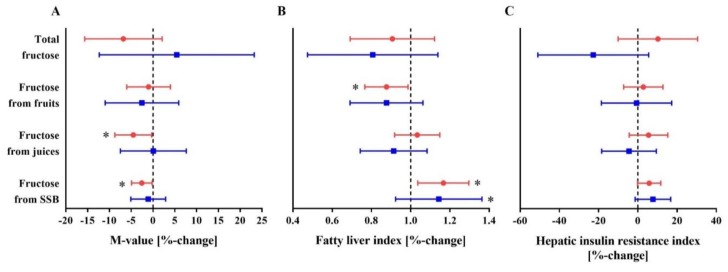
The association between the amount and sources of fructose intake with insulin sensitivity and liver fat needs further elucidation. This study aimed at examining whether habitual intake of sucrose plus non-sucrose bound as well as of non-sucrose bound fructose (total fructose, fruit-derived, juice-derived, sugar sweetened beverages (SSB)-derived fructose) is cross-sectionally associated with insulin sensitivity and fatty liver index (FLI). Fructose intake was estimated using the EPIC food frequency questionnaire from 161 participants with type 2 diabetes (T2D) in the ongoing German Diabetes Study (GDS) (age 53 ± 9 years; HbA1c 6.4 ± 0.9%) and 62 individuals without diabetes (CON) (47 ± 14 years; 5.3 ± 0.3%). Peripheral (M-value) and hepatic insulin resistance were assessed by hyperinsulinemic-euglycemic clamps with stable isotope dilution. FLI was calculated based on body mass index, waist circumference, triglyceride and gamma glutamyl transferase concentrations. Multivariable linear regression analyses were performed. A doubling of SSB-derived sucrose plus non-sucrose bound as well as of non-sucrose bound fructose intake was independently associated with a reduction of the M-value by -2.6% (-4.9; -0.2) and -2.7% (-5.2; -0.1) among T2D, respectively, with an increase in the odds of fatty liver by 16% and 17%, respectively among T2D (all < 0.05). Doubling fruit-derived sucrose plus non-sucrose bound fructose intake independently related to a reduction in the odds of fatty liver by 13% ( = 0.033) among T2D. Moderate SSB-derived fructose intake may detrimentally affect peripheral insulin sensitivity, whereas fruit-derived fructose intake appeared beneficial for liver fat content.
果糖摄入量的多少和来源与胰岛素敏感性和肝脂肪之间的关系仍需进一步阐明。本研究旨在探讨习惯性摄入蔗糖加非结合态果糖以及非结合态果糖(总果糖、水果来源果糖、果汁来源果糖、含糖饮料(SSB)来源果糖)是否与胰岛素敏感性和脂肪肝指数(FLI)相关。通过对正在进行的德国糖尿病研究(GDS)中 161 名 2 型糖尿病(T2D)患者(年龄 53 ± 9 岁;HbA1c 6.4 ± 0.9%)和 62 名非糖尿病患者(CON)(47 ± 14 岁;5.3 ± 0.3%)使用 EPIC 食物频率问卷进行果糖摄入量评估。采用稳定同位素稀释的高胰岛素-正葡萄糖钳夹技术评估外周(M 值)和肝胰岛素抵抗。根据体重指数、腰围、甘油三酯和γ-谷氨酰转移酶浓度计算 FLI。采用多元线性回归分析。在 T2D 中,SSB 来源的蔗糖加非结合态以及非结合态果糖的摄入量增加一倍,与 M 值分别降低 2.6%(-4.9;-0.2)和 2.7%(-5.2;-0.1)相关,与脂肪肝的几率分别增加 16%和 17%相关(均<0.05)。在 T2D 中,水果来源的蔗糖加非结合态果糖摄入量增加一倍,与脂肪肝几率降低 13%相关( = 0.033)。中等 SSB 来源的果糖摄入可能对外周胰岛素敏感性产生不利影响,而水果来源的果糖摄入似乎对肝脂肪含量有益。