Centre for Translation Studies, University College London, London, United Kingdom.
Institute of Applied Linguistics, University of Warsaw, Warsaw, Poland.
PLoS One. 2018 Jun 19;13(6):e0199331. doi: 10.1371/journal.pone.0199331. eCollection 2018.
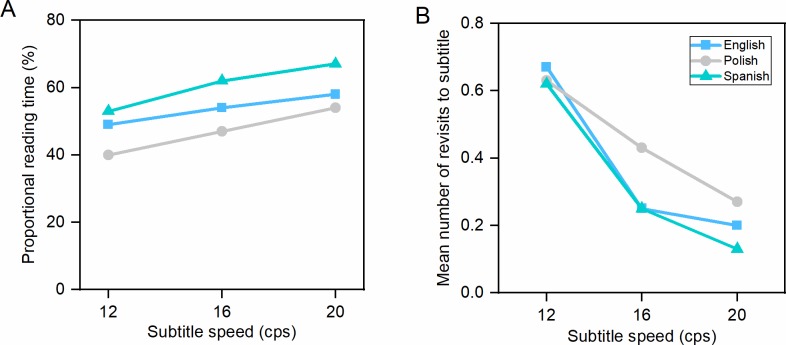
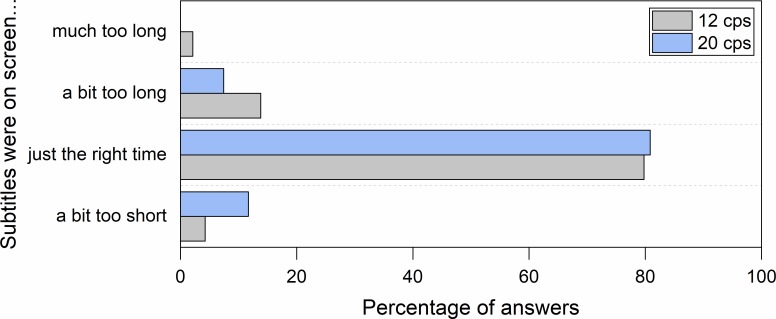
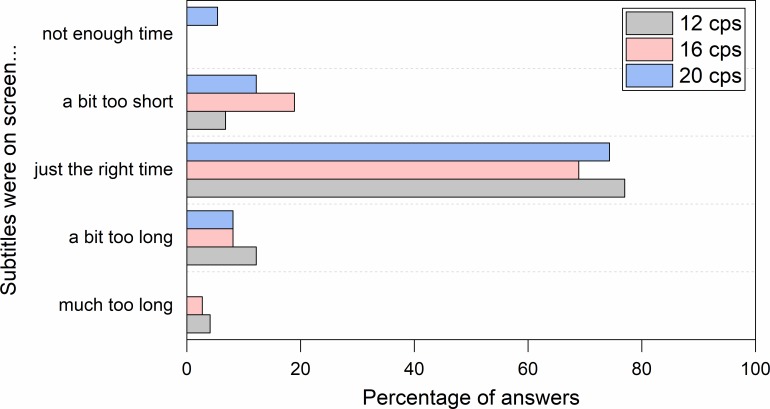
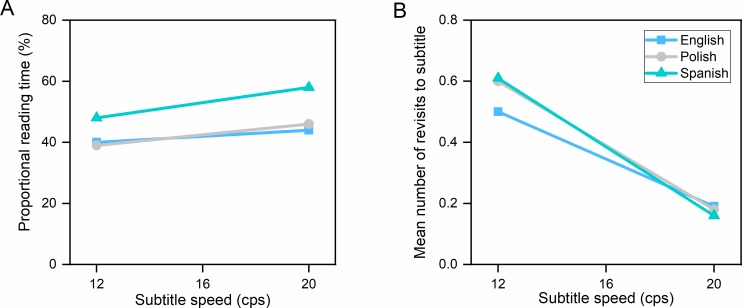
People watch subtitled audiovisual materials more than ever before. With the proliferation of subtitled content, we are also witnessing an increase in subtitle speeds. However, there is an ongoing controversy about what optimum subtitle speeds should be. This study looks into whether viewers can keep up with increasingly fast subtitles and whether the way people cope with subtitled content depends on their familiarity with subtitling and on their knowledge of the language of the film soundtrack. We tested 74 English, Polish and Spanish viewers watching films subtitled at different speeds (12, 16 and 20 characters per second). The films were either in Hungarian, a language unknown to the participants (Experiment 1), or in English (Experiment 2). We measured viewers' comprehension, self-reported cognitive load, scene and subtitle recognition, preferences and enjoyment. By analyzing people's eye gaze, we were able to discover that most viewers could read the subtitles as well as follow the images, coping well even with fast subtitle speeds. Slow subtitles triggered more re-reading, particularly in English clips, causing more frustration and less enjoyment. Faster subtitles with unreduced text were preferred in the case of English videos, and slower subtitles with text edited down in Hungarian videos. The results provide empirical grounds for revisiting current subtitling practices to enable more efficient processing of subtitled videos for viewers.
人们比以往任何时候都更喜欢观看带有字幕的视听材料。随着字幕内容的激增,我们也见证了字幕速度的加快。然而,对于最佳字幕速度应该是多少,一直存在争议。本研究探讨了观众是否能够跟上越来越快的字幕,以及人们处理字幕内容的方式是否取决于他们对字幕的熟悉程度和对电影配乐语言的了解。我们测试了 74 名观看不同速度(每秒 12、16 和 20 个字符)字幕的英语、波兰语和西班牙语观众。这些电影要么是匈牙利语的(参与者不熟悉的语言,实验 1),要么是英语的(实验 2)。我们测量了观众的理解、自我报告的认知负荷、场景和字幕识别、偏好和享受程度。通过分析人们的眼球注视,我们发现大多数观众能够阅读字幕并跟上图像,即使是在快速的字幕速度下也能很好地应对。较慢的字幕会引发更多的重读,尤其是在英语片段中,这会导致更多的挫折感和更少的享受。在英语视频中,人们更喜欢速度较快且未删减文本的字幕,而在匈牙利语视频中,人们更喜欢速度较慢且文本被删减的字幕。研究结果为重新审视当前的字幕实践提供了经验依据,以使观众能够更有效地处理带字幕的视频。