Del Chierico Federica, Abbatini Francesca, Russo Alessandra, Quagliariello Andrea, Reddel Sofia, Capoccia Danila, Caccamo Romina, Ginanni Corradini Stefano, Nobili Valerio, De Peppo Francesco, Dallapiccola Bruno, Leonetti Frida, Silecchia Gianfranco, Putignani Lorenza
Human Microbiome Unit, Bambino Gesù Children's Hospital, IRCCS, Rome, Italy.
Department of Medical Surgical Sciences and Biotechnologies, Faculty of Pharmacy and Medicine, Bariatric Center of Excellence IFSO-EU, Sapienza University, Rome, Italy.
Front Microbiol. 2018 Jun 5;9:1210. doi: 10.3389/fmicb.2018.01210. eCollection 2018.
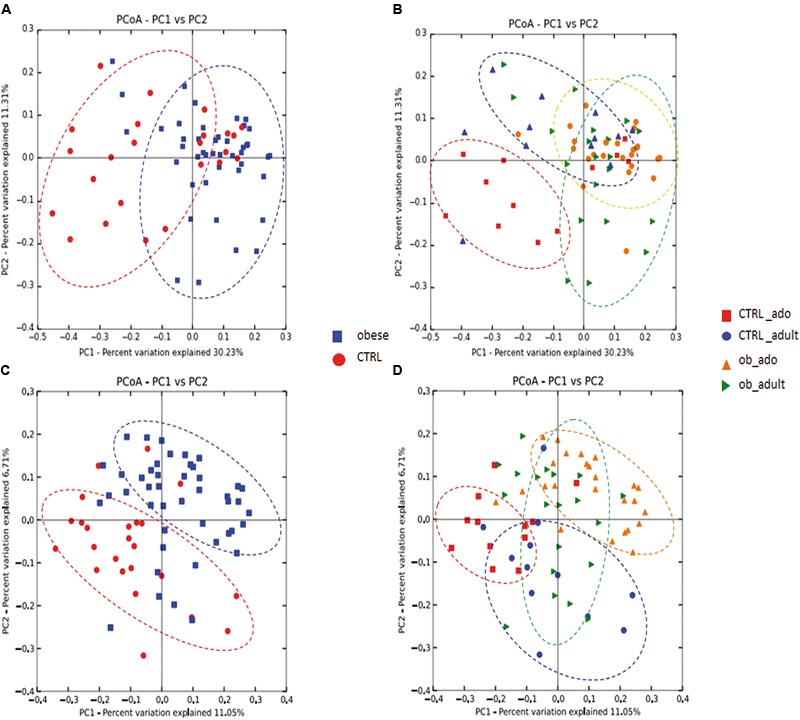
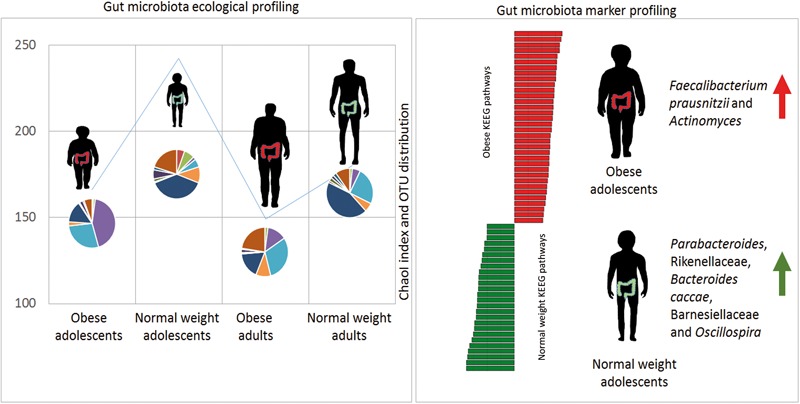
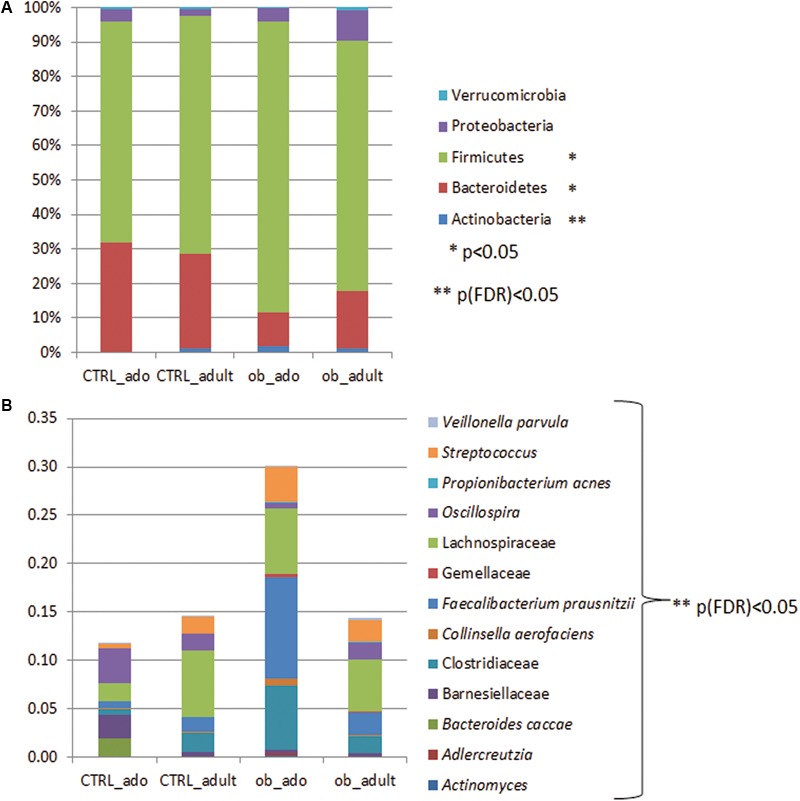
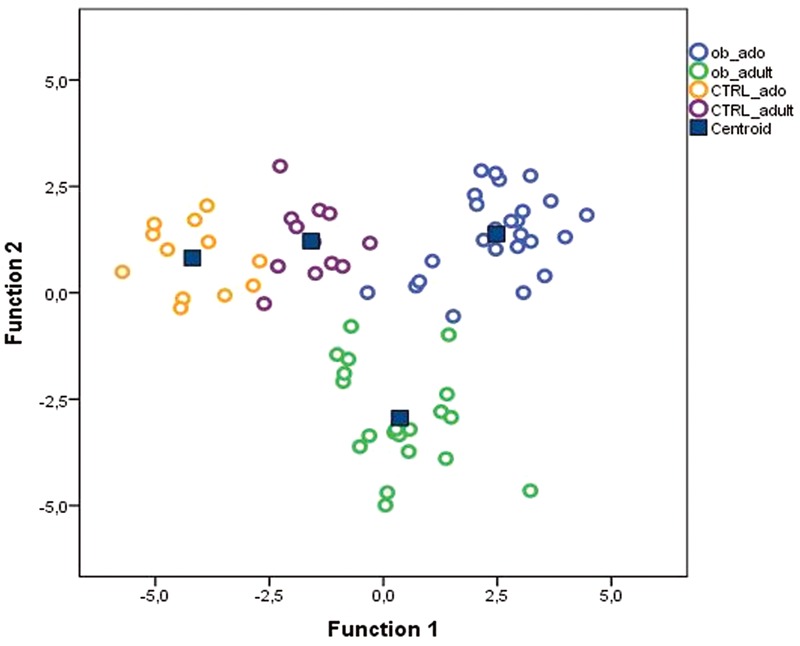
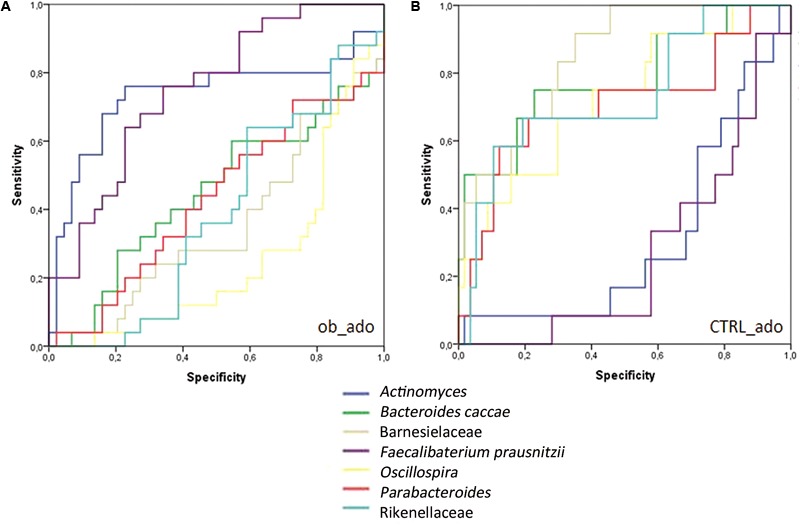
Obesity levels, especially in children, have dramatically increased over the last few decades. Recently, several studies highlighted the involvement of gut microbiota in the pathophysiology of obesity. We investigated the composition of gut microbiota in obese adolescents and adults compared to age-matched normal weight (NW) volunteers in order to assemble age- and obesity-related microbiota profiles. The composition of gut microbiota was analyzed by 16S rRNA-based metagenomics. Ecological representations of microbial communities were computed, and univariate, multivariate, and correlation analyses performed on bacterial profiles. The prediction of metagenome functional content from 16S rRNA gene surveys was carried out. Ecological analyses revealed a dissimilarity among the subgroups, and resultant microbiota profiles differed between obese adolescents and adults. Using statistical analyses, we assigned, as microbial markers, and to the microbiota of obese adolescents, and , Rikenellaceae, , Barnesiellaceae, and to the microbiota of NW adolescents. The predicted metabolic profiles resulted different in adolescent groups. Particularly, biosynthesis of primary bile acid and steroid acids, metabolism of fructose, mannose, galactose, butanoate, and pentose phosphate and glycolysis/gluconeogenesis were for the majority associated to obese, while biosynthesis and metabolism of glycan, biosynthesis of secondary bile acid, metabolism of steroid hormone and lipoic acid were associated to NW adolescents. Our study revealed unique features of gut microbiota in terms of ecological patterns, microbial composition and metabolism in obese patients. The assignment of novel obesity bacterial markers may open avenues for the development of patient-tailored treatments dependent on age-related microbiota profiles.
在过去几十年中,肥胖水平显著上升,尤其是在儿童中。最近,多项研究强调了肠道微生物群在肥胖病理生理学中的作用。我们调查了肥胖青少年和成年人的肠道微生物群组成,并与年龄匹配的正常体重(NW)志愿者进行比较,以构建与年龄和肥胖相关的微生物群谱。通过基于16S rRNA的宏基因组学分析肠道微生物群的组成。计算微生物群落的生态表征,并对细菌谱进行单变量、多变量和相关性分析。从16S rRNA基因调查中预测宏基因组功能内容。生态分析揭示了各亚组之间的差异,肥胖青少年和成年人的微生物群谱也有所不同。通过统计分析,我们将 和 确定为肥胖青少年微生物群的微生物标志物,将 、理研菌科、 、巴内西菌科和 确定为NW青少年微生物群的微生物标志物。预测的代谢谱在青少年组中有所不同。特别是,初级胆汁酸和类固醇酸的生物合成、果糖、甘露糖、半乳糖、丁酸和磷酸戊糖的代谢以及糖酵解/糖异生在大多数情况下与肥胖相关,而聚糖的生物合成和代谢、次级胆汁酸的生物合成、类固醇激素和硫辛酸的代谢与NW青少年相关。我们的研究揭示了肥胖患者肠道微生物群在生态模式、微生物组成和代谢方面的独特特征。新型肥胖细菌标志物的确定可能为开发基于年龄相关微生物群谱的个性化治疗方法开辟道路。