Department of Behavioural Sciences and Learning, Linköping University, Linköping, Sweden.
Linnaeus Centre HEAD, The Swedish Institute for Disability Research, Linköping and Örebro Universities, Linköping, Sweden.
Ear Hear. 2019 Mar/Apr;40(2):272-286. doi: 10.1097/AUD.0000000000000612.
Speech understanding may be cognitively demanding, but it can be enhanced when semantically related text cues precede auditory sentences. The present study aimed to determine whether (a) providing text cues reduces pupil dilation, a measure of cognitive load, during listening to sentences, (b) repeating the sentences aloud affects recall accuracy and pupil dilation during recall of cue words, and (c) semantic relatedness between cues and sentences affects recall accuracy and pupil dilation during recall of cue words.
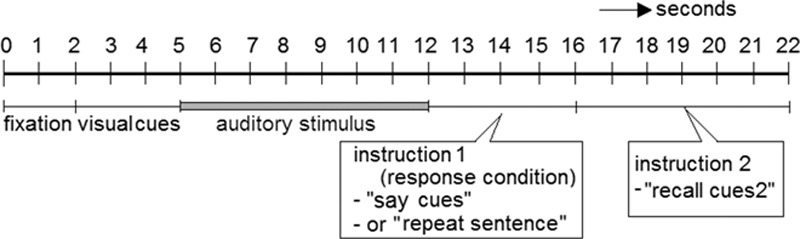
Sentence repetition following text cues and recall of the text cues were tested. Twenty-six participants (mean age, 22 years) with normal hearing listened to masked sentences. On each trial, a set of four-word cues was presented visually as text preceding the auditory presentation of a sentence whose meaning was either related or unrelated to the cues. On each trial, participants first read the cue words, then listened to a sentence. Following this they spoke aloud either the cue words or the sentence, according to instruction, and finally on all trials orally recalled the cues. Peak pupil dilation was measured throughout listening and recall on each trial. Additionally, participants completed a test measuring the ability to perceive degraded verbal text information and three working memory tests (a reading span test, a size-comparison span test, and a test of memory updating).
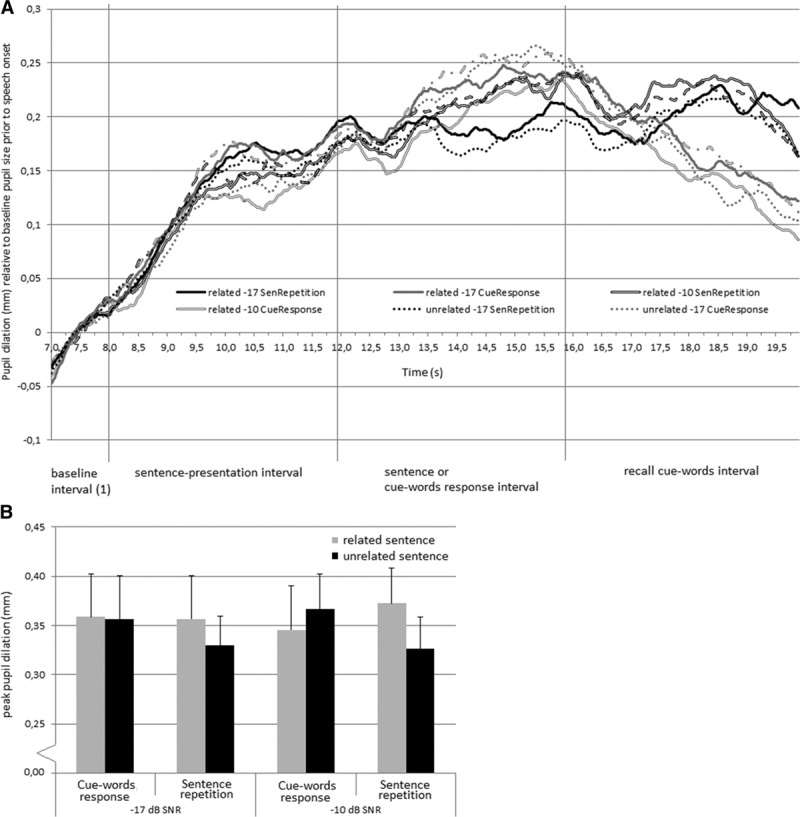
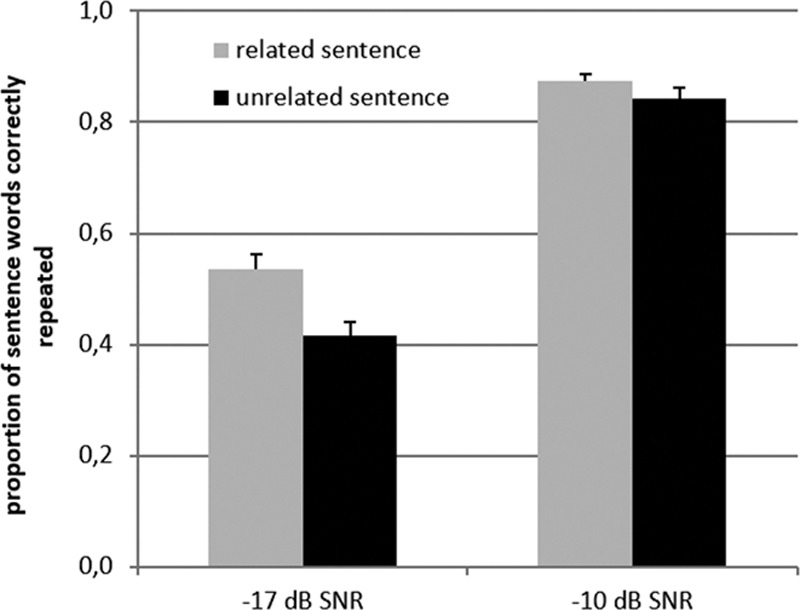
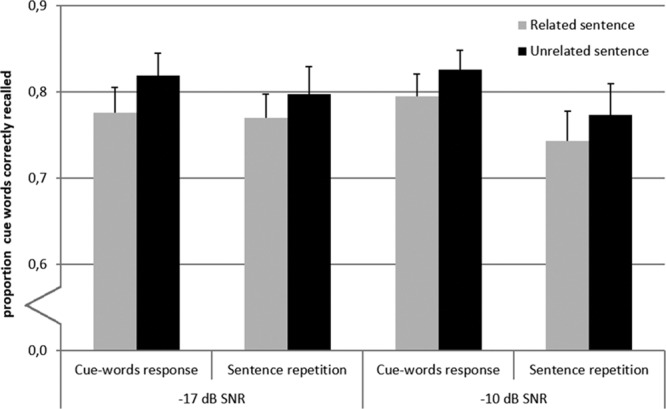
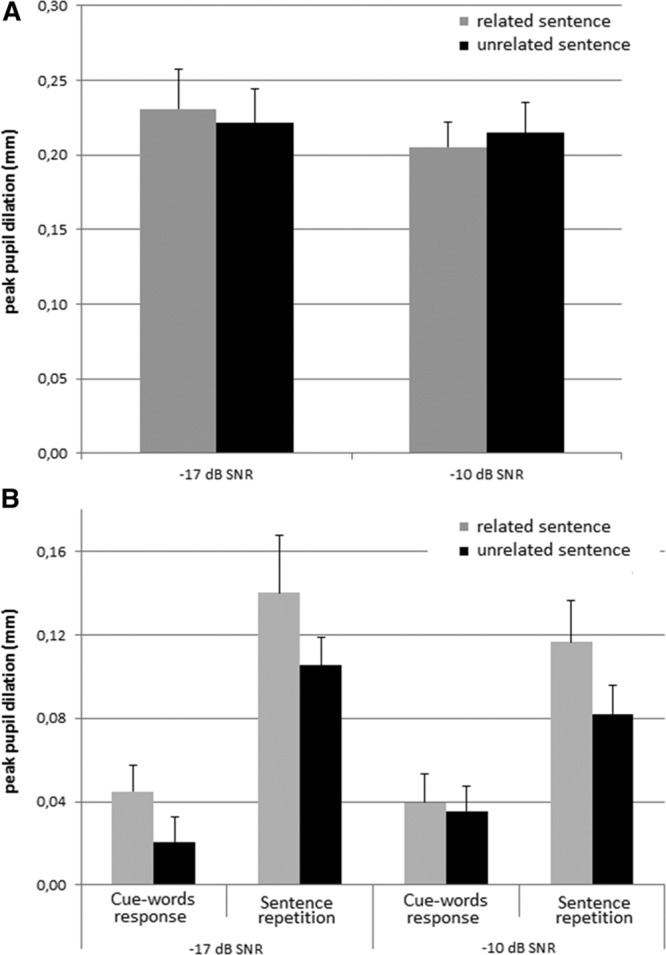
Cue words that were semantically related to the sentence facilitated sentence repetition but did not reduce pupil dilation. Recall was poorer and there were more intrusion errors when the cue words were related to the sentences. Recall was also poorer when sentences were repeated aloud. Both behavioral effects were associated with greater pupil dilation. Larger reading span capacity and smaller size-comparison span were associated with larger peak pupil dilation during listening. Furthermore, larger reading span and greater memory updating ability were both associated with better cue recall overall.
Although sentence-related word cues facilitate sentence repetition, our results indicate that they do not reduce cognitive load during listening in noise with a concurrent memory load. As expected, higher working memory capacity was associated with better recall of the cues. Unexpectedly, however, semantic relatedness with the sentence reduced word cue recall accuracy and increased intrusion errors, suggesting an effect of semantic confusion. Further, speaking the sentence aloud also reduced word cue recall accuracy, probably due to articulatory suppression. Importantly, imposing a memory load during listening to sentences resulted in the absence of formerly established strong effects of speech intelligibility on the pupil dilation response. This nullified intelligibility effect demonstrates that the pupil dilation response to a cognitive (memory) task can completely overshadow the effect of perceptual factors on the pupil dilation response. This highlights the importance of taking cognitive task load into account during auditory testing.
言语理解可能需要认知能力,但在语义相关的文本提示先于听觉句子出现时,言语理解能力可以得到增强。本研究旨在确定:(a)提供文本提示是否会减少在听句子时瞳孔扩张,即认知负荷的衡量标准;(b)重复说出句子是否会影响对提示词的回忆准确性和瞳孔扩张;以及(c)提示词和句子之间的语义相关性是否会影响对提示词的回忆准确性和瞳孔扩张。
测试了在文本提示后重复句子和回忆提示词的情况。26 名听力正常的参与者(平均年龄 22 岁)听了掩蔽的句子。在每次试验中,都会在听觉呈现句子之前,以文本形式呈现一组四字提示词,这些提示词的含义与句子相关或不相关。在每次试验中,参与者首先阅读提示词,然后听句子。在这之后,根据指令,他们要么大声说出提示词,要么说出句子,最后在所有试验中,他们都口头回忆提示词。在每次试验中,都在听和回忆的整个过程中测量瞳孔扩张的峰值。此外,参与者还完成了一项测试,该测试用于测量感知语音文本信息的能力,以及三项工作记忆测试(阅读广度测试、大小比较广度测试和记忆更新测试)。
与句子语义相关的提示词促进了句子重复,但并未减少瞳孔扩张。当提示词与句子相关时,回忆的效果较差,并且出现了更多的干扰错误。当句子被大声重复时,回忆的效果也较差。这两种行为效应都与更大的瞳孔扩张有关。较大的阅读广度能力和较小的大小比较广度与听力过程中瞳孔扩张的峰值较大有关。此外,较大的阅读广度和更大的记忆更新能力都与提示词的整体回忆效果更好有关。
尽管与句子相关的词提示可以促进句子重复,但我们的结果表明,它们不会减少噪声中听句子时的认知负荷,同时存在记忆负荷。正如预期的那样,较高的工作记忆能力与更好的提示词回忆相关。出乎意料的是,与句子的语义相关性降低了提示词的回忆准确性,并增加了干扰错误,这表明存在语义混淆的影响。此外,大声说出句子也降低了提示词的回忆准确性,可能是由于发音抑制。重要的是,在听句子时施加记忆负荷导致先前建立的语音可懂度对瞳孔扩张反应的强烈影响消失了。这消除了可懂度效应,表明对认知(记忆)任务的瞳孔扩张反应可以完全掩盖感知因素对瞳孔扩张反应的影响。这凸显了在听觉测试中考虑认知任务负荷的重要性。