UCLA Fielding School of Public Health, 650 Charles E. Young Drive South, Los Angeles, CA, 90095-1772, USA.
University of Washington School of Nursing, Box 357260, Seattle, WA, 98195, USA.
BMC Public Health. 2018 Jun 20;18(1):771. doi: 10.1186/s12889-018-5670-8.
Immigrants to the United States are usually healthier than their U.S.-born counterparts, yet the health of immigrants declines with duration of stay in the U.S. This pattern is often seen for numerous health problems such as obesity, and is usually attributed to acculturation (the adoption of "American" behaviors and norms). However, an alternative explanation is secular trends, given that rates of obesity have been rising globally. Few studies of immigrants are designed to distinguish the effects of acculturation versus secular trends, in part because most studies of immigrants are cross-sectional, lack baseline data prior to migration, and do not have a comparison group of non-migrants in the country of origin. This paper describes the Health of Philippine Emigrants Study (HoPES), a study designed to address many of these limitations.
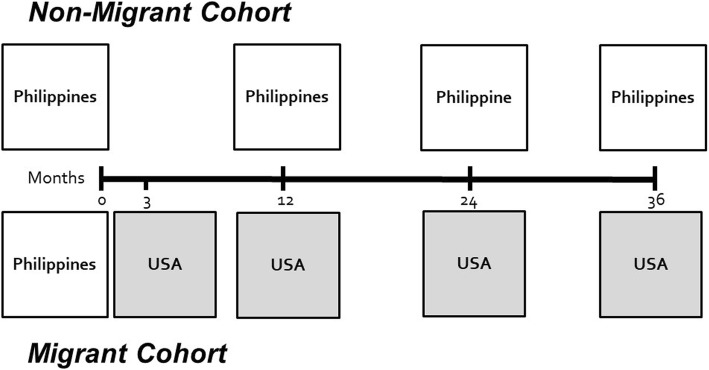
HoPES is a dual-cohort, longitudinal, transnational study. The first cohort consisted of Filipinos migrating to the United States (n = 832). The second cohort consisted of non-migrant Filipinos who planned to remain in the Philippines (n = 805). Baseline data were collected from both cohorts in 2017 in the Philippines, with follow-up data collection planned over 3 years in either the U.S. for the migrant cohort or the Philippines for the non-migrant cohort. At baseline, interviewers administered semi-structured questionnaires that assessed demographic characteristics, diet, physical activity, stress, and immigration experiences. Interviewers also measured weight, height, waist and hip circumferences, blood pressure, and collected dried blood spot samples.
Migrants enrolled in the study appear to be representative of recent Filipino migrants to the U.S. Additionally, migrant and non-migrant study participants are comparable on several characteristics that we attempted to balance at baseline, including age, gender, and education. HoPES is a unique study that approximates a natural experiment from which to study the effects of immigration on obesity and other health problems. A number of innovative methodological strategies were pursued to expand the boundaries of current immigrant health research. Key to accomplishing this research was investment in building collaborative relationships with stakeholders across the U.S. and the Philippines with shared interest in the health of migrants.
移民到美国的人通常比在美国出生的人更健康,但随着在美国停留时间的增加,移民的健康状况会下降。这种模式通常适用于许多健康问题,如肥胖症,通常归因于文化适应(采用“美国”行为和规范)。然而,另一种解释是由于肥胖率在全球范围内呈上升趋势,这是一个长期趋势。很少有针对移民的研究旨在区分文化适应与长期趋势的影响,部分原因是大多数移民研究都是横断面研究,在移民前缺乏基线数据,并且在原籍国没有非移民的对照组。本文描述了菲律宾移民健康研究(HoPES),这是一项旨在解决许多这些局限性的研究。
HoPES 是一项双队列、纵向、跨国研究。第一队列由移民到美国的菲律宾人组成(n=832)。第二队列由计划留在菲律宾的非移民菲律宾人组成(n=805)。2017 年在菲律宾对两个队列进行了基线数据收集,计划对移民队列在美国或非移民队列在菲律宾进行为期 3 年的随访数据收集。在基线时,访谈者进行了半结构化问卷调查,评估人口统计学特征、饮食、身体活动、压力和移民经历。访谈者还测量了体重、身高、腰围和臀围、血压,并采集了干血斑样本。
参加该研究的移民似乎代表了最近移民到美国的菲律宾人。此外,移民和非移民研究参与者在我们试图在基线时平衡的几个特征上是可比的,包括年龄、性别和教育程度。HoPES 是一项独特的研究,它近似于一项自然实验,可以从中研究移民对肥胖和其他健康问题的影响。为了扩展当前移民健康研究的边界,采用了许多创新的方法策略。关键是要与美国和菲律宾的利益相关者建立合作关系,共同关注移民的健康,从而实现这一研究。