Siddiqui Ali, Loprinzi Paul D
Exercise Psychology Laboratory, Physical Activity Epidemiology Laboratory, Department of Health, Exercise Science and Recreation Management, 229 Turner Center, School of Applied Sciences, The University of Mississippi, Oxford, MS 38677, USA.
J Clin Med. 2018 Jun 21;7(7):157. doi: 10.3390/jcm7070157.
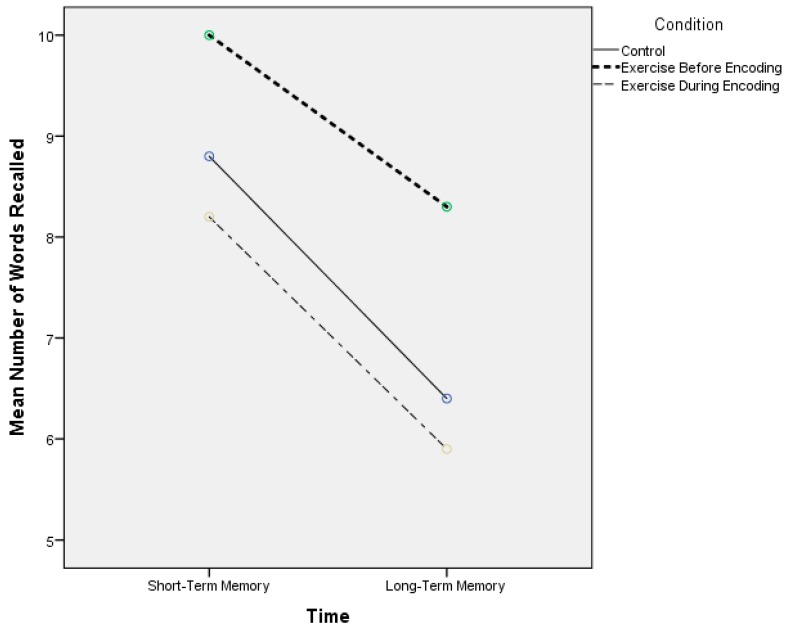
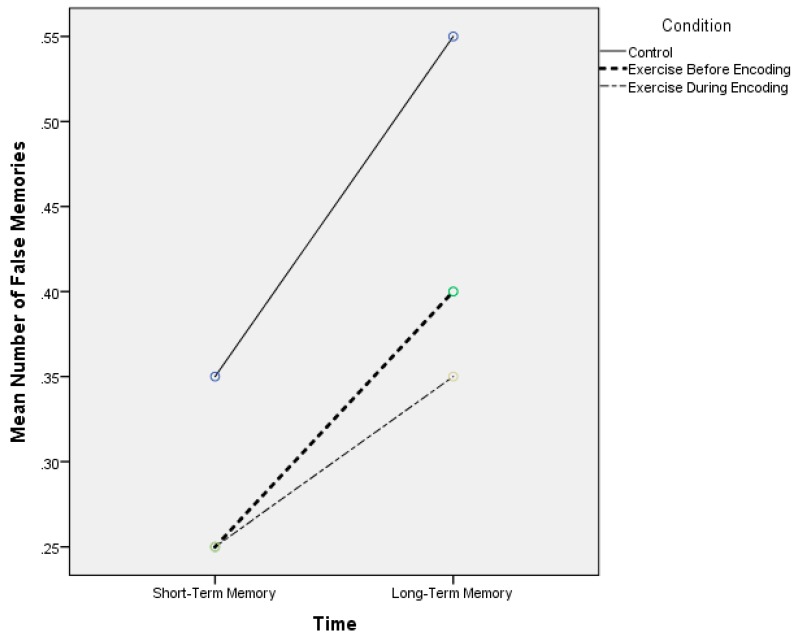
Previous experimental work suggests that acute exercise may positively influence the accurate recall of past episodic events. However, few studies have examined whether acute exercise also reduces the number of false episodic memories. We evaluated this paradigm in conjunction with an examination of the temporal effects of acute exercise, which have previously been shown to play an important role in subserving episodic memory function. Twenty young adults participated in three experimental visits, including a non-exercise control visit, a visit involving an acute bout (20 min) of moderate-intensity exercise occurring prior to the memory task, and a visit involving an acute bout of exercise occurring during the encoding of the memory task. All visits were counterbalanced and occurred at least 24 h apart. The Deese⁻Roediger⁻McDermott (DRM) Paradigm, involving a separate word list trial for each visit, was employed to assess accurate and false episodic memory recall. For each visit, a short-term (immediate recall) and a long-term (25-min delay) memory recall was assessed. For both time points, the visit that involved exercise prior to encoding resulted in better short-term and long-term memory function (F(2) = 11.56, < 0.001, η² = 0.38). For both time points, the control visit resulted in a greater number of false memories. These findings suggest that acute moderate-intensity exercise may help to increase the accurate recall of past episodic memories and may help to reduce the rate of false memories.
先前的实验研究表明,急性运动可能对准确回忆过去的情景事件产生积极影响。然而,很少有研究探讨急性运动是否也能减少错误情景记忆的数量。我们结合对急性运动时间效应的考察评估了这一范式,此前已证明该效应在支持情景记忆功能方面发挥着重要作用。20名年轻成年人参与了三次实验性访视,包括一次无运动对照访视、一次在记忆任务之前进行20分钟中等强度急性运动的访视,以及一次在记忆任务编码期间进行急性运动的访视。所有访视均采用平衡设计,且间隔至少24小时。采用迪ese⁻罗德iger⁻麦克德莫特(DRM)范式,每次访视使用单独的单词列表试验,以评估情景记忆的准确和错误回忆。每次访视均评估短期(即时回忆)和长期(25分钟延迟)记忆回忆。在两个时间点上,编码前进行运动的访视均产生了更好的短期和长期记忆功能(F(2) = 11.56,< 0.001,η² = 0.38)。在两个时间点上,对照访视产生的错误记忆数量更多。这些发现表明,急性中等强度运动可能有助于提高对过去情景记忆的准确回忆,并可能有助于降低错误记忆的发生率。