School of Health and Related Research, University of Sheffield, S14DA Sheffield, UK.
Mapi Research Trust, 27 Rue de la Villette, 69003 Lyon, France.
Int J Environ Res Public Health. 2018 Jun 26;15(7):1342. doi: 10.3390/ijerph15071342.
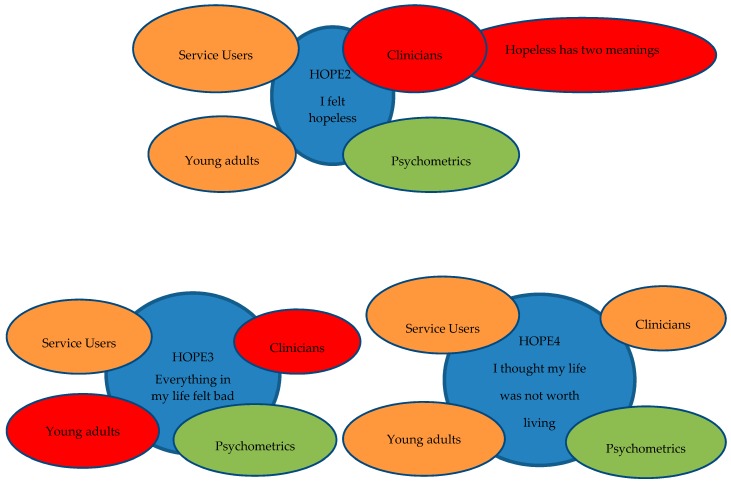
While it is important to treat symptoms, there is growing recognition that in order to help people with mental health problems lead meaningful and fulfilling lives, it is crucial to capture the impact of their conditions on wider aspects of their social lives. We constructed two versions of the Recovering Quality of Life (ReQoL) measure—ReQoL-10 and ReQoL-20—for use in routine settings and clinical trials from a larger pool of items by combining qualitative and quantitative evidence covering six domains. Qualitative evidence was gathered through interviews and focus groups with over 76 service users, clinicians, and a translatability assessment. Psychometric evidence generated from data from over 6200 service users was obtained from confirmatory factor models and item response theory analyses. In this paper we present an approach based on a traffic light pictorial format that was developed to present qualitative and quantitative evidence to a group of service users, clinicians, and researchers to help to make the final selection. This work provides a pragmatic yet rigorous approach to combining qualitative and quantitative evidence to ensure that ReQoL is psychometrically robust and has high relevance to service users and clinicians. This approach can be extended to the development of patient reported outcome measures in general.
虽然治疗症状很重要,但人们越来越认识到,为了帮助有心理健康问题的人过上有意义和充实的生活,捕捉他们的状况对其社会生活更广泛方面的影响至关重要。我们从更大的项目池中构建了两种版本的恢复生活质量(ReQoL)衡量标准——ReQoL-10 和 ReQoL-20——用于常规环境和临床试验,方法是结合涵盖六个领域的定性和定量证据进行组合。定性证据是通过对 76 多名服务用户、临床医生的访谈和焦点小组以及可翻译性评估收集的。来自 6200 多名服务用户数据的心理测量证据是通过验证性因子模型和项目反应理论分析获得的。在本文中,我们提出了一种基于交通灯图像格式的方法,该方法是为了向一组服务用户、临床医生和研究人员展示定性和定量证据而开发的,以帮助做出最终选择。这项工作提供了一种实用且严格的结合定性和定量证据的方法,以确保 ReQoL 在心理测量上是稳健的,并且与服务用户和临床医生高度相关。这种方法可以扩展到一般患者报告结果测量的开发。