Department of Microbiology and Immunology, University of Michigan, Ann Arbor, Michigan, USA.
Department of Internal Medicine/Infectious Diseases Division, University of Michigan Medical Center, Ann Arbor, Michigan, USA.
mSphere. 2018 Jun 27;3(3). doi: 10.1128/mSphere.00261-18.
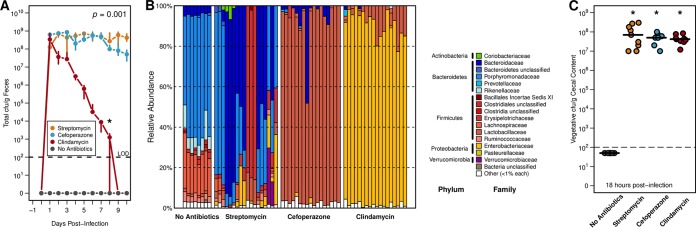
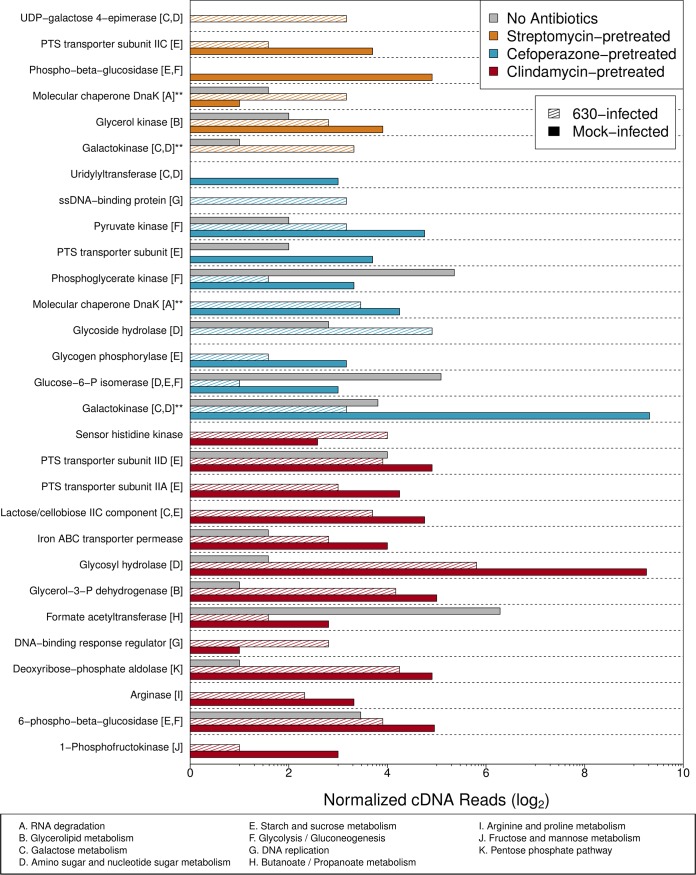
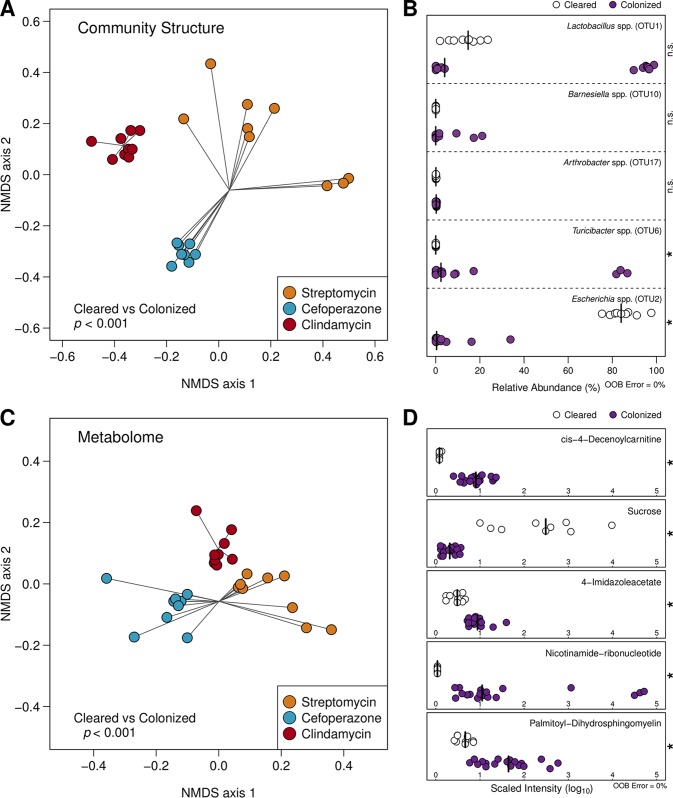
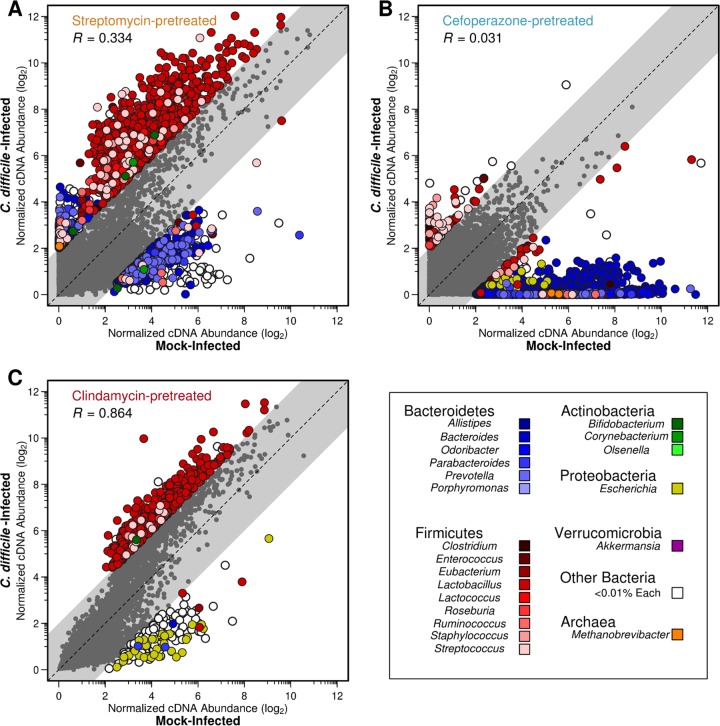
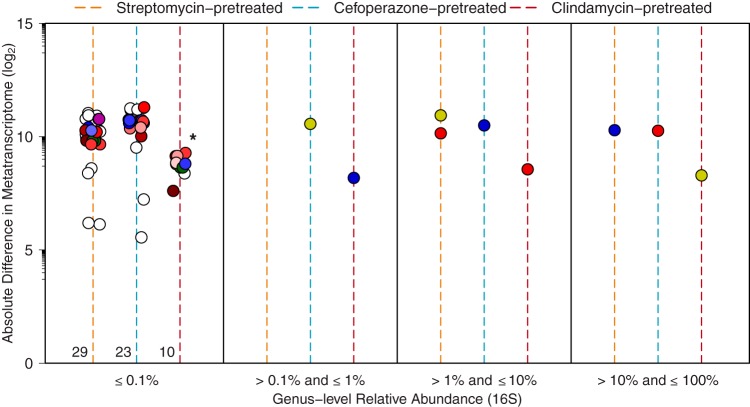
Susceptibility to infection (CDI) is primarily associated with previous exposure to antibiotics, which compromise the structure and function of the gut bacterial community. Specific antibiotic classes correlate more strongly with recurrent or persistent infection. As such, we utilized a mouse model of infection to explore the effect of distinct antibiotic classes on the impact that infection has on community-level transcription and metabolic signatures shortly following pathogen colonization and how those changes may associate with persistence of Untargeted metabolomic analysis revealed that infection had significantly larger impacts on the metabolic environment across cefoperazone- and streptomycin-pretreated mice, which became persistently colonized compared to clindamycin-pretreated mice, where infection quickly became undetectable. Through metagenome-enabled metatranscriptomics, we observed that transcripts for genes associated with carbon and energy acquisition were greatly reduced in infected animals, suggesting that those niches were instead occupied by Furthermore, the largest changes in transcription were seen in the least abundant species, indicating that may "attack the loser" in gut environments where sustained infection occurs more readily. Overall, our results suggest that is able to restructure the nutrient-niche landscape in the gut to promote persistent infection. has become the most common single cause of hospital-acquired infection over the last decade in the United States. Colonization resistance to the nosocomial pathogen is primarily provided by the gut microbiota, which is also involved in clearing the infection as the community recovers from perturbation. As distinct antibiotics are associated with different risk levels for CDI, we utilized a mouse model of infection with 3 separate antibiotic pretreatment regimens to generate alternative gut microbiomes that each allowed for colonization but varied in clearance rate. To assess community-level dynamics, we implemented an integrative multi-omics approach that revealed that infection significantly changed many aspects of the gut community. The degree to which the community changed was inversely correlated with clearance during the first 6 days of infection, suggesting that differentially modifies the gut environment to promote persistence. This is the first time that metagenome-enabled metatranscriptomics have been employed to study the behavior of a host-associated microbiota in response to an infection. Our results allow for a previously unseen understanding of the ecology associated with infection and provide the groundwork for identification of context-specific probiotic therapies.
易感性 感染 (CDI) 主要与先前接触抗生素有关,抗生素会破坏肠道细菌群落的结构和功能。特定的抗生素类别与复发性或持续性感染相关性更强。因此,我们利用感染小鼠模型来探索不同抗生素类别对感染后短时间内社区水平转录和代谢特征的影响,以及这些变化如何与 未靶向代谢组学分析表明,与克林霉素预处理的小鼠相比,在头孢哌酮和链霉素预处理的持续感染小鼠中, 感染对代谢环境的影响更大,而在克林霉素预处理的小鼠中,感染很快就无法检测到。通过基于宏基因组的宏转录组学,我们观察到与碳和能量获取相关的基因转录本在感染动物中大大减少,这表明这些生态位被 进一步,转录的最大变化发生在最不丰富的物种中,这表明在持续感染更容易发生的肠道环境中, 可能会“攻击失败者”。总的来说,我们的研究结果表明, 能够重构肠道中的营养小生境,以促进持续性感染。 在过去十年中, 已成为美国最常见的医院获得性感染单一原因。肠道共生菌主要为医院病原体定植提供抗定植能力,当群落从扰动中恢复时,共生菌也参与清除感染。由于不同的抗生素与 CDI 的风险水平不同,我们利用感染的小鼠模型,采用 3 种不同的抗生素预处理方案,产生了不同的肠道微生物组,这些微生物组都允许 定植,但清除率不同。为了评估群落水平的动态变化,我们采用了一种整合的多组学方法,该方法揭示了感染显著改变了肠道群落的许多方面。群落变化的程度与感染的前 6 天内的清除率呈负相关,这表明 不同程度地改变了肠道环境,以促进持续性感染。这是首次使用基于宏基因组的宏转录组学来研究宿主相关微生物群对感染的反应行为。我们的研究结果使人们对与 感染相关的生态学有了以前从未有过的认识,并为鉴定特定环境的益生菌疗法奠定了基础。