Gkikas Ilias, Palikaras Konstantinos, Tavernarakis Nektarios
Institute of Molecular Biology and Biotechnology, Foundation for Research and Technology-Hellas, Heraklion, Greece.
Department of Biology, University of Crete, Heraklion, Greece.
Front Immunol. 2018 Jun 5;9:1283. doi: 10.3389/fimmu.2018.01283. eCollection 2018.
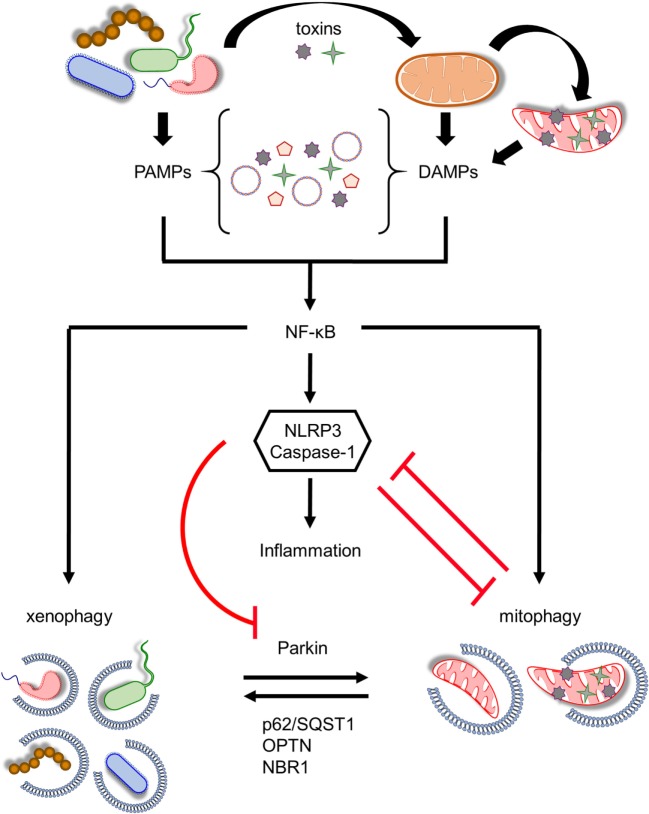
Mitochondria are cellular organelles essential for multiple biological processes, including energy production, metabolites biosynthesis, cell death, and immunological responses among others. Recent advances in the field of immunology research reveal the pivotal role of energy metabolism in innate immune cells fate and function. Therefore, the maintenance of mitochondrial network integrity and activity is a prerequisite for immune system homeostasis. Mitochondrial selective autophagy, known as mitophagy, surveils mitochondrial population eliminating superfluous and/or impaired organelles and mediating cellular survival and viability in response to injury/trauma and infection. Defective removal of damaged mitochondria leads to hyperactivation of inflammatory signaling pathways and subsequently to chronic systemic inflammation and development of inflammatory diseases. Here, we review the molecular mechanisms of mitophagy and highlight its critical role in the innate immune system homeostasis.
线粒体是细胞内的细胞器,对多种生物学过程至关重要,包括能量产生、代谢物生物合成、细胞死亡以及免疫反应等。免疫学研究领域的最新进展揭示了能量代谢在天然免疫细胞命运和功能中的关键作用。因此,维持线粒体网络的完整性和活性是免疫系统稳态的先决条件。线粒体选择性自噬,即线粒体自噬,监测线粒体群体,清除多余和/或受损的细胞器,并在应对损伤/创伤和感染时介导细胞存活和活力。受损线粒体的清除缺陷会导致炎症信号通路的过度激活,进而导致慢性全身性炎症和炎症性疾病的发展。在此,我们综述了线粒体自噬的分子机制,并强调其在天然免疫系统稳态中的关键作用。