Kashaninasab Fatemeh, Alavi Kaveh, Farhadi Mohammad, Salehi Mansour, Ghaleh Bandi Mir Farhad
Rasoul Akram Hospital, Iran University of Medical Sciences, Tehran, Iran.
Mental Health Research Center, Psychiatric Department, Iran University of Medical Sciences, Tehran, Iran.
Med J Islam Repub Iran. 2017 Dec 23;31:122. doi: 10.14196/mjiri.31.122. eCollection 2017.
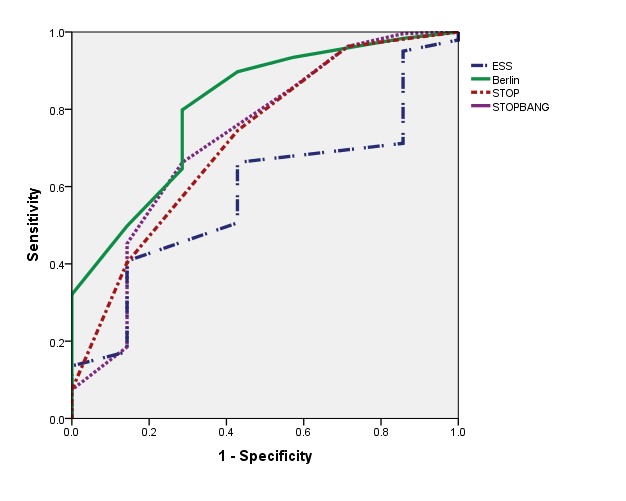
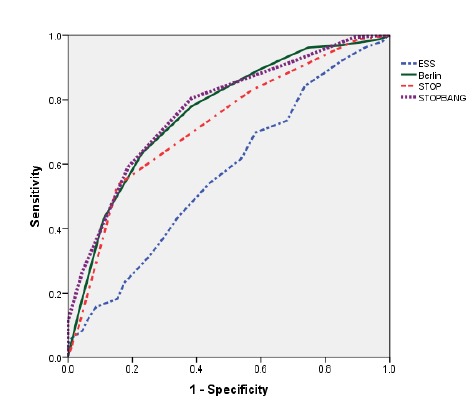
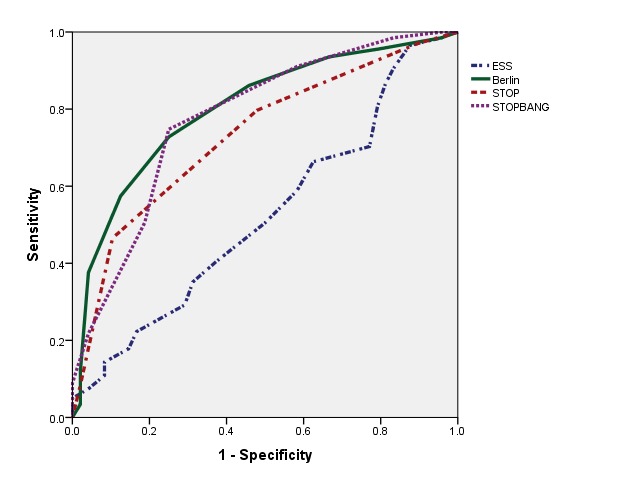
Diagnosis of obstructive sleep apnea syndrome (OSAS) is valuable, but it is time-consuming and expensive. Appropriate screening instruments help clinicians select high-risk individuals for further investigations. In the present study, we compared 4 popular instruments used in screening OSAS including Berlin, STOP, STOP-BANG questionnaires, and Epworth Sleepiness Scale (ESS). A total of 250 individuals, who referred to Sleep Laboratory of Shoorideh Hospital (Tehran, Iran) for polysomnography during May 2015 to November 2015, were recruited for this cross-sectional study. In addition to taking history and physical examination, 4 screening instruments including Berlin, STOP, STOP-BANG questionnaires, and ESS were completed. Diagnosis of OSAS was established using apnea-hypopnea index (AHI) in 3 categories of mild, moderate, and severe. Severe OSAS was diagnosed in 159 (63.6%), moderate OSAS in 43 (17.2%), and mild OSAS in 41 (16.4%) of the participants, moreover, AHI was within normal range in the other 7 (2.8%). To diagnose OSAS with any severity, Berlin questionnaire was a preferable instrument, with a sensitivity of 79.8% and specificity of 71.4%, considering the cut-point value of 3.5. In addition, in cases of severe OSAS, Berlin questionnaire showed superiority over other instruments, with a sensitivity of 80.5% and specificity of 61.5% using the cut-point value of 3.5. None of the 4 instruments are ideal to predict OSAS. However, considering the simplicity and availability of the instruments, Berlin and STOP-BANG questionnaires had maximum diagnostic values that helped us distinguish OSAS and severe OSAS, respectively.
阻塞性睡眠呼吸暂停低通气综合征(OSAS)的诊断具有重要价值,但耗时且费用高昂。合适的筛查工具可帮助临床医生筛选出高风险个体进行进一步检查。在本研究中,我们比较了用于筛查OSAS的4种常用工具,包括柏林问卷、STOP问卷、STOP - BANG问卷和爱泼华嗜睡量表(ESS)。共有250名在2015年5月至2015年11月期间前往伊朗德黑兰舒里德医院睡眠实验室进行多导睡眠监测的个体被纳入这项横断面研究。除了采集病史和进行体格检查外,还完成了包括柏林问卷、STOP问卷、STOP - BANG问卷和ESS在内的4种筛查工具的评估。根据呼吸暂停低通气指数(AHI)将OSAS分为轻度、中度和重度3类进行诊断。参与者中,159人(63.6%)被诊断为重度OSAS,43人(17.2%)为中度OSAS,41人(16.4%)为轻度OSAS,另外7人(2.8%)的AHI在正常范围内。对于诊断任何严重程度的OSAS,考虑切点值为3.5时,柏林问卷是一种更优的工具,敏感性为79.8%,特异性为71.4%。此外,在重度OSAS病例中,使用切点值3.5时,柏林问卷比其他工具更具优势,敏感性为80.5%,特异性为61.5%。这4种工具都并非预测OSAS的理想工具。然而,考虑到工具的简单性和可获得性,柏林问卷和STOP - BANG问卷分别具有最大诊断价值,有助于我们区分OSAS和重度OSAS。