Kruglikov Ilja L, Scherer Philipp E
Wellcomet GmbH, Karlsruhe, Germany.
Department of Internal Medicine, Touchstone Diabetes Center, University of Texas Southwestern Medical Center, Dallas, TX, USA.
Nutr Healthy Aging. 2018 Jun 15;4(4):291-307. doi: 10.3233/NHA-170037.
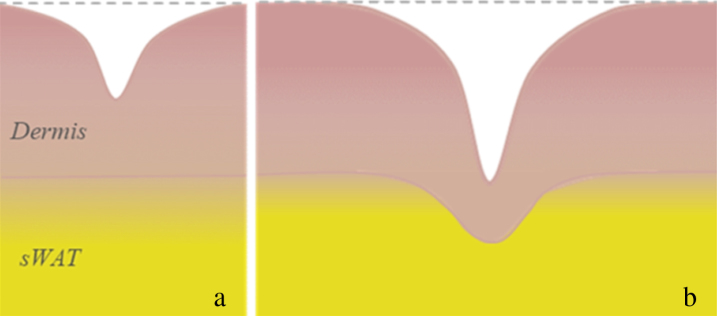
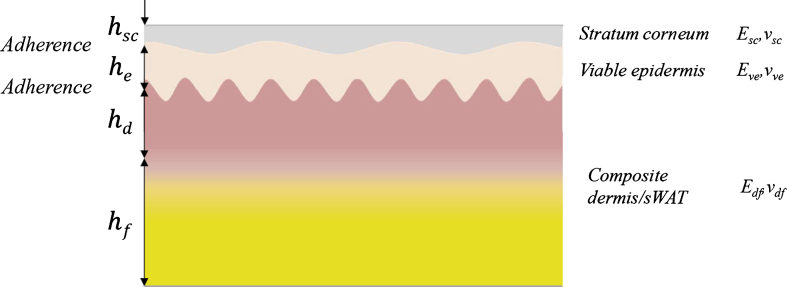
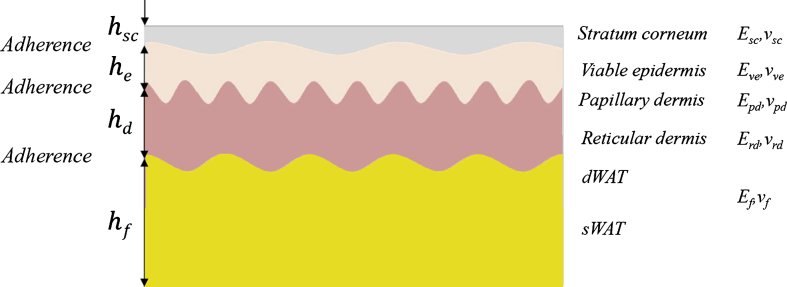
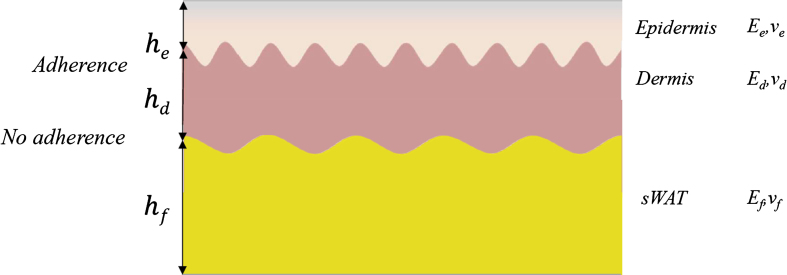
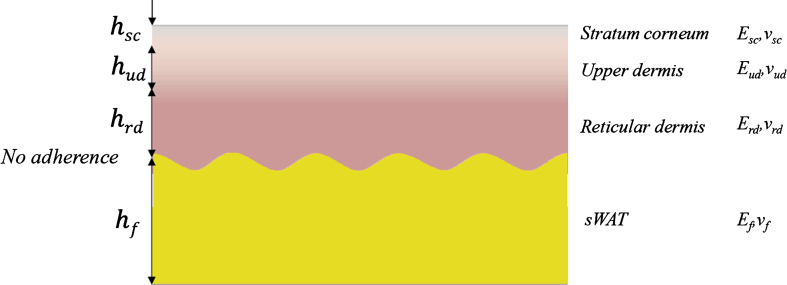
From a mechanical point of view, human skin appears as a layered composite containing the stiff thin cover layer presented by the stratum corneum, below which are the more compliant layers of viable epidermis and dermis and further below the much more compliant adjacent layer of subcutaneous white adipose tissue (sWAT). Upon exposure to a strain, such a multi-layer system demonstrates structural instabilities in its stiffer layers, which in its simplest form is the wrinkling. These instabilities appear hierarchically when the mechanical strain in the skin exceeds some critical values. Their appearance is mainly dependent on the mismatch in mechanical properties between adjacent skin layers or between the skin and sWAT, on the adhesive strength and thickness ratios between the layers, on their bending and tensile stiffness as well as on the value of the stress existing in single layers. Gradual reduction of elastic fibers in aging significantly reduces the skin's ability to bend, prompting an up to 4-fold reduction of its stability against wrinkling, thereby explaining the role of these fibers in skin aging. While chronological and extrinsic aging differently modify these parameters, they lead to the same end result, reducing the critical strain required for the onset of instabilities. Comparing of mechanical properties of the skin presented as a bi-, tri- or tetra-layer structure demonstrates the particular importance of the papillary dermis in skin aging and provides the arguments to consider the undulations on the dermal-epidermal and dermal-sWAT interfaces as the result of mechanical bifurcation, leading to structural instabilities inside of the skin. According to this model, anti-aging strategies should focus not as much on the reinforcement of the dermis, but rather aim to treat the elastic mismatch between different adjacent layers in the skin and sWAT as well as the adhesion between these layers.
从力学角度来看,人体皮肤呈现为一种分层复合材料,包含角质层形成的坚硬薄覆盖层,其下方是更具柔韧性的活表皮和真皮层,再往下是更具柔韧性的皮下白色脂肪组织(sWAT)相邻层。在受到应变时,这样的多层系统在其较硬的层中表现出结构不稳定性,最简单的形式就是起皱。当皮肤中的机械应变超过某些临界值时,这些不稳定性会分层出现。它们的出现主要取决于相邻皮肤层之间或皮肤与sWAT之间力学性能的不匹配、层间的粘附强度和厚度比、它们的弯曲和拉伸刚度以及单层中存在的应力值。衰老过程中弹性纤维的逐渐减少显著降低了皮肤的弯曲能力,使其抗皱稳定性降低多达4倍,从而解释了这些纤维在皮肤衰老中的作用。虽然自然衰老和外在衰老以不同方式改变这些参数,但它们导致相同的最终结果,即降低了不稳定性开始所需的临界应变。将呈现为双层、三层或四层结构的皮肤力学性能进行比较,表明乳头层真皮在皮肤衰老中具有特别重要的意义,并为将真皮 - 表皮和真皮 - sWAT界面上的波动视为机械分叉的结果提供了论据,这种分叉会导致皮肤内部的结构不稳定性。根据该模型,抗衰老策略不应过多地侧重于强化真皮,而应旨在处理皮肤和sWAT中不同相邻层之间的弹性不匹配以及这些层之间的粘附。