Department of Mechanical Engineering, University of Utah, Salt Lake City, UT, United States of America.
Gene and Linda Voiland School of Chemical and Bioengineering, Washington State University, Pullman, WA, United States of America.
PLoS One. 2018 Jun 28;13(6):e0199912. doi: 10.1371/journal.pone.0199912. eCollection 2018.
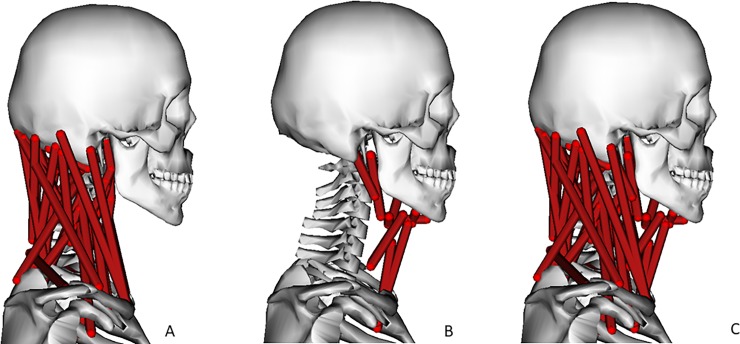
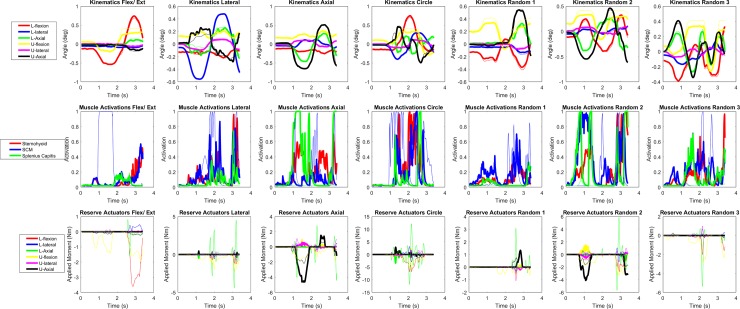
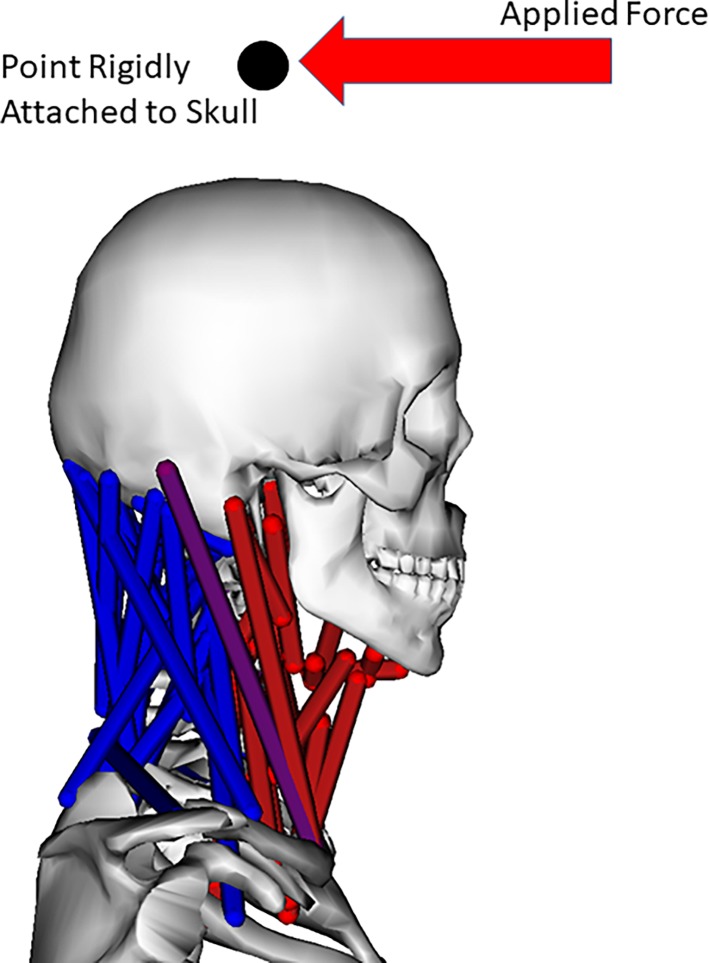
OpenSim musculoskeletal models of the head and neck can provide information about muscle activity and the response of the head and neck to a variety of situations. Previous models report weak flexion strength, which is partially due to lacking moment generating capacity in the upper cervical spine. Previous models have also lacked realistic hyoid muscles, which have the capability to improve flexion strength and control in the upper cervical spine. Suprahyoid and infrahyoid muscles were incorporated in an OpenSim musculoskeletal model of the head and neck. This model was based on previous OpenSim models, and now includes hyoid muscles and passive elements. The moment generating capacity of the model was tested by simulating physical experiments in the OpenSim environment. The flexor and extensor muscle strengths were scaled to match static experimental results. Models with and without hyoid muscles were used to simulate experimentally captured motions, and the need for reserve actuators was evaluated. The addition of hyoid muscles greatly increased flexion strength, and the model is the first of its kind to have realistic strength values in all directions. Less reserve actuator moment was required to simulate real motions with the addition of hyoid muscles. Several additional ways of improving flexion strength were investigated. Hyoid muscles add control and strength to OpenSim musculoskeletal models of the head and neck and improve simulations of head and neck movements.
OpenSim 头颈部肌肉骨骼模型可以提供有关肌肉活动以及头部和颈部对各种情况的反应的信息。以前的模型报告的弯曲强度较弱,这部分是由于上颈椎缺乏产生力矩的能力。以前的模型也缺乏真实的舌骨肌肉,它具有提高上颈椎弯曲强度和控制能力的能力。颏舌骨肌和舌骨下肌被纳入头颈部的 OpenSim 肌肉骨骼模型中。该模型基于以前的 OpenSim 模型,现在包括了舌骨肌肉和被动元素。通过在 OpenSim 环境中模拟物理实验来测试模型的产生力矩能力。模型的屈肌和伸肌强度被缩放以匹配静态实验结果。使用有和没有舌骨肌肉的模型来模拟实验捕获的运动,并评估备用执行器的需求。添加舌骨肌肉大大增加了弯曲强度,并且该模型是第一个在所有方向上具有真实强度值的模型。添加舌骨肌肉后,模拟真实运动所需的备用执行器力矩更小。研究了几种增加弯曲强度的其他方法。舌骨肌肉为头颈部的 OpenSim 肌肉骨骼模型增加了控制和力量,并改善了对头部和颈部运动的模拟。