• 文献检索
  • 文档翻译
  • 深度研究
  • 学术资讯
  • Suppr Zotero 插件Zotero 插件
  • 邀请有礼
  • 套餐&价格
  • 历史记录
应用&插件
Suppr Zotero 插件Zotero 插件浏览器插件Mac 客户端Windows 客户端微信小程序
定价
高级版会员购买积分包购买API积分包
服务
文献检索文档翻译深度研究API 文档MCP 服务
关于我们
关于 Suppr公司介绍联系我们用户协议隐私条款
关注我们

Suppr 超能文献

核心技术专利:CN118964589B侵权必究
粤ICP备2023148730 号-1Suppr @ 2026

文献检索

告别复杂PubMed语法,用中文像聊天一样搜索,搜遍4000万医学文献。AI智能推荐,让科研检索更轻松。

立即免费搜索

文件翻译

保留排版,准确专业,支持PDF/Word/PPT等文件格式,支持 12+语言互译。

免费翻译文档

深度研究

AI帮你快速写综述,25分钟生成高质量综述,智能提取关键信息,辅助科研写作。

立即免费体验

十字花科蔬菜消费趋势及其与乳腺癌风险的关联:一项病例对照研究。

Trends in Cruciferous Vegetable Consumption and Associations with Breast Cancer Risk: A Case-Control Study.

作者信息

Lin Tengda, Zirpoli Gary R, McCann Susan E, Moysich Kirsten B, Ambrosone Christine B, Tang Li

机构信息

Department of Cancer Prevention and Control, Roswell Park Cancer Institute, Buffalo, NY.

出版信息

Curr Dev Nutr. 2017 Jul 18;1(8):e000448. doi: 10.3945/cdn.117.000448. eCollection 2017 Aug.

DOI:10.3945/cdn.117.000448
PMID:29955715
原文链接:https://pmc.ncbi.nlm.nih.gov/articles/PMC5998357/
Abstract

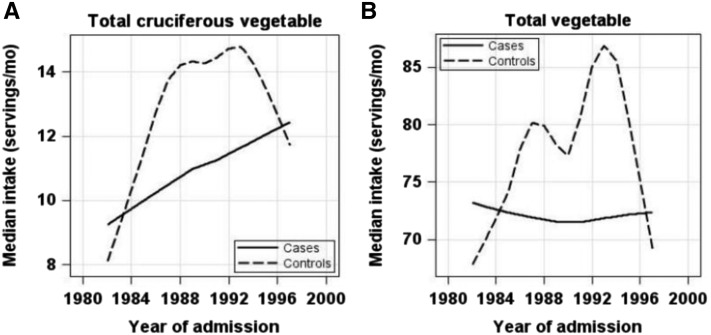
The chemopreventive activities of cruciferous vegetables were recognized in the early 1990s, followed by a growth of evidence in various cancer models, including breast cancer. To our knowledge, no studies have examined whether consumption of cruciferous vegetables has changed accordingly, and what impact, if any, on breast cancer risk may have resulted. The time trend in cruciferous vegetable intake was investigated between 1982 and 1998, and its associations with breast cancer risk were examined. In a hospital-based case-control study in 1491 patients with breast cancer and 1482 controls, loess curves were constructed to describe the relation between median consumption of cruciferous vegetables and year of admission. ORs and 95% CIs were calculated with unconditional logistic regression, adjusting for age, year of admission, family income, body mass index, cigarette smoking, age at menarche, parity, age at first birth, family history of breast cancer, hormone replacement therapy, and total meat intake. Consumption patterns differed between cases and controls. A slow but steady increase in cruciferous vegetable intake was observed in the cases, although among controls, cruciferous vegetable consumption increased from 1982 to 1987, reached a plateau during 1988-1992, and then declined from 1993 to 1998. Accordingly, although an overall inverse association with breast cancer risk was observed for cruciferous vegetable intake (highest compared with lowest quartile-OR: 0.68; 95% CI: 0.55, 0.86; -trend = 0.0006), the inverse association tended to be more pronounced within more recent-year strata, with an OR of 0.52 (95% CI: 0.33, 0.83) for 1993-1998 compared with an OR of 0.89 (95% CI: 0.64, 1.23) for 1982-1987. The consumption of cruciferous vegetables increased during the past 2 decades, showing different trends in cases and controls. The subtle but sustained increase in cruciferous vegetable intake reported by the cases could influence association studies with breast cancer risk.

摘要

十字花科蔬菜的化学预防活性在20世纪90年代初得到认可,随后在包括乳腺癌在内的各种癌症模型中,证据不断增加。据我们所知,尚无研究调查十字花科蔬菜的摄入量是否相应发生了变化,以及这可能对乳腺癌风险产生何种影响(若有影响的话)。我们调查了1982年至1998年间十字花科蔬菜摄入量的时间趋势,并研究了其与乳腺癌风险的关联。在一项基于医院的病例对照研究中,纳入了1491例乳腺癌患者和1482例对照,构建了局部加权回归曲线以描述十字花科蔬菜的中位摄入量与入院年份之间的关系。采用无条件逻辑回归计算比值比(OR)和95%可信区间(CI),并对年龄、入院年份、家庭收入、体重指数、吸烟情况、初潮年龄、生育次数、首次生育年龄、乳腺癌家族史、激素替代疗法和肉类总摄入量进行了调整。病例组和对照组的消费模式有所不同。病例组中十字花科蔬菜的摄入量虽增长缓慢但较为稳定,而对照组中,十字花科蔬菜的消费量在1982年至1987年增加,在1988 - 1992年达到平稳状态,然后在1993年至1998年下降。因此,尽管观察到十字花科蔬菜摄入量与乳腺癌风险总体呈负相关(最高四分位数与最低四分位数相比,OR:0.68;95%CI:0.55,0.86;趋势P = 0.0006),但这种负相关在最近几年的分层中往往更为明显,1993 - 1998年的OR为0.52(95%CI:0.33,0.83),而1982 - 1987年的OR为0.89(95%CI:0.64,1.23)。在过去20年中,十字花科蔬菜的消费量有所增加,病例组和对照组呈现出不同的趋势。病例组报告的十字花科蔬菜摄入量的细微但持续增加可能会影响与乳腺癌风险的关联研究。
https://cdn.ncbi.nlm.nih.gov/pmc/blobs/5766/5998357/797cb594a15d/cdn000448fig1.jpg

相似文献

1
Trends in Cruciferous Vegetable Consumption and Associations with Breast Cancer Risk: A Case-Control Study.十字花科蔬菜消费趋势及其与乳腺癌风险的关联:一项病例对照研究。
Curr Dev Nutr. 2017 Jul 18;1(8):e000448. doi: 10.3945/cdn.117.000448. eCollection 2017 Aug.
2
Glucosinolate and isothiocyanate intakes are inversely associated with breast cancer risk: a case-control study in China.类葡萄糖硫苷和异硫氰酸酯的摄入量与乳腺癌风险呈负相关:中国的一项病例对照研究。
Br J Nutr. 2018 Apr;119(8):957-964. doi: 10.1017/S0007114518000600.
3
Postdiagnosis cruciferous vegetable consumption and breast cancer outcomes: a report from the After Breast Cancer Pooling Project.诊断后十字花科蔬菜的消费与乳腺癌结局:来自乳腺癌后汇总项目的报告。
Cancer Epidemiol Biomarkers Prev. 2013 Aug;22(8):1451-6. doi: 10.1158/1055-9965.EPI-13-0446. Epub 2013 Jun 13.
4
Consumption of raw cruciferous vegetables is inversely associated with bladder cancer risk.食用生十字花科蔬菜与膀胱癌风险呈负相关。
Cancer Epidemiol Biomarkers Prev. 2008 Apr;17(4):938-44. doi: 10.1158/1055-9965.EPI-07-2502.
5
Cruciferous Vegetable Intake Is Inversely Associated with Lung Cancer Risk among Current Nonsmoking Men in the Japan Public Health Center (JPHC) Study.在日本公共卫生中心(JPHC)研究中,十字花科蔬菜摄入量与当前不吸烟男性的肺癌风险呈负相关。
J Nutr. 2017 May;147(5):841-849. doi: 10.3945/jn.117.247494. Epub 2017 Apr 5.
6
Cruciferous vegetable consumption and pancreatic cancer: A case-control study.十字花科蔬菜的摄入与胰腺癌:一项病例对照研究。
Cancer Epidemiol. 2021 Jun;72:101924. doi: 10.1016/j.canep.2021.101924. Epub 2021 Mar 11.
7
Cruciferous vegetables and colorectal cancer risk: a hospital-based matched case-control study in Northeast China.十字花科蔬菜与结直肠癌风险:中国东北地区基于医院的匹配病例对照研究。
Eur J Clin Nutr. 2019 Mar;73(3):450-457. doi: 10.1038/s41430-018-0341-5. Epub 2018 Oct 15.
8
Cruciferous vegetable intake is inversely associated with lung cancer risk among smokers: a case-control study.十字花科蔬菜摄入量与吸烟者肺癌风险呈负相关:一项病例对照研究。
BMC Cancer. 2010 Apr 27;10:162. doi: 10.1186/1471-2407-10-162.
9
Cruciferous vegetable intake and lung cancer risk: a nested case-control study matched on cigarette smoking.十字花科蔬菜摄入量与肺癌风险:基于吸烟状况匹配的巢式病例对照研究。
Cancer Epidemiol Biomarkers Prev. 2010 Oct;19(10):2534-40. doi: 10.1158/1055-9965.EPI-10-0475. Epub 2010 Sep 14.
10
Usual Cruciferous Vegetable Consumption and Ovarian Cancer: A Case-Control Study.常见十字花科蔬菜摄入量与卵巢癌:一项病例对照研究。
Nutr Cancer. 2018 May-Jun;70(4):678-683. doi: 10.1080/01635581.2018.1464346. Epub 2018 Apr 25.

引用本文的文献

1
Broccoli Consumption and Risk of Cancer: An Updated Systematic Review and Meta-Analysis of Observational Studies.西兰花摄入与癌症风险:观察性研究的更新系统评价和荟萃分析。
Nutrients. 2024 May 23;16(11):1583. doi: 10.3390/nu16111583.
2
Association of the bitter taste genes TAS2R38 and CA6 and breast cancer risk; a case-control study of Polish women in Poland and Polish immigrants in USA.苦味基因 TAS2R38 和 CA6 与乳腺癌风险的关联;波兰女性和美国波兰移民的病例对照研究。
PLoS One. 2024 Apr 30;19(4):e0300061. doi: 10.1371/journal.pone.0300061. eCollection 2024.
3
Antioxidant and Antiproliferative Activities of Kale ( L. Var. DC.) and Wild Cabbage ( Ten.) Polyphenolic Extracts.

本文引用的文献

1
Research on cruciferous vegetables, indole-3-carbinol, and cancer prevention: A tribute to Lee W. Wattenberg.十字花科蔬菜、吲哚 - 3 - 甲醇与癌症预防的研究:向李·W·瓦滕伯格致敬。
Mol Nutr Food Res. 2016 Jun;60(6):1228-38. doi: 10.1002/mnfr.201500889. Epub 2016 May 23.
2
Dietary Glucosinolates Sulforaphane, Phenethyl Isothiocyanate, Indole-3-Carbinol/3,3'-Diindolylmethane: Anti-Oxidative Stress/Inflammation, Nrf2, Epigenetics/Epigenomics and Cancer Chemopreventive Efficacy.膳食中的硫代葡萄糖苷、萝卜硫素、苯乙基异硫氰酸酯、吲哚 - 3 - 甲醇/3,3'-二吲哚甲烷:抗氧化应激/炎症、核因子E2相关因子2、表观遗传学/表观基因组学及癌症化学预防功效
Curr Pharmacol Rep. 2015 May;1(3):179-196. doi: 10.1007/s40495-015-0017-y. Epub 2015 Jan 30.
3
羽衣甘蓝(L. Var. DC.)和野生甘蓝(Ten.)多酚提取物的抗氧化和抗增殖活性。
Molecules. 2023 Feb 15;28(4):1840. doi: 10.3390/molecules28041840.
4
Epigenetic Effects of Healthy Foods and Lifestyle Habits from the Southern European Atlantic Diet Pattern: A Narrative Review.《来自南欧大西洋饮食模式的健康食物和生活方式习惯的表观遗传效应:叙述性综述》
Adv Nutr. 2022 Oct 2;13(5):1725-1747. doi: 10.1093/advances/nmac038.
5
Transepithelial Anti-Neuroblastoma Response to Kale among Four Vegetable Juices Using In Vitro Model Co-Culture System.四种蔬菜汁体外共培养模型中羽衣甘蓝的跨上皮抗神经母细胞瘤反应。
Nutrients. 2021 Feb 2;13(2):488. doi: 10.3390/nu13020488.
6
Chemoprevention of Breast Cancer With Vitamins and Micronutrients: A Concise Review.维生素和微量营养素预防乳腺癌:简要综述。
In Vivo. 2019 Jul-Aug;33(4):983-997. doi: 10.21873/invivo.11568.
7
Role of Krüppel-like Factor 4-p21 Axis in Breast Cancer Stem-like Cell Inhibition by Benzyl Isothiocyanate.Krüppel 样因子 4-p21 轴在苄基异硫氰酸酯抑制乳腺癌干细胞样细胞中的作用。
Cancer Prev Res (Phila). 2019 Mar;12(3):125-134. doi: 10.1158/1940-6207.CAPR-18-0393. Epub 2019 Feb 5.
8
AKT-dependent sugar addiction by benzyl isothiocyanate in breast cancer cells.AKT 依赖性糖瘾:苯甲基异硫氰酸酯在乳腺癌细胞中的作用。
Mol Carcinog. 2019 Jun;58(6):996-1007. doi: 10.1002/mc.22988. Epub 2019 Mar 5.
9
Induction of Apoptosis and Cytotoxicity by Raphasatin in Human Breast Adenocarcinoma MCF-7 Cells.拉帕他丁诱导人乳腺癌 MCF-7 细胞凋亡和细胞毒性。
Molecules. 2018 Nov 27;23(12):3092. doi: 10.3390/molecules23123092.
10
Effects of thermal and non-thermal processing of cruciferous vegetables on glucosinolates and its derived forms.十字花科蔬菜的热加工和非热加工对硫代葡萄糖苷及其衍生形式的影响。
J Food Sci Technol. 2018 Jun;55(6):1973-1981. doi: 10.1007/s13197-018-3153-7. Epub 2018 Apr 16.
Molecular Mechanisms Underlying Anti-Inflammatory Actions of 6-(Methylsulfinyl)hexyl Isothiocyanate Derived from Wasabi (Wasabia japonica).
源自山葵(山嵛菜)的6-(甲基亚磺酰基)己基异硫氰酸酯抗炎作用的分子机制
Adv Pharmacol Sci. 2012;2012:614046. doi: 10.1155/2012/614046. Epub 2012 Aug 15.
4
Cruciferous vegetables intake is inversely associated with risk of breast cancer: a meta-analysis.十字花科蔬菜的摄入与乳腺癌风险呈负相关:一项荟萃分析。
Breast. 2013 Jun;22(3):309-13. doi: 10.1016/j.breast.2012.07.013. Epub 2012 Aug 9.
5
Prevention of mammary carcinogenesis in MMTV-neu mice by cruciferous vegetable constituent benzyl isothiocyanate.十字花科蔬菜成分苄基异硫氰酸酯预防 MMTV-neu 小鼠的乳腺肿瘤发生。
Cancer Res. 2009 Dec 15;69(24):9473-80. doi: 10.1158/0008-5472.CAN-09-2960.
6
Greater vegetable and fruit intake is associated with a lower risk of breast cancer among Chinese women.在中国女性中,增加蔬菜和水果的摄入量与降低患乳腺癌的风险相关。
Int J Cancer. 2009 Jul 1;125(1):181-8. doi: 10.1002/ijc.24358.
7
Association of lifestyle and other risk factors with breast cancer according to menopausal status: a case-control study in the Region of Western Pomerania (Poland).根据绝经状态分析生活方式及其他风险因素与乳腺癌的关联:在波兰西波美拉尼亚地区开展的一项病例对照研究
Asian Pac J Cancer Prev. 2007 Oct-Dec;8(4):513-24.
8
Discovery and development of sulforaphane as a cancer chemopreventive phytochemical.萝卜硫素作为一种癌症化学预防植物化学物质的发现与开发。
Acta Pharmacol Sin. 2007 Sep;28(9):1343-54. doi: 10.1111/j.1745-7254.2007.00679.x.
9
Preclinical and clinical evaluation of sulforaphane for chemoprevention in the breast.萝卜硫素用于乳腺癌化学预防的临床前和临床评估。
Carcinogenesis. 2007 Jul;28(7):1485-90. doi: 10.1093/carcin/bgm049. Epub 2007 Mar 7.
10
Cruciferous vegetables and human cancer risk: epidemiologic evidence and mechanistic basis.十字花科蔬菜与人类癌症风险:流行病学证据及作用机制
Pharmacol Res. 2007 Mar;55(3):224-36. doi: 10.1016/j.phrs.2007.01.009. Epub 2007 Jan 25.