Wu Kejia, Yi Yuexiong, Liu Fulin, Wu Wanrong, Chen Yurou, Zhang Wei
Department of Gynecology, Zhongnan Hospital of Wuhan University, Wuhan, Hubei 430071, P.R. China.
The First Department of Gynecology, Renmin Hospital of Wuhan University, Wuhan, Hubei 430060, P.R. China.
Oncol Lett. 2018 Jul;16(1):1003-1009. doi: 10.3892/ol.2018.8768. Epub 2018 May 22.
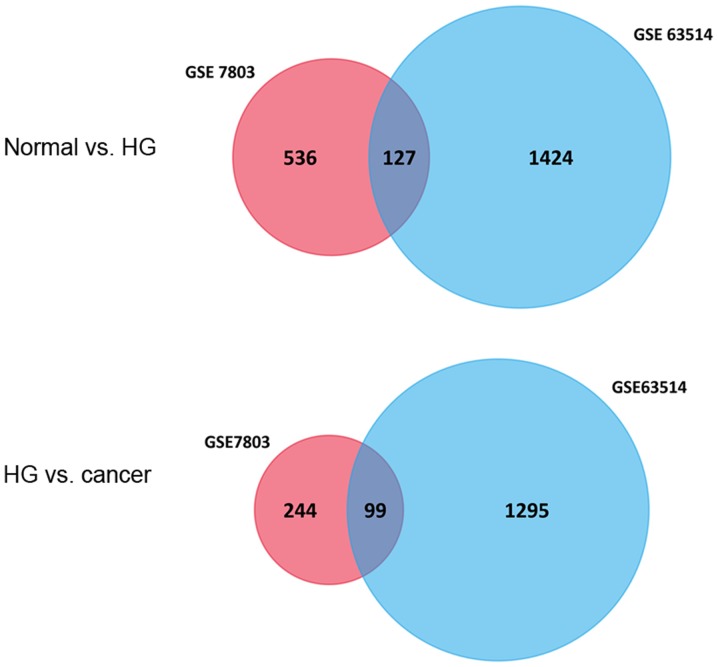
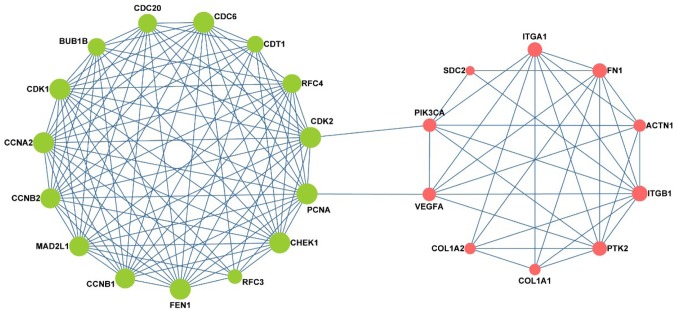
The aim of the present study was to investigate the key pathways and genes in the progression of cervical cancer. The gene expression profiles GSE7803 and GSE63514 were obtained from the Gene Expression Omnibus database. Differentially expressed genes (DEGs) were identified using GEO2R and the limma package, and Gene Ontology (GO) and Kyoto Encyclopedia of Genes and Genomes (KEGG) enrichment analyses were conducted using the Database for Annotation, Visualization and Integrated Discovery. The hub genes were identified using Cytoscape and protein-protein interaction (PPI) networks were constructed using the STRING database. A total of 127 and 99 DEGs were identified in the pre-invasive and invasive stages of cervical cancer, respectively. GO enrichment analysis indicated that the DEGs in pre-invasive cervical cancer were primarily associated with the 'protein binding', 'single-stranded DNA-dependent ATPase activity', 'DNA replication origin binding' and 'microtubule binding' terms, whereas the DEGs in invasive cervical cancer were associated with the 'extracellular matrix (ECM) structural constituent', 'heparin binding' and 'integrin binding'. KEGG enrichment analysis revealed that the pre-invasive DEGs were significantly enriched in the 'cell cycle', 'DNA replication' and 'p53 signaling pathway' terms, while the invasive DEGs were enriched in the 'amoebiasis', 'focal adhesion', 'ECM-receptor interaction' and 'platelet activation' terms. The PPI network identified 4 key genes (PCNA, CDK2, VEGFA and PIK3CA), which were hub genes for pre-invasive and invasive cervical cancer. In conclusion, bioinformatics analysis identified 4 key genes in cervical cancer progression (PCNA, CDK2, VEGFA and PIK3CA), which may be potential biomarkers for differentiating normal cervical epithelial tissue from cervical cancer.
本研究的目的是探究宫颈癌进展中的关键途径和基因。基因表达谱GSE7803和GSE63514取自基因表达综合数据库。使用GEO2R和limma软件包鉴定差异表达基因(DEG),并使用注释、可视化和综合发现数据库进行基因本体(GO)和京都基因与基因组百科全书(KEGG)富集分析。使用Cytoscape鉴定枢纽基因,并使用STRING数据库构建蛋白质-蛋白质相互作用(PPI)网络。在宫颈癌的癌前阶段和浸润阶段分别鉴定出127个和99个DEG。GO富集分析表明,癌前宫颈癌中的DEG主要与“蛋白质结合”“单链DNA依赖性ATP酶活性”“DNA复制起点结合”和“微管结合”等术语相关,而浸润性宫颈癌中的DEG与“细胞外基质(ECM)结构成分”“肝素结合”和“整合素结合”相关。KEGG富集分析显示,癌前DEG在“细胞周期”“DNA复制”和“p53信号通路”等术语中显著富集,而浸润性DEG在“阿米巴病”“粘着斑”“ECM-受体相互作用”和“血小板活化”等术语中富集。PPI网络鉴定出4个关键基因(PCNA、CDK2、VEGFA和PIK3CA),它们是癌前和浸润性宫颈癌的枢纽基因。总之,生物信息学分析确定了宫颈癌进展中的4个关键基因(PCNA、CDK2、VEGFA和PIK3CA),它们可能是区分正常宫颈上皮组织和宫颈癌的潜在生物标志物。