• 文献检索
  • 文档翻译
  • 深度研究
  • 学术资讯
  • Suppr Zotero 插件Zotero 插件
  • 邀请有礼
  • 套餐&价格
  • 历史记录
应用&插件
Suppr Zotero 插件Zotero 插件浏览器插件Mac 客户端Windows 客户端微信小程序
定价
高级版会员购买积分包购买API积分包
服务
文献检索文档翻译深度研究API 文档MCP 服务
关于我们
关于 Suppr公司介绍联系我们用户协议隐私条款
关注我们

Suppr 超能文献

核心技术专利:CN118964589B侵权必究
粤ICP备2023148730 号-1Suppr @ 2026

文献检索

告别复杂PubMed语法,用中文像聊天一样搜索,搜遍4000万医学文献。AI智能推荐,让科研检索更轻松。

立即免费搜索

文件翻译

保留排版,准确专业,支持PDF/Word/PPT等文件格式,支持 12+语言互译。

免费翻译文档

深度研究

AI帮你快速写综述,25分钟生成高质量综述,智能提取关键信息,辅助科研写作。

立即免费体验

生物信息学分析宫颈癌发展过程中的差异表达基因和通路。

Bioinformatics analysis of differentially expressed genes and pathways in the development of cervical cancer.

机构信息

Shanghai Zerun Biotechnology Co., Ltd., Pilot Department, Building 9, 1690 Zhangheng Road Pudong, Shanghai, 201203, China.

出版信息

BMC Cancer. 2021 Jun 26;21(1):733. doi: 10.1186/s12885-021-08412-4.

DOI:10.1186/s12885-021-08412-4
PMID:34174849
原文链接:https://pmc.ncbi.nlm.nih.gov/articles/PMC8236200/
Abstract

BACKGROUND

This study aimed to explore and identify key genes and signaling pathways that contribute to the progression of cervical cancer to improve prognosis.

METHODS

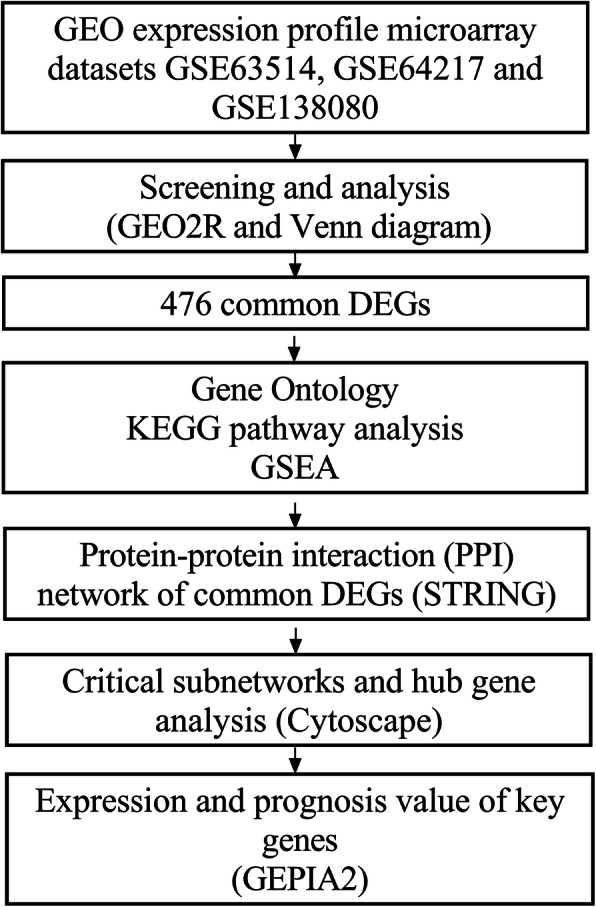
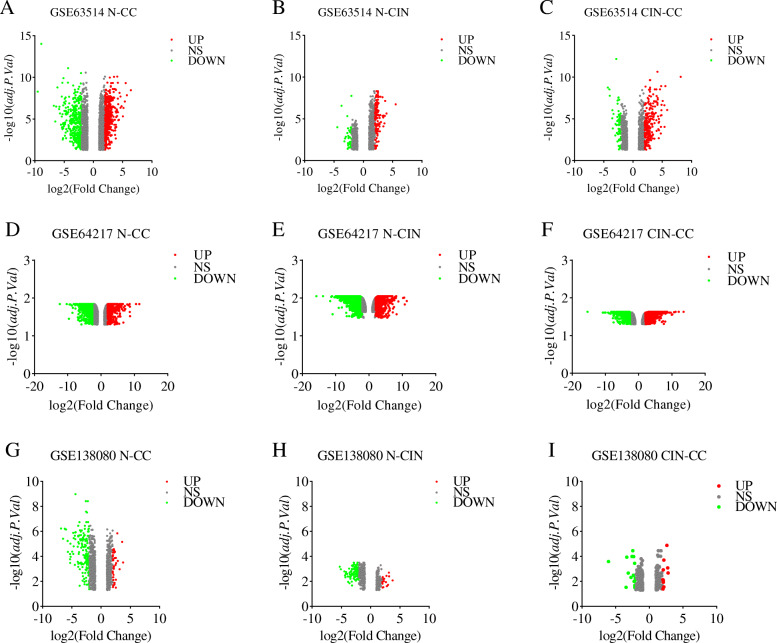
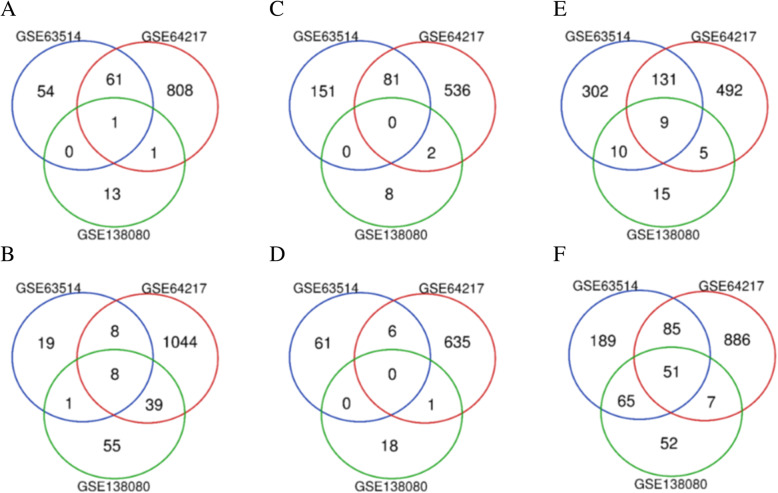
Three gene expression profiles (GSE63514, GSE64217 and GSE138080) were screened and downloaded from the Gene Expression Omnibus database (GEO). Differentially expressed genes (DEGs) were screened using the GEO2R and Venn diagram tools. Then, Gene Ontology (GO) and Kyoto Encyclopedia of Genes and Genomes (KEGG) pathway enrichment analyses were performed. Gene set enrichment analysis (GSEA) was performed to analyze the three gene expression profiles. Moreover, a protein-protein interaction (PPI) network of the DEGs was constructed, and functional enrichment analysis was performed. On this basis, hub genes from critical PPI subnetworks were explored with Cytoscape software. The expression of these genes in tumors was verified, and survival analysis of potential prognostic genes from critical subnetworks was conducted. Functional annotation, multiple gene comparison and dimensionality reduction in candidate genes indicated the clinical significance of potential targets.

RESULTS

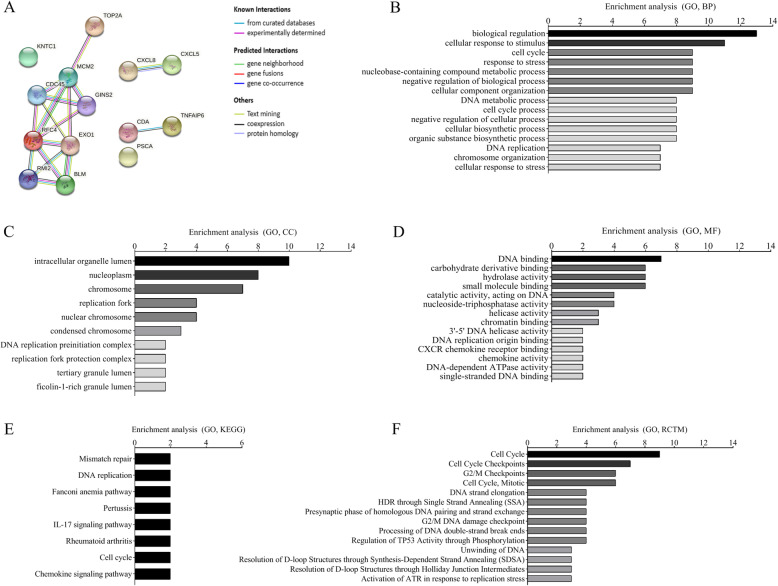
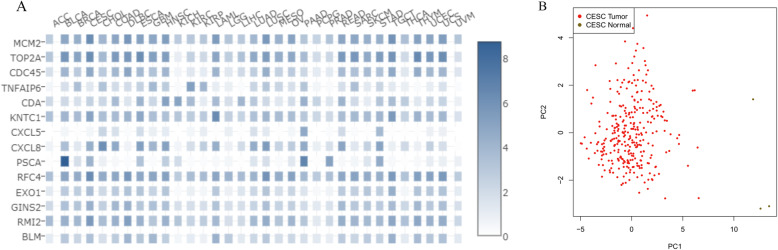
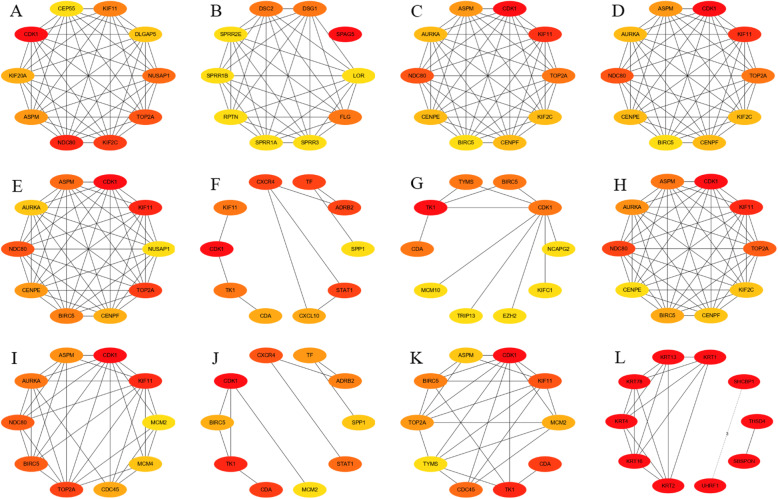
A total of 476 DEGs were screened: 253 upregulated genes and 223 downregulated genes. DEGs were enriched in 22 biological processes, 16 cellular components and 9 molecular functions in precancerous lesions and cervical cancer. DEGs were mainly enriched in 10 KEGG pathways. Through intersection analysis and data mining, 3 key KEGG pathways and related core genes were revealed by GSEA. Moreover, a PPI network of 476 DEGs was constructed, hub genes from 12 critical subnetworks were explored, and a total of 14 potential molecular targets were obtained.

CONCLUSIONS

These findings promote the understanding of the molecular mechanism of and clinically related molecular targets for cervical cancer.

摘要

背景

本研究旨在探索和确定导致宫颈癌进展的关键基因和信号通路,以改善预后。

方法

从基因表达综合数据库(GEO)中筛选并下载了三个基因表达谱(GSE63514、GSE64217 和 GSE138080)。使用 GEO2R 和 Venn 图工具筛选差异表达基因(DEGs)。然后进行基因本体论(GO)和京都基因与基因组百科全书(KEGG)通路富集分析。进行基因集富集分析(GSEA)以分析三个基因表达谱。此外,构建 DEGs 的蛋白质-蛋白质相互作用(PPI)网络,并进行功能富集分析。在此基础上,利用 Cytoscape 软件探索关键 PPI 子网络中的枢纽基因。验证这些基因在肿瘤中的表达,并对关键子网络中的潜在预后基因进行生存分析。对候选基因进行功能注释、多基因比较和降维分析,表明了潜在靶标的临床意义。

结果

共筛选出 476 个 DEGs:253 个上调基因和 223 个下调基因。DEGs 在癌前病变和宫颈癌中富集于 22 个生物过程、16 个细胞成分和 9 个分子功能。DEGs 主要富集于 10 个 KEGG 通路。通过交集分析和数据挖掘,通过 GSEA 揭示了 3 个关键 KEGG 通路和相关的核心基因。此外,构建了 476 个 DEGs 的 PPI 网络,探索了 12 个关键子网的枢纽基因,并获得了 14 个潜在的分子靶标。

结论

这些发现促进了对宫颈癌分子机制和临床相关分子靶标的理解。
https://cdn.ncbi.nlm.nih.gov/pmc/blobs/05d9/8236200/f26448e2787d/12885_2021_8412_Fig14_HTML.jpg
https://cdn.ncbi.nlm.nih.gov/pmc/blobs/05d9/8236200/bbe020c0eda8/12885_2021_8412_Fig1_HTML.jpg
https://cdn.ncbi.nlm.nih.gov/pmc/blobs/05d9/8236200/bbbee22d28d7/12885_2021_8412_Fig2_HTML.jpg
https://cdn.ncbi.nlm.nih.gov/pmc/blobs/05d9/8236200/e58af8ffc6eb/12885_2021_8412_Fig3_HTML.jpg
https://cdn.ncbi.nlm.nih.gov/pmc/blobs/05d9/8236200/c715a338dba2/12885_2021_8412_Fig4_HTML.jpg
https://cdn.ncbi.nlm.nih.gov/pmc/blobs/05d9/8236200/00d8417356e6/12885_2021_8412_Fig5_HTML.jpg
https://cdn.ncbi.nlm.nih.gov/pmc/blobs/05d9/8236200/a360ffc3a1d0/12885_2021_8412_Fig6_HTML.jpg
https://cdn.ncbi.nlm.nih.gov/pmc/blobs/05d9/8236200/6797798842a9/12885_2021_8412_Fig7_HTML.jpg
https://cdn.ncbi.nlm.nih.gov/pmc/blobs/05d9/8236200/190adede7f7b/12885_2021_8412_Fig8_HTML.jpg
https://cdn.ncbi.nlm.nih.gov/pmc/blobs/05d9/8236200/0c1d7c1b4fcd/12885_2021_8412_Fig9_HTML.jpg
https://cdn.ncbi.nlm.nih.gov/pmc/blobs/05d9/8236200/3060bac04acf/12885_2021_8412_Fig10_HTML.jpg
https://cdn.ncbi.nlm.nih.gov/pmc/blobs/05d9/8236200/b730129edeff/12885_2021_8412_Fig11_HTML.jpg
https://cdn.ncbi.nlm.nih.gov/pmc/blobs/05d9/8236200/dcb14b342458/12885_2021_8412_Fig12_HTML.jpg
https://cdn.ncbi.nlm.nih.gov/pmc/blobs/05d9/8236200/47c9555c5398/12885_2021_8412_Fig13_HTML.jpg
https://cdn.ncbi.nlm.nih.gov/pmc/blobs/05d9/8236200/f26448e2787d/12885_2021_8412_Fig14_HTML.jpg
https://cdn.ncbi.nlm.nih.gov/pmc/blobs/05d9/8236200/bbe020c0eda8/12885_2021_8412_Fig1_HTML.jpg
https://cdn.ncbi.nlm.nih.gov/pmc/blobs/05d9/8236200/bbbee22d28d7/12885_2021_8412_Fig2_HTML.jpg
https://cdn.ncbi.nlm.nih.gov/pmc/blobs/05d9/8236200/e58af8ffc6eb/12885_2021_8412_Fig3_HTML.jpg
https://cdn.ncbi.nlm.nih.gov/pmc/blobs/05d9/8236200/c715a338dba2/12885_2021_8412_Fig4_HTML.jpg
https://cdn.ncbi.nlm.nih.gov/pmc/blobs/05d9/8236200/00d8417356e6/12885_2021_8412_Fig5_HTML.jpg
https://cdn.ncbi.nlm.nih.gov/pmc/blobs/05d9/8236200/a360ffc3a1d0/12885_2021_8412_Fig6_HTML.jpg
https://cdn.ncbi.nlm.nih.gov/pmc/blobs/05d9/8236200/6797798842a9/12885_2021_8412_Fig7_HTML.jpg
https://cdn.ncbi.nlm.nih.gov/pmc/blobs/05d9/8236200/190adede7f7b/12885_2021_8412_Fig8_HTML.jpg
https://cdn.ncbi.nlm.nih.gov/pmc/blobs/05d9/8236200/0c1d7c1b4fcd/12885_2021_8412_Fig9_HTML.jpg
https://cdn.ncbi.nlm.nih.gov/pmc/blobs/05d9/8236200/3060bac04acf/12885_2021_8412_Fig10_HTML.jpg
https://cdn.ncbi.nlm.nih.gov/pmc/blobs/05d9/8236200/b730129edeff/12885_2021_8412_Fig11_HTML.jpg
https://cdn.ncbi.nlm.nih.gov/pmc/blobs/05d9/8236200/dcb14b342458/12885_2021_8412_Fig12_HTML.jpg
https://cdn.ncbi.nlm.nih.gov/pmc/blobs/05d9/8236200/47c9555c5398/12885_2021_8412_Fig13_HTML.jpg
https://cdn.ncbi.nlm.nih.gov/pmc/blobs/05d9/8236200/f26448e2787d/12885_2021_8412_Fig14_HTML.jpg

相似文献

1
Bioinformatics analysis of differentially expressed genes and pathways in the development of cervical cancer.生物信息学分析宫颈癌发展过程中的差异表达基因和通路。
BMC Cancer. 2021 Jun 26;21(1):733. doi: 10.1186/s12885-021-08412-4.
2
Bioinformatics analyses of significant genes, related pathways and candidate prognostic biomarkers in glioblastoma.脑胶质母细胞瘤中显著基因、相关通路和候选预后生物标志物的生物信息学分析。
Mol Med Rep. 2018 Nov;18(5):4185-4196. doi: 10.3892/mmr.2018.9411. Epub 2018 Aug 21.
3
The identification of key genes and pathways in hepatocellular carcinoma by bioinformatics analysis of high-throughput data.通过高通量数据的生物信息学分析鉴定肝细胞癌中的关键基因和信号通路。
Med Oncol. 2017 Jun;34(6):101. doi: 10.1007/s12032-017-0963-9. Epub 2017 Apr 21.
4
Integrated bioinformatics analysis for the screening of hub genes and therapeutic drugs in ovarian cancer.卵巢癌中枢纽基因和治疗药物的筛选的综合生物信息学分析。
J Ovarian Res. 2020 Jan 27;13(1):10. doi: 10.1186/s13048-020-0613-2.
5
Identification of candidate biomarkers and pathways associated with SCLC by bioinformatics analysis.通过生物信息学分析鉴定与 SCLC 相关的候选生物标志物和途径。
Mol Med Rep. 2018 Aug;18(2):1538-1550. doi: 10.3892/mmr.2018.9095. Epub 2018 May 29.
6
Identification of key genes and pathways in castrate-resistant prostate cancer by integrated bioinformatics analysis.基于整合生物信息学分析鉴定去势抵抗性前列腺癌的关键基因和通路。
Pathol Res Pract. 2020 Oct;216(10):153109. doi: 10.1016/j.prp.2020.153109. Epub 2020 Jul 13.
7
Identification of differentially expressed genes regulated by molecular signature in breast cancer-associated fibroblasts by bioinformatics analysis.通过生物信息学分析鉴定乳腺癌相关成纤维细胞中受分子特征调控的差异表达基因。
Arch Gynecol Obstet. 2018 Jan;297(1):161-183. doi: 10.1007/s00404-017-4562-y. Epub 2017 Oct 23.
8
Bioinformatics analyses of gene expression profile identify key genes and functional pathways involved in cutaneous lupus erythematosus.基于基因表达谱的生物信息学分析鉴定出参与皮肤红斑狼疮的关键基因和功能途径。
Clin Rheumatol. 2022 Feb;41(2):437-452. doi: 10.1007/s10067-021-05913-2. Epub 2021 Sep 23.
9
Bioinformatics analysis of the transcriptional expression of minichromosome maintenance proteins as potential indicators of survival in patients with cervical cancer.微小染色体维持蛋白转录表达的生物信息学分析作为宫颈癌患者生存的潜在指标
BMC Cancer. 2021 Aug 18;21(1):928. doi: 10.1186/s12885-021-08674-y.
10
Identification of core genes and outcomes in hepatocellular carcinoma by bioinformatics analysis.基于生物信息学分析鉴定肝细胞癌的核心基因和预后标志物。
J Cell Biochem. 2019 Jun;120(6):10069-10081. doi: 10.1002/jcb.28290. Epub 2018 Dec 7.

引用本文的文献

1
Impact of PM2.5 exposure on acute toxicities and survival outcomes in radiotherapy for cervical cancer.PM2.5暴露对宫颈癌放疗急性毒性及生存结局的影响
Sci Rep. 2025 Aug 20;15(1):30557. doi: 10.1038/s41598-025-15852-6.
2
Prognostic value of a circadian rhythm-related gene signature in breast cancer patients: A retrospective cohort study.昼夜节律相关基因特征对乳腺癌患者的预后价值:一项回顾性队列研究。
Medicine (Baltimore). 2025 Aug 15;104(33):e43882. doi: 10.1097/MD.0000000000043882.
3
Identification of CDK2 as a key apoptotic gene for predicting cervical cancer prognosis using bioinformatics and machine learning.

本文引用的文献

1
CXCL5 contributes to the tumorigenicity of cervical cancer and is post-transcriptionally regulated by miR-577.CXCL5促进宫颈癌的致瘤性,并受到miR-577的转录后调控。
Int J Clin Exp Pathol. 2020 Dec 1;13(12):2984-2993. eCollection 2020.
2
Bioinformatics Analysis of Key Genes and Pathways of Cervical Cancer.宫颈癌关键基因和通路的生物信息学分析
Onco Targets Ther. 2020 Dec 29;13:13275-13283. doi: 10.2147/OTT.S281533. eCollection 2020.
3
Screening and Discovery of New Potential Biomarkers and Small Molecule Drugs for Cervical Cancer: A Bioinformatics Analysis.
利用生物信息学和机器学习鉴定CDK2作为预测宫颈癌预后的关键凋亡基因。
Am J Cancer Res. 2025 Jun 25;15(6):2750-2764. doi: 10.62347/RUXJ3980. eCollection 2025.
4
Leucine-rich repeat-containing protein 19 suppresses colorectal cancer by targeting cyclin-dependent kinase 6/E2F1 and remodeling the immune microenvironment.富含亮氨酸重复序列蛋白19通过靶向细胞周期蛋白依赖性激酶6/E2F1和重塑免疫微环境来抑制结直肠癌。
World J Gastroenterol. 2025 Jul 7;31(25):107893. doi: 10.3748/wjg.v31.i25.107893.
5
Multi-omics analysis of the effects of pla2g4a on the prognosis of various cancers and its experimental validation in breast cancer cell lines.磷脂酶A2γ4a(PLA2G4A)对各种癌症预后影响的多组学分析及其在乳腺癌细胞系中的实验验证
Discov Oncol. 2025 Jul 7;16(1):1278. doi: 10.1007/s12672-025-03118-6.
6
Decoding multiple myeloma: single-cell insights into tumor heterogeneity, immune dynamics, and disease progression.解码多发性骨髓瘤:对肿瘤异质性、免疫动态和疾病进展的单细胞见解
Front Immunol. 2025 May 8;16:1584350. doi: 10.3389/fimmu.2025.1584350. eCollection 2025.
7
Prediction of new candidate proteins and analysis of sub-modules and protein hubs associated with seed development in rice (Oryza sativa) using an ensemble network-based systems biology approach.利用基于集成网络的系统生物学方法预测水稻(Oryza sativa)新的候选蛋白,并分析与种子发育相关的子模块和蛋白枢纽。
BMC Plant Biol. 2025 May 8;25(1):604. doi: 10.1186/s12870-025-06595-7.
8
Identification of a disulfidptosis-related genes signature for diagnostic and immune infiltration characteristics in cervical cancer.用于宫颈癌诊断及免疫浸润特征的二硫化物介导的程序性坏死相关基因特征的鉴定
PLoS One. 2025 Apr 30;20(4):e0322387. doi: 10.1371/journal.pone.0322387. eCollection 2025.
9
Integrative analysis reveals key molecular mechanisms and prognostic model for Ethylnitrosourea-induced gliomagenesis.综合分析揭示了乙基亚硝基脲诱导胶质瘤发生的关键分子机制和预后模型。
BMC Pharmacol Toxicol. 2025 Apr 22;26(1):89. doi: 10.1186/s40360-025-00919-x.
10
Correlation analysis on risk factors for cervical cancer in perimenopausal women.围绝经期女性宫颈癌危险因素的相关性分析
Am J Transl Res. 2025 Jan 15;17(1):211-220. doi: 10.62347/KOWP5000. eCollection 2025.
宫颈癌新型潜在生物标志物和小分子药物的筛选与发现:生物信息学分析。
Technol Cancer Res Treat. 2020 Jan-Dec;19:1533033820980112. doi: 10.1177/1533033820980112.
4
CCNB1 Expedites the Progression of Cervical Squamous Cell Carcinoma via the Regulation by FOXM1.CCNB1通过FOXM1调控加速宫颈鳞状细胞癌进展。
Onco Targets Ther. 2020 Dec 1;13:12383-12395. doi: 10.2147/OTT.S279951. eCollection 2020.
5
TOP2A and CENPF are synergistic master regulators activated in cervical cancer.TOP2A 和 CENPF 是协同激活的宫颈癌主要调控因子。
BMC Med Genomics. 2020 Oct 6;13(1):145. doi: 10.1186/s12920-020-00800-2.
6
Bioinformatics analysis shows that TOP2A functions as a key candidate gene in the progression of cervical cancer.生物信息学分析表明,TOP2A作为宫颈癌进展中的关键候选基因发挥作用。
Biomed Rep. 2020 Oct;13(4):21. doi: 10.3892/br.2020.1328. Epub 2020 Jul 9.
7
Effect of BRCA1 on the Concurrent Chemoradiotherapy Resistance of Cervical Squamous Cell Carcinoma Based on Transcriptome Sequencing Analysis.基于转录组测序分析的 BRCA1 对宫颈鳞癌同步放化疗耐药的影响。
Biomed Res Int. 2020 Jun 21;2020:3598417. doi: 10.1155/2020/3598417. eCollection 2020.
8
Integrated analysis of key microRNAs /TFs /mRNAs/ in HPV-positive cervical cancer based on microRNA sequencing and bioinformatics analysis.基于 miRNA 测序和生物信息学分析的 HPV 阳性宫颈癌关键 miRNA/TFs/mRNAs 的综合分析。
Pathol Res Pract. 2020 Jun;216(6):152952. doi: 10.1016/j.prp.2020.152952. Epub 2020 Apr 8.
9
Decreased Expression of NUSAP1 Predicts Poor Overall Survival in Cervical Cancer.NUSAP1表达降低预示宫颈癌患者总生存期较差。
J Cancer. 2020 Feb 21;11(10):2852-2863. doi: 10.7150/jca.34640. eCollection 2020.
10
Identification of Deregulated Pathways, Key Regulators, and Novel miRNA-mRNA Interactions in HPV-Mediated Transformation.人乳头瘤病毒介导的转化中失调通路、关键调节因子及新型miRNA-mRNA相互作用的鉴定
Cancers (Basel). 2020 Mar 16;12(3):700. doi: 10.3390/cancers12030700.