Department of Pharmaceutical Sciences, School of Pharmacy, University of Jordan, Queen Rania Street, Amman, 11942, Jordan.
Laboratory of Process Engineering, Faculty of Technology, Laghouat University, 03000, Laghouat, Algeria.
BMC Complement Altern Med. 2018 Jul 3;18(1):201. doi: 10.1186/s12906-018-2274-x.
Mentha spicata (M. spicata) is a member of Lamiaceae that spreads mainly in the temperate and sub-temperate zones of the world. It is considered as a rich source of essential oils, which is widely used in pharmaceutical industries and food production. The objectives of the current study were to evaluate chemical composition, antioxidant, antimicrobial and antiproliferative activities associated with the essential oil of M. spicata cultivated in Algerian Saharan Atlas.
The aerial parts of M. spicata were subjected to hydrodistillation to produce the oil. Chemical identification of the oil composition was conducted by GC and GC-MS analyses. The antioxidant activity of the hydrodistilled oil was studied using DPPH, ABTS radical scavenging and ferric-reducing power assay. Antimicrobial potential was characterized against two microorganisms, signifying Gram positive, and Gram negative bacteria, and one Candida species. The microdilution method was employed to determine the minimum inhibitory concentration (MIC). The oil's antiproliferative effects against three human tumor cell lines were also investigated using the MTT assay, and the toxic doses that yielded 50% reduction of cell viability (LD) were reported.
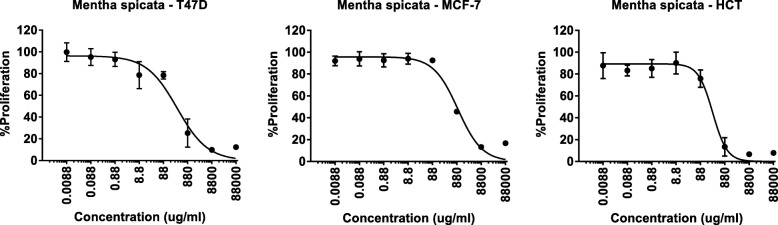
Chemical analysis of the essential oil composition revealed 44 unique compounds with oxygenated monoterpenes (67.2%), followed by monoterpene hydrocarbons (20.8%), as the most abundant chemical components. Essential oil of M. spicata demonstrated moderate antioxidant activities as well as moderate to weak antimicrobial activities with best susceptibility observed for Gram positive bacteria towards the oil. In addition, anticancer activities that are associated with the oil against three human cancer cell lines were observed with LD values of 324 μg/mL, 279 μg/mL, 975 μg/mL against T47D, HCT-116 and MCF-7 cell lines, respectively.
The results suggest that M. spicata essential oil may have potential value as a bioactive oil, for nutraceutical and medical applications, with its antioxidant, antimicrobial and antiproliferative activities.
留兰香(M. spicata)是唇形科的一员,主要分布在世界的温带和亚热带地区。它被认为是精油的丰富来源,广泛应用于制药工业和食品生产。本研究的目的是评估在阿尔及利亚撒哈拉阿特拉斯种植的留兰香精油的化学成分、抗氧化、抗菌和抗增殖活性。
将留兰香的地上部分进行水蒸馏以产生油。通过 GC 和 GC-MS 分析对油的化学成分进行鉴定。通过 DPPH、ABTS 自由基清除和铁还原能力测定研究水蒸馏油的抗氧化活性。采用微量稀释法测定最小抑菌浓度(MIC),评价其对两种革兰氏阳性和革兰氏阴性细菌以及一种念珠菌的抗菌潜力。采用 MTT 法研究油对三种人肿瘤细胞系的增殖抑制作用,并报告产生 50%细胞活力降低的毒性剂量(LD)。
化学分析表明,该精油的化学成分有 44 种独特的化合物,其中含氧单萜(67.2%)、单萜烃(20.8%)为最丰富的化学成分。留兰香精油具有中等抗氧化活性,以及中等至弱的抗菌活性,对革兰氏阳性菌的敏感性最强。此外,还观察到该精油对三种人癌细胞系的抗癌活性,其 LD 值分别为 324μg/mL、279μg/mL 和 975μg/mL,对 T47D、HCT-116 和 MCF-7 细胞系。
结果表明,留兰香精油可能具有作为生物活性油的潜在价值,可用于营养保健品和医学应用,具有抗氧化、抗菌和抗增殖活性。