Akhavan Neda S, Ormsbee Lauren, Johnson Sarah A, George Kelli S, Foley Elizabeth M, Elam Marcus L, Ezzat-Zadeh Zahra, Panton Lynn B, Arjmandi Bahram H
Department of Nutrition, Food and Exercise Sciences, Florida State University, Tallahassee, FL 32306-4310, USA.
Center for Advancing Exercise and Nutrition Research on Aging (CAENRA), College of Human Sciences, Florida State University, Tallahassee, FL 32306-4310, USA.
Healthcare (Basel). 2018 Jul 4;6(3):74. doi: 10.3390/healthcare6030074.
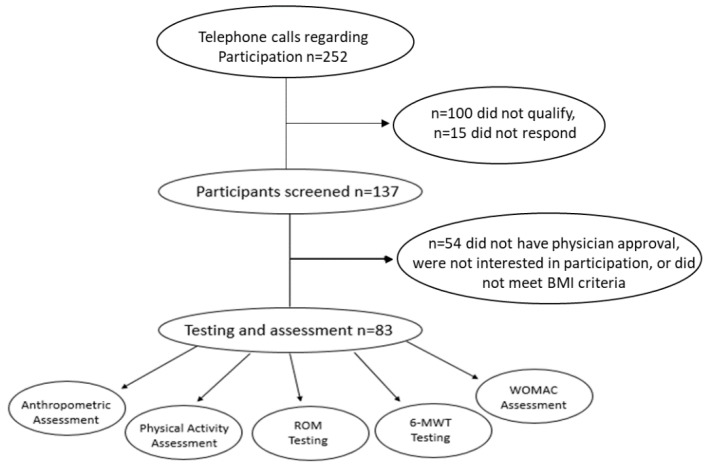
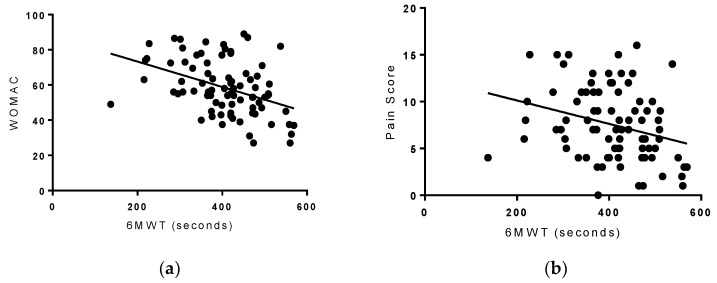
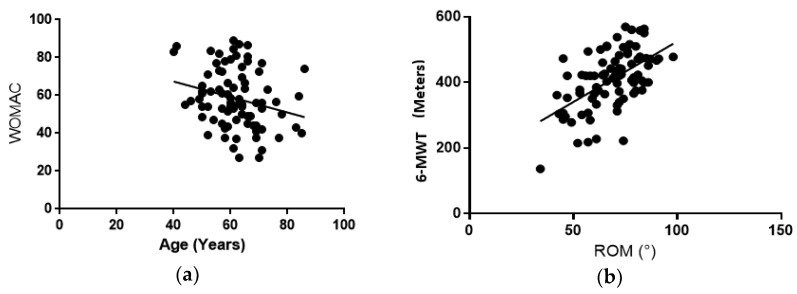
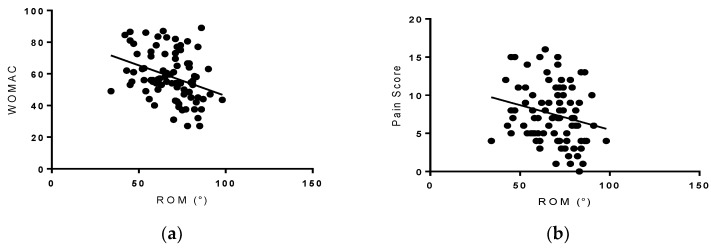
Patients with knee osteoarthritis (OA) suffer from immobility and pain. The objective of this cross-sectional study was to investigate the relationship between pain and functionality in middle-aged and older overweight and obese individuals with mild-to-moderate knee OA. Overall pattern, physical activity, and total energy expenditure (TEE) were assessed in 83 participants. The Western Ontario McMaster Universities Arthritis Index (WOMAC) was used to assess lower extremity pain and function. The six-minute walk test (6-MWT) and range of motion (ROM) were also assessed. Results indicated that age was inversely associated with body mass index (BMI) ( = 0.349) and total WOMAC scores ( = 0.247). BMI was positively associated with TEE ( = 0.430) and WOMAC scores ( = 0.268), while ROM was positively associated with the 6-MWT ( = 0.561) and negatively associated with WOMAC ( = 0.338) and pain scores ( = 0.222). Furthermore, women had significantly greater WOMAC scores ( 0.046) than men. Older participants (≥65 years old) had significantly lower BMI ( 0.002), and distance traveled during the 6-MWT ( 0.013). Our findings indicate that older individuals in this population with knee OA had lower BMI, greater ROM, and less pain and stiffness and walked slower than middle-aged individuals. Women reported greater pain, stiffness, and reduced functionality, indicating that the manifestation of OA may vary due to gender.
膝关节骨关节炎(OA)患者会出现行动不便和疼痛症状。这项横断面研究的目的是调查患有轻至中度膝关节OA的中老年超重和肥胖个体的疼痛与功能之间的关系。对83名参与者的整体模式、身体活动和总能量消耗(TEE)进行了评估。采用西安大略和麦克马斯特大学骨关节炎指数(WOMAC)评估下肢疼痛和功能。还评估了六分钟步行试验(6-MWT)和活动范围(ROM)。结果表明,年龄与体重指数(BMI)呈负相关(=0.349),与WOMAC总分呈负相关(=0.247)。BMI与TEE呈正相关(=0.430),与WOMAC评分呈正相关(=0.268),而ROM与6-MWT呈正相关(=0.561),与WOMAC呈负相关(=0.338),与疼痛评分呈负相关(=0.222)。此外,女性的WOMAC评分显著高于男性(P=0.046)。年龄较大的参与者(≥65岁)的BMI显著较低(P=0.002),6-MWT期间行走的距离也显著较短(P=0.013)。我们的研究结果表明,在患有膝关节OA的这一人群中,老年个体的BMI较低,ROM较大,疼痛和僵硬较少,且行走速度比中年个体慢。女性报告的疼痛、僵硬和功能下降更为严重,这表明OA的表现可能因性别而异。