Department of Occupational and Environmental Health, Nagoya University Graduate School of Medicine, Nagoya, Japan.
Voluntary Body for International Health Care in Universities, Nagoya, Japan.
PLoS One. 2018 Jul 5;13(7):e0198743. doi: 10.1371/journal.pone.0198743. eCollection 2018.
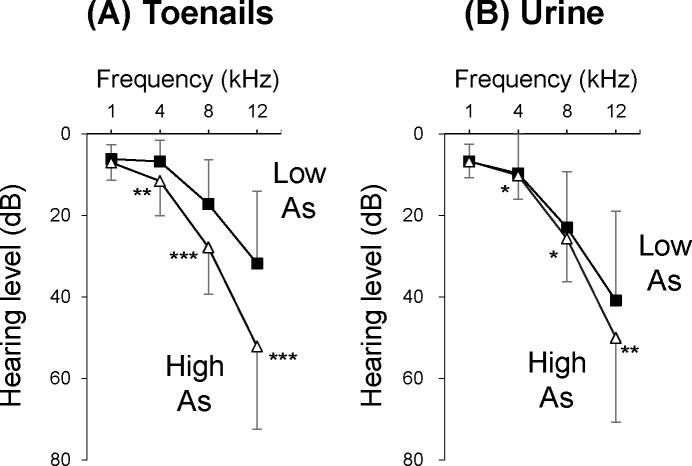
Arsenic (As) pollution in drinking water is a worldwide health risk for humans. We previously showed hearing loss in young people who live in areas of As-polluted drinking water and in young mice orally treated with As. In this study, we epidemiologically examined associations between As levels in toenails and hearing in 145 Bangladeshi aged 12-55 years in 2014. Levels of As in toenails, but not those in urine, were shown to be significantly correlated with hearing loss at 4 kHz [odds ratio (OR) = 4.27; 95% confidence interval (CI): 1.51, 12.05], 8 kHz (OR = 3.91; 95% CI: 1.47, 10.38) and 12 kHz (OR = 4.15; 95% CI: 1.55, 11.09) by multivariate analysis with adjustments for age, sex, smoking and BMI. Our experimental study further showed a significant association between As levels in inner ears and nails (r = 0.8113, p = 0.0014) in mice orally exposed to As, suggesting that As level in nails is a suitable index to assess As level in inner ears. Taken together, the results of our study suggest that As level in nails could be a convenient and non-invasive biomarker for As-mediated hearing loss in humans.
饮用水中的砷(As)污染对人类的健康构成了全球性的威胁。我们之前的研究表明,生活在砷污染饮用水地区的年轻人和经口给予砷处理的年轻小鼠会出现听力损失。在这项研究中,我们在 2014 年对 145 名年龄在 12-55 岁的孟加拉国人的脚趾甲中砷水平与听力之间的关联进行了流行病学调查。结果表明,脚趾甲中的砷水平(而非尿液中的砷水平)与 4 kHz(比值比 [OR] = 4.27;95%置信区间 [CI]:1.51,12.05)、8 kHz(OR = 3.91;95% CI:1.47,10.38)和 12 kHz(OR = 4.15;95% CI:1.55,11.09)的听力损失显著相关,该结果通过多变量分析进行了调整,包括年龄、性别、吸烟和 BMI。我们的实验研究进一步表明,在经口给予砷处理的小鼠中,内耳和指甲中的砷水平之间存在显著关联(r = 0.8113,p = 0.0014),这表明指甲中的砷水平是评估内耳砷水平的一个合适指标。综上所述,我们的研究结果表明,指甲中的砷水平可能是评估人类砷介导的听力损失的一种方便、非侵入性的生物标志物。