Departments of Occupational and Environmental Health, Nagoya University Graduate School of Medicine, 65 Tsurumai-cho, Showa-ku, Nagoya, Aichi, 466-8550, Japan.
Voluntary Body for International Health Care in Universities, 65 Tsurumai-cho, Showa-ku, Nagoya, Aichi, 466-8550, Japan.
Environ Health Prev Med. 2020 May 27;25(1):16. doi: 10.1186/s12199-020-00855-8.
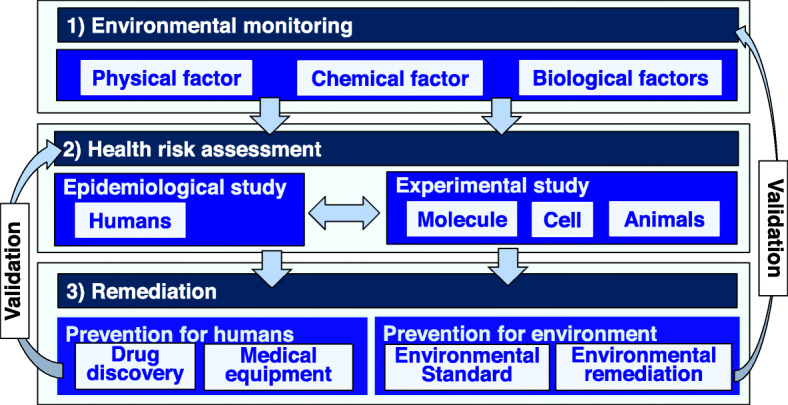
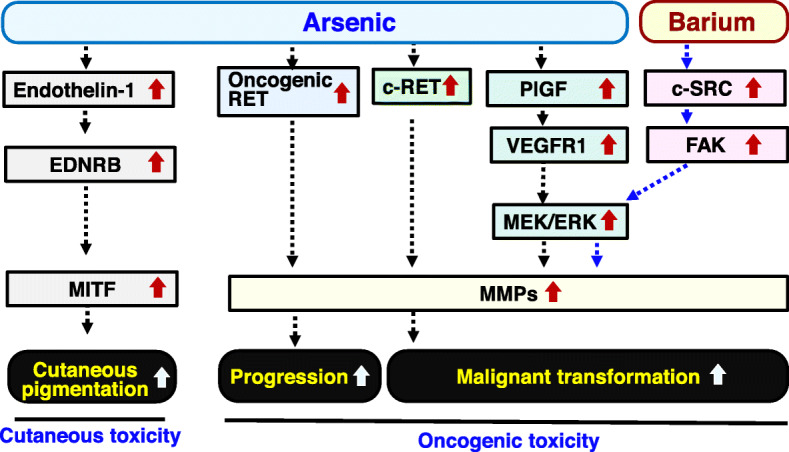
Well water could be a stable source of drinking water. Recently, the use of well water as drinking water has been encouraged in developing countries. However, many kinds of disorders caused by toxic elements in well drinking water have been reported. It is our urgent task to resolve the global issue of element-originating diseases. In this review article, our multidisciplinary approaches focusing on oncogenic toxicities and disturbances of sensory organs (skin and ear) induced by arsenic and barium are introduced. First, our environmental monitoring in developing countries in Asia showed elevated concentrations of arsenic and barium in well drinking water. Then our experimental studies in mice and our epidemiological studies in humans showed arsenic-mediated increased risks of hyperpigmented skin and hearing loss with partial elucidation of their mechanisms. Our experimental studies using cultured cells with focus on the expression and activity levels of intracellular signal transduction molecules such as c-SRC, c-RET, and oncogenic RET showed risks for malignant transformation and/or progression arose from arsenic and barium. Finally, our original hydrotalcite-like compound was proposed as a novel remediation system to effectively remove arsenic and barium from well drinking water. Hopefully, comprehensive studies consisting of (1) environmental monitoring, (2) health risk assessments, and (3) remediation will be expanded in the field of environmental health to prevent various disorders caused by environmental factors including toxic elements in drinking water.
井水可能是一种稳定的饮用水源。最近,发展中国家鼓励将井水用作饮用水。然而,已经报道了许多由井水有毒元素引起的疾病。解决全球元素源性疾病问题是我们的当务之急。在这篇综述文章中,我们介绍了专注于砷和钡诱导的致癌毒性和感觉器官(皮肤和耳朵)紊乱的多学科方法。首先,我们在亚洲发展中国家的环境监测显示,井水的砷和钡浓度升高。然后,我们在小鼠中的实验研究和在人类中的流行病学研究表明,砷介导的皮肤色素沉着过度和听力损失风险增加,并部分阐明了其机制。我们使用培养细胞进行的实验研究侧重于细胞内信号转导分子(如 c-SRC、c-RET 和致癌 RET)的表达和活性水平,结果表明,砷和钡会带来恶性转化和/或进展的风险。最后,我们提出了一种新型水滑石类似化合物作为一种新型修复系统,可有效去除井水中的砷和钡。希望在环境卫生领域扩大包括(1)环境监测、(2)健康风险评估和(3)修复在内的综合研究,以预防包括饮用水中有毒元素在内的各种环境因素引起的疾病。