Leibniz-Institute of Freshwater Ecology and Inland Fisheries (IGB), Berlin, Germany.
Institute of Biology-Freie Universität Berlin, Berlin, Germany.
PLoS One. 2018 Jul 5;13(7):e0199327. doi: 10.1371/journal.pone.0199327. eCollection 2018.
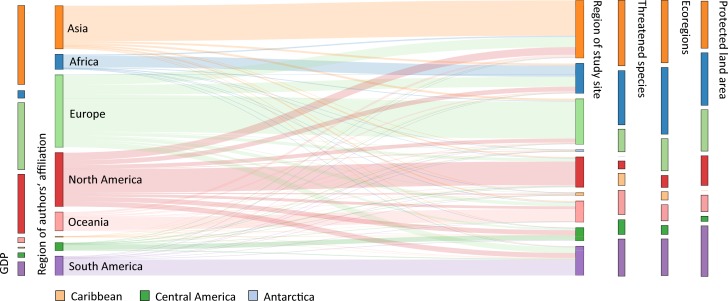
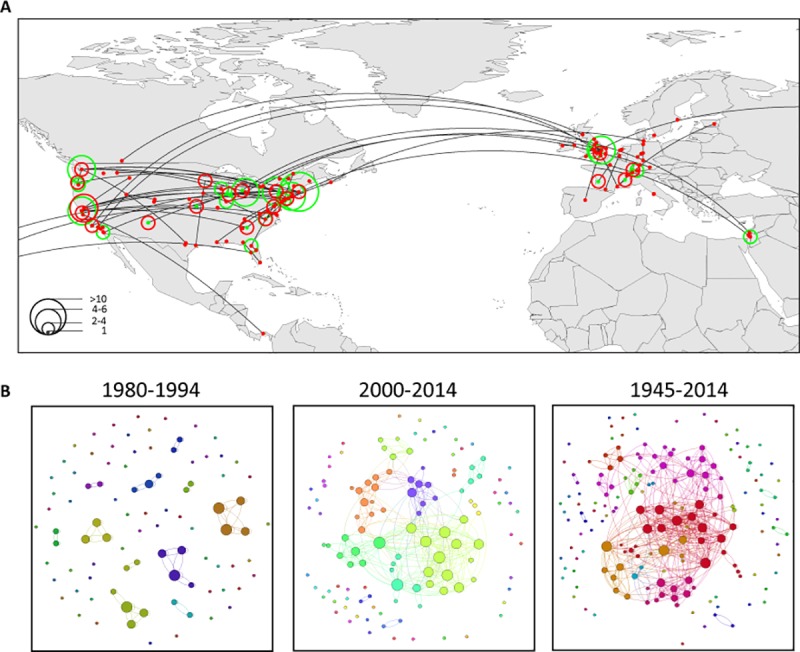
The rapid erosion of biodiversity is among the biggest challenges human society is facing. Concurrently, major efforts are in place to quantify changes in biodiversity, to understand the consequences for ecosystem functioning and human wellbeing, and to develop sustainable management strategies. Based on comprehensive bibliometric analyses covering 134,321 publications, we report systematic spatial biases in biodiversity-related research. Research is dominated by wealthy countries, while major research deficits occur in regions with disproportionately high biodiversity as well as a high share of threatened species. Similarly, core scientists, who were assessed through their publication impact, work primarily in North America and Europe. Though they mainly exchange and collaborate across locations of these two continents, the connectivity among them has increased with time. Finally, biodiversity-related research has primarily focused on terrestrial systems, plants, and the species level, and is frequently conducted in Europe and Asia by researchers affiliated with European and North American institutions. The distinct spatial imbalances in biodiversity research, as demonstrated here, must be filled, research capacity built, particularly in the Global South, and spatially-explicit biodiversity data bases improved, curated and shared.
生物多样性的迅速丧失是人类社会所面临的最大挑战之一。与此同时,人们正在做出重大努力来量化生物多样性的变化,了解其对生态系统功能和人类福祉的影响,并制定可持续的管理战略。本研究基于涵盖 134321 篇文献的综合文献计量分析,报告了与生物多样性相关的研究中存在系统性的空间偏倚。研究主要由富裕国家主导,而在生物多样性高度丰富和受威胁物种比例高的地区,以及在评估核心科学家的科研影响力时,主要科研人员的数量却存在明显不足。同样,通过出版物影响力评估的核心科学家主要分布在北美和欧洲。尽管他们主要在这两个大陆的研究地点之间进行交流与合作,但他们之间的联系随着时间的推移而增加。最后,与生物多样性相关的研究主要集中在陆地系统、植物和物种层面,并且主要由与欧洲和北美机构有关联的研究人员在欧洲和亚洲进行。如本文所示,必须填补生物多样性研究中的明显空间不平衡,建立研究能力,特别是在全球南方,并改进、维护和共享具有空间分辨率的生物多样性数据库。