Department for Health, University of Bath, Bath, UK.
Musculoskeletal Research Unit, Bristol Medical School, University of Bristol, Bristol, UK.
Sci Rep. 2018 Jul 5;8(1):10181. doi: 10.1038/s41598-018-28155-w.
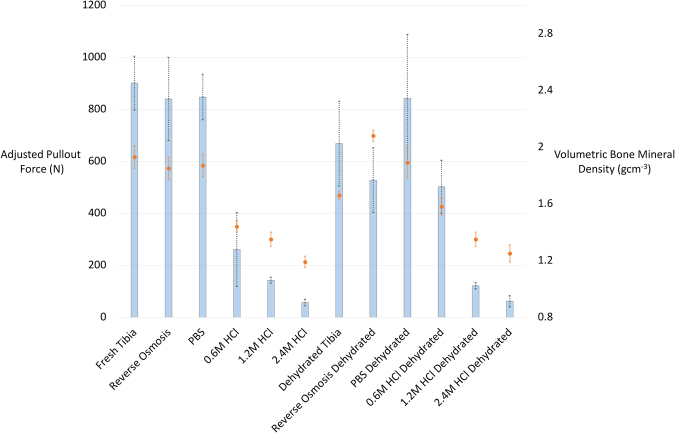
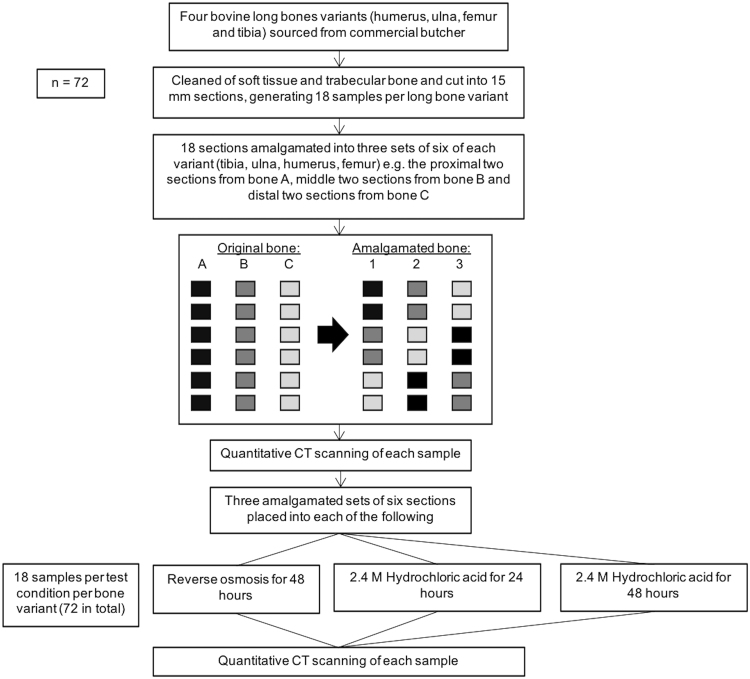
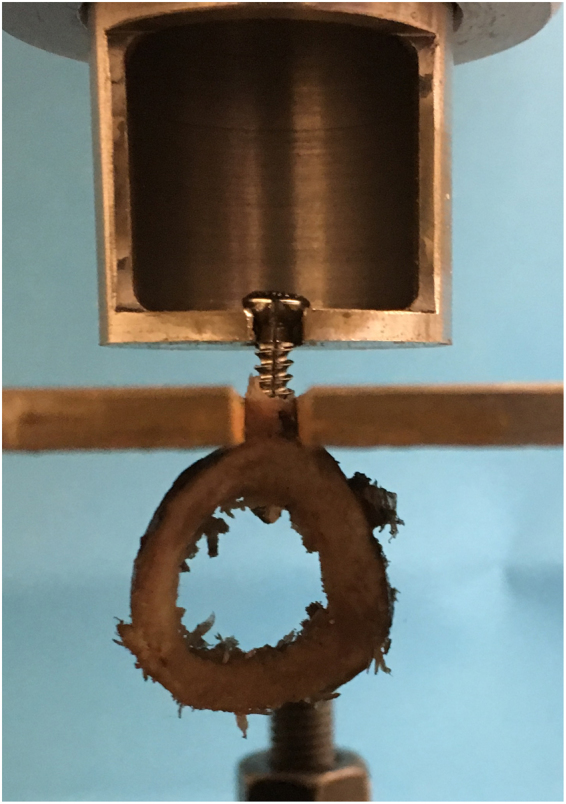
Orthopaedic research necessitates accurate and reliable models of human bone to enable biomechanical discoveries and translation into clinical scenarios. Juvenile bovine bone is postulated to be a potential model of normal human bone given its dimensions and comparatively reduced ethical restrictions. Demineralisation techniques can reduce bone density and alter bone properties, and methods to model osteoporotic bone using demineralised juvenile bovine bone are investigated. Juvenile bovine long bones were quantitatively CT scanned to assess bone density. Demineralisation using hydrochloric acid (0.6, 1.2 and 2.4 M) was performed to create different bone density models which underwent biomechanical validation for normal and osteoporotic bone models. All long bones were found to have comparable features to normal human bone including bone density (1.96 ± 0.08 gcm), screw insertion torque and pullout strength. Demineralisation significantly reduced bone density and pullout strength for all types, with 0.6 M hydrochloric acid creating reductions of 25% and 71% respectively. Juvenile bovine bone is inexpensive, easy to source and not subject to extensive ethical procedures. This study establishes for the first time, the use of its long bones as surrogates for both normal and osteoporotic human specimens and offers preliminary validation for its use in biomechanical testing.
矫形研究需要准确、可靠的人类骨骼模型,以实现生物力学发现并转化为临床应用。鉴于其尺寸和相对较少的伦理限制,幼年牛骨被认为是正常人类骨骼的潜在模型。脱矿技术可以降低骨密度并改变骨特性,本研究旨在探讨使用脱矿幼年牛骨来模拟骨质疏松性骨骼的方法。对幼年牛长骨进行定量 CT 扫描以评估骨密度。使用盐酸(0.6、1.2 和 2.4 M)进行脱矿处理,以创建不同的骨密度模型,并对正常和骨质疏松性骨模型进行生物力学验证。所有长骨均被发现具有与正常人类骨骼相似的特征,包括骨密度(1.96±0.08 gcm)、螺钉插入扭矩和拔出强度。所有类型的脱矿处理均显著降低了骨密度和拔出强度,0.6 M 盐酸分别降低了 25%和 71%。幼年牛骨价格低廉、易于获取且不受广泛的伦理程序限制。本研究首次建立了其长骨作为正常和骨质疏松人类标本替代物的用途,并为其在生物力学测试中的应用提供了初步验证。