Aghanejad Ayuob, Babamiri Hiwa, Adibkia Khosro, Barar Jaleh, Omidi Yadollah
Research Center for Pharmaceutical Nanotechnology, Biomedicine Institute, Tabriz University of Medical Sciences, Tabriz, Iran.
Department of Pharmaceutics, Faculty of Pharmacy, Tabriz University of Medical Sciences, Tabriz, Iran.
Bioimpacts. 2018;8(2):117-127. doi: 10.15171/bi.2018.14. Epub 2018 May 5.
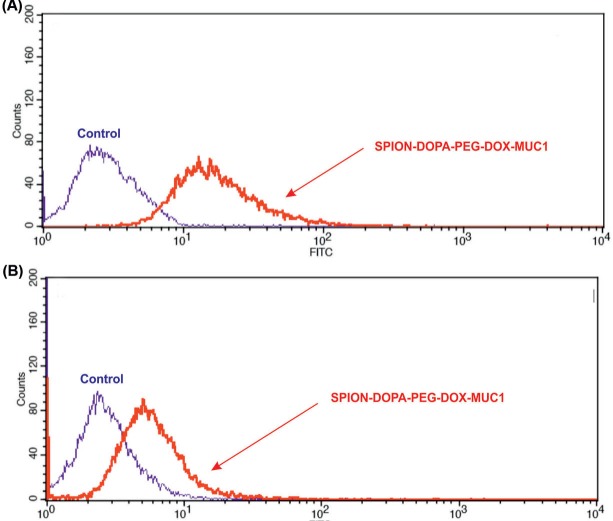
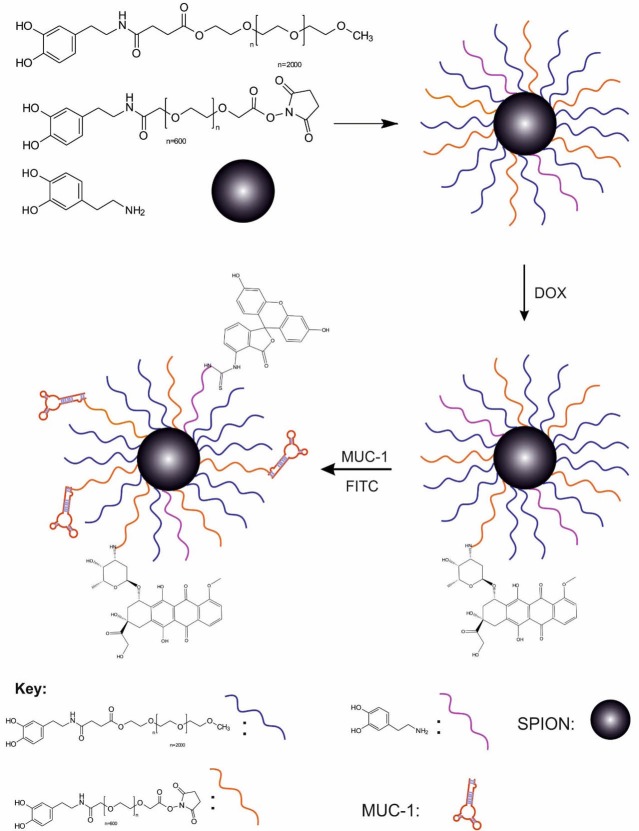
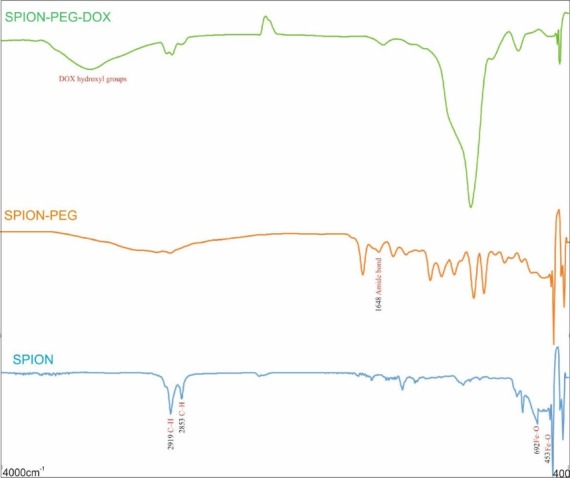
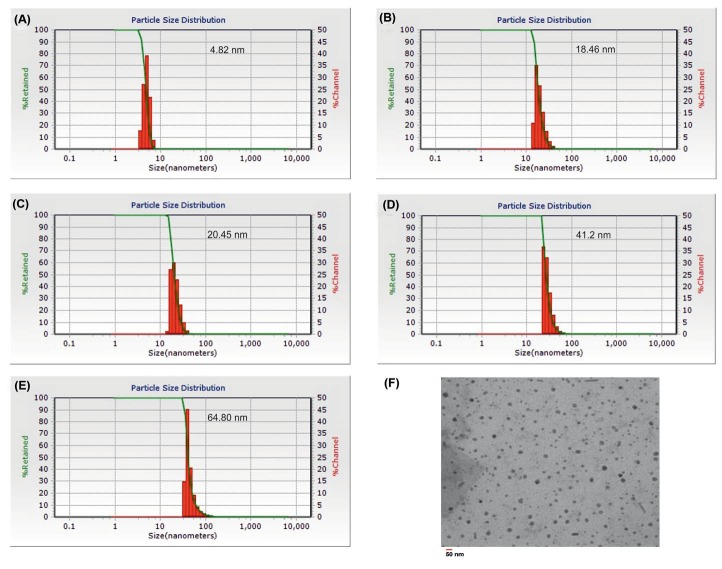
Superparamagnetic iron oxide nanoparticles (SPIONs) can be functionalized with various agents (e.g., targeting and therapeutic agents) and used for targeted imaging/therapy of cancer. In the present study, we engineered doxorubicin (DOX)-conjugated anti-mucin -1 (MUC-1) aptamer (Ap)-armed PEGylated SPIONs for targeted delivery of DOX molecules to the breast cancer MCF-7 cells. The SPIONs were synthesized using the thermal decomposition method and modified by polyethylene glycol (PEG) to maximize their biocompatibility and minimize any undesired cytotoxicity effects. Subsequently, DOX molecules were loaded onto the SPIONs, which were further armed with amine-modified MUC-1 aptamer by EDC/NHS chemistry. The morphologic and size analyses of nanoparticles (NPs) by transmission electron microscopy (TEM) and dynamic light scattering (DLS) revealed spherical and monodisperse MNPs with a size range of 5-64 nm. The FT-IR spectrophotometry and HNMR analysis confirmed the surface modification of NPs. The cytotoxicity assay of the aptamer-armed MNPs exhibited a higher death rate in the MUC-1 over-expressing MCF-7 cells as compared to the MUC-1 under-expressing MDA-MB-231 cells. The flow cytometry analysis of the engineered Ap-armed SPIONs revealed a higher uptake as compared to the SPIONs alone. Based on our findings, the anti-MUC-1 Ap-armed PEGylated SPIONs loaded with DOX molecules could serve as an effective multifunctional theranostics for simultaneous detection and eradication of MUC-1-positive breast cancer cells.
超顺磁性氧化铁纳米颗粒(SPIONs)可以用各种试剂(如靶向和治疗剂)进行功能化修饰,并用于癌症的靶向成像/治疗。在本研究中,我们设计了一种载有阿霉素(DOX)的抗粘蛋白-1(MUC-1)适配体(Ap)修饰的聚乙二醇化SPIONs,用于将DOX分子靶向递送至乳腺癌MCF-7细胞。采用热分解法合成SPIONs,并通过聚乙二醇(PEG)进行修饰,以最大限度地提高其生物相容性,并将任何不良细胞毒性作用降至最低。随后,将DOX分子负载到SPIONs上,并通过EDC/NHS化学方法进一步用胺修饰的MUC-1适配体进行武装。通过透射电子显微镜(TEM)和动态光散射(DLS)对纳米颗粒(NPs)进行形态和尺寸分析,结果显示为球形且单分散的MNPs,尺寸范围为5-64nm。傅里叶变换红外光谱法(FT-IR)和核磁共振氢谱(HNMR)分析证实了NPs的表面修饰。与MUC-1表达不足的MDA-MB-231细胞相比,载有适配体的MNPs的细胞毒性试验在MUC-1过表达的MCF-7细胞中表现出更高的死亡率。对设计的载有Ap的SPIONs进行流式细胞术分析,结果显示其摄取量比单独的SPIONs更高。基于我们的研究结果,载有DOX分子的抗MUC-1 Ap修饰的聚乙二醇化SPIONs可作为一种有效的多功能诊疗试剂,用于同时检测和根除MUC-1阳性乳腺癌细胞。