Addo Bright, Sencherey Sally, Babayara Michael N K
University of Ghana School of Public Health, Legon, Accra, Ghana.
Komfo Anokye Teaching Hospital (KATH), Kumasi, Ghana.
Int J Chronic Dis. 2018 Jun 7;2018:7187284. doi: 10.1155/2018/7187284. eCollection 2018.
Despite the growing interest in understanding the aetiology of chronic diseases, limited studies exist on medication noncompliance, especially, among periurban and rural dwellers in Ghana. In this study, we determined the prevalence of medication noncompliance and explored the medication intake behaviour of patients with chronic diseases. The relative influence of cost on medication noncompliance and the risk factors for noncompliance were also assessed.
The design was a cross-sectional study of 200 patients from ages below 40 years to ages above 60 years sampled from the Offinso South Municipality, a periurban district of the Ashanti region of Ghana. Data collected through the administration of structured questionnaires was coded, cleaned, and analysed using the SPSS (v20) software programme. Descriptive and multivariate analyses using binary logistic regression were performed.
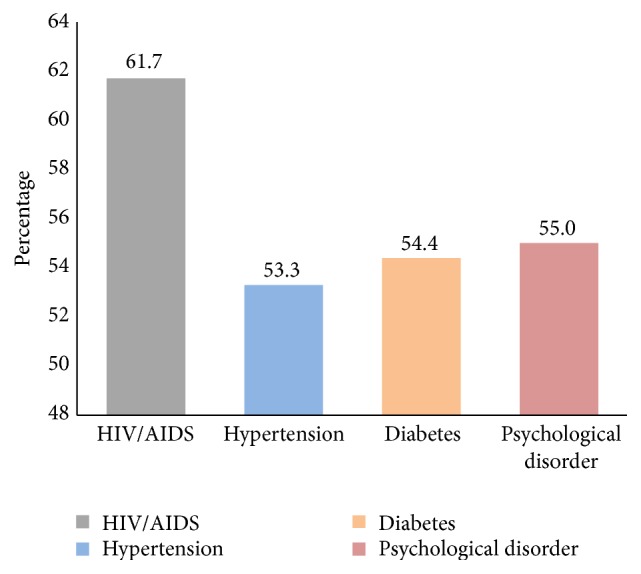
Medication noncompliance was high (55.5%), with patients living with HIV/AIDS and those with psychological disorders being the most noncompliant. Majority of patients took at least 2 medications (81.5%), did so twice daily (79.0%), did not experience side effects with intake (67.0%), considered their medication to be effective (88.5%), and were aware of the complications that could arise from noncompliance. The dominant route of medication intake was oral (86.8%) and a lesser proportion of patients (22.5%) took herbal preparation alongside their prescribed medications. The cost of medication did not prevent patients from adhering to their medication regimen as most of these drugs were covered by the National Health Insurance Scheme (NHIS). Age, duration of diagnosis and difficulty in remembering medication instructions were identified as significant predictors of noncompliance.
Educating patients on the need to be compliant with their medication regimen, the complications that could arise from noncompliance and avoidance of intake of herbal medications during their treatment should form part of the clinical sessions organized for patients with chronic conditions.
尽管人们对了解慢性病病因的兴趣日益浓厚,但关于用药不依从性的研究有限,尤其是在加纳的城乡结合部和农村居民中。在本研究中,我们确定了用药不依从性的患病率,并探讨了慢性病患者的用药行为。还评估了费用对用药不依从性的相对影响以及不依从性的风险因素。
本研究为横断面研究,从加纳阿散蒂地区城乡结合部的奥芬索南市政区抽取了200名年龄在40岁以下至60岁以上的患者。通过结构化问卷收集的数据进行编码、清理,并使用SPSS(v20)软件程序进行分析。进行了描述性分析和使用二元逻辑回归的多变量分析。
用药不依从性很高(55.5%),艾滋病毒/艾滋病患者和患有心理障碍的患者最不依从。大多数患者至少服用2种药物(81.5%),每天服用两次(79.0%),服药时未出现副作用(67.0%),认为他们的药物有效(88.5%),并意识到不依从可能产生的并发症。用药的主要途径是口服(86.8%),较少比例的患者(22.5%)在服用处方药的同时服用草药制剂。药物费用并没有阻止患者坚持用药方案,因为这些药物大多由国家健康保险计划(NHIS)覆盖。年龄、诊断时间和记忆用药说明困难被确定为不依从性的重要预测因素。
对患者进行关于遵守用药方案的必要性、不依从可能产生的并发症以及在治疗期间避免服用草药的教育,应成为为慢性病患者组织的临床诊疗的一部分。