Schroer Martin A, Blanchet Clement E, Gruzinov Andrey Yu, Gräwert Melissa A, Brennich Martha E, Hajizadeh Nelly R, Jeffries Cy M, Svergun Dmitri I
European Molecular Biology Laboratory (EMBL), Hamburg Outstation c/o DESY, Notkestrasse 85, 22607 Hamburg, Germany.
European Molecular Biology Laboratory (EMBL), Grenoble Outstation, 71 Avenue des Martyrs, 38042 Grenoble, France.
J Synchrotron Radiat. 2018 Jul 1;25(Pt 4):1113-1122. doi: 10.1107/S1600577518007907. Epub 2018 Jun 26.
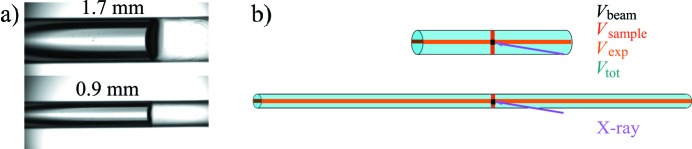
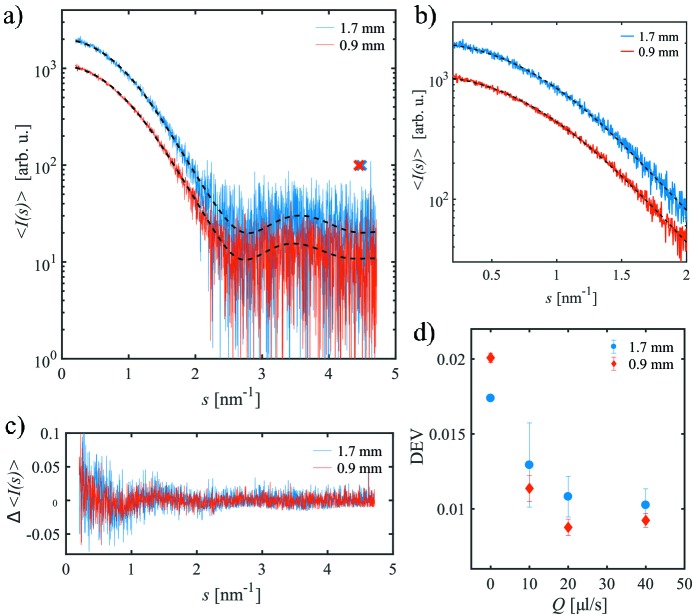
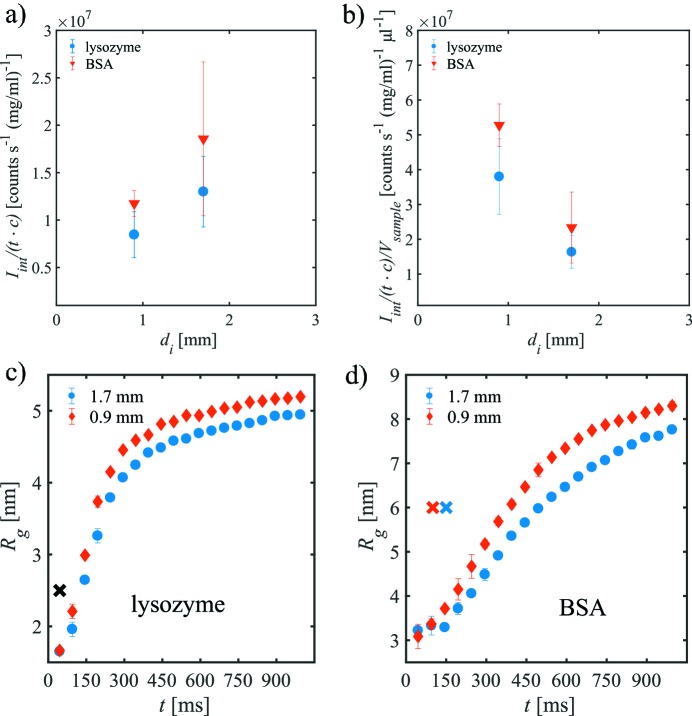
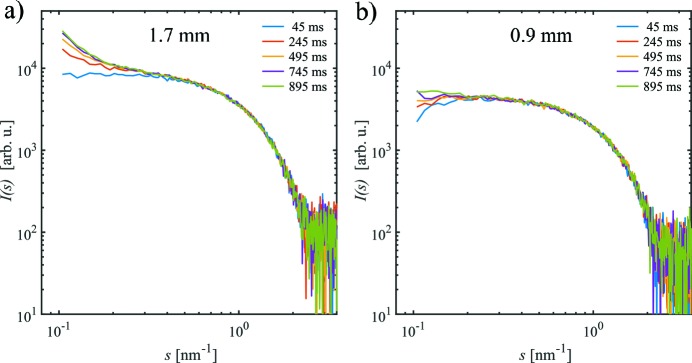
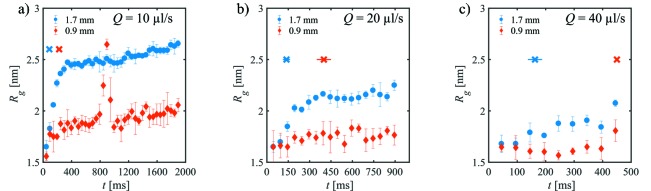
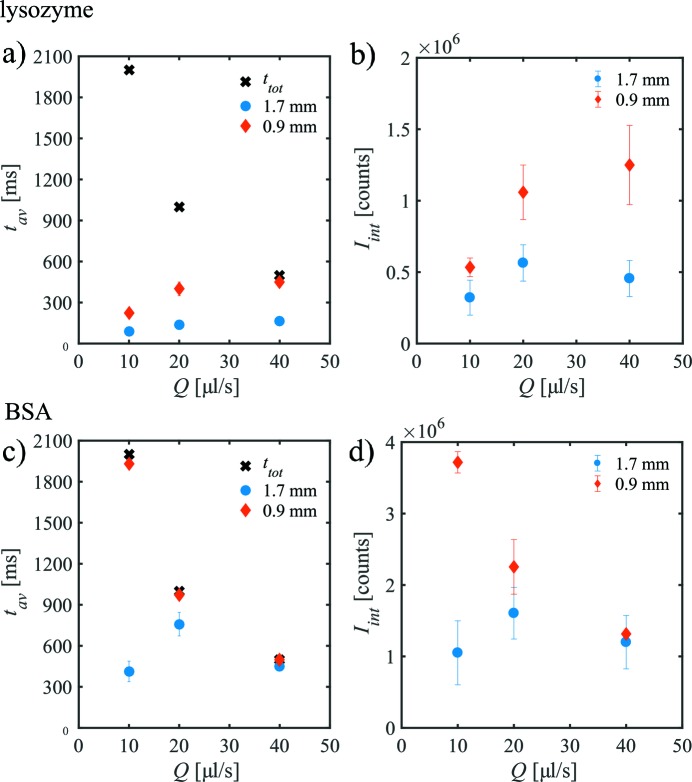
Radiation damage by intense X-ray beams at modern synchrotron facilities is one of the major complications for biological small-angle X-ray scattering (SAXS) investigations of macromolecules in solution. To limit the damage, samples are typically measured under a laminar flow through a cell (typically a capillary) such that fresh solution is continuously exposed to the beam during measurement. The diameter of the capillary that optimizes the scattering-to-absorption ratio at a given X-ray wavelength can be calculated a priori based on fundamental physical properties. However, these well established scattering and absorption principles do not take into account the radiation susceptibility of the sample or the often very limited amounts of precious biological material available for an experiment. Here it is shown that, for biological solution SAXS, capillaries with smaller diameters than those calculated from simple scattering/absorption criteria allow for a better utilization of the available volumes of radiation-sensitive samples. This is demonstrated by comparing two capillary diameters d (d = 1.7 mm, close to optimal for 10 keV; and d = 0.9 mm, which is nominally sub-optimal) applied to study different protein solutions at various flow rates. The use of the smaller capillaries ultimately allows one to collect higher-quality SAXS data from the limited amounts of purified biological macromolecules.
在现代同步加速器设施中,强X射线束造成的辐射损伤是溶液中生物大分子的生物小角X射线散射(SAXS)研究的主要并发症之一。为了限制损伤,样品通常在层流条件下通过样品池(通常是毛细管)进行测量,以便在测量过程中新鲜溶液持续暴露于X射线下。在给定X射线波长下优化散射与吸收比的毛细管直径可以根据基本物理性质预先计算出来。然而,这些已确立的散射和吸收原理没有考虑样品的辐射敏感性或实验中通常非常有限的珍贵生物材料量。本文表明,对于生物溶液SAXS,直径小于根据简单散射/吸收标准计算出的直径的毛细管能够更好地利用辐射敏感样品的可用体积。通过比较两种毛细管直径d(d = 1.7 mm,接近10 keV时的最佳值;d = 0.9 mm,名义上是次优的)在不同流速下用于研究不同蛋白质溶液的情况,证明了这一点。使用较小的毛细管最终能够从有限量的纯化生物大分子中收集到更高质量的SAXS数据。