Zhou Jihan, Taylor Matthew, Melinte Georgian A, Shahani Ashwin J, Dharmawardhana Chamila C, Heinz Hendrik, Voorhees Peter W, Perepezko John H, Bustillo Karen, Ercius Peter, Miao Jianwei
Department of Physics and Astronomy and California NanoSystems Institute, University of California, Los Angeles, CA, 90095, USA.
Department of Materials Science and Engineering, University of Wisconsin-Madison, Madison, WI, 53706, USA.
Sci Rep. 2018 Jul 6;8(1):10239. doi: 10.1038/s41598-018-28348-3.
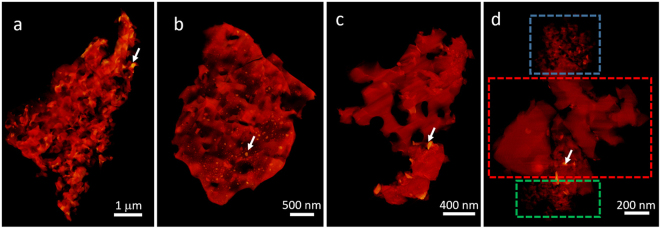
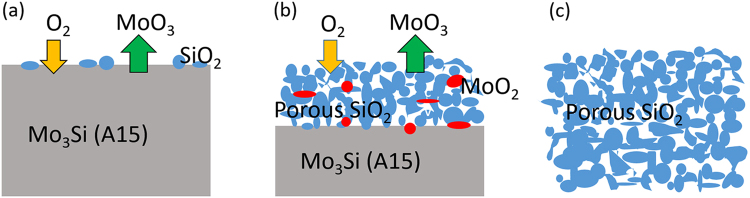
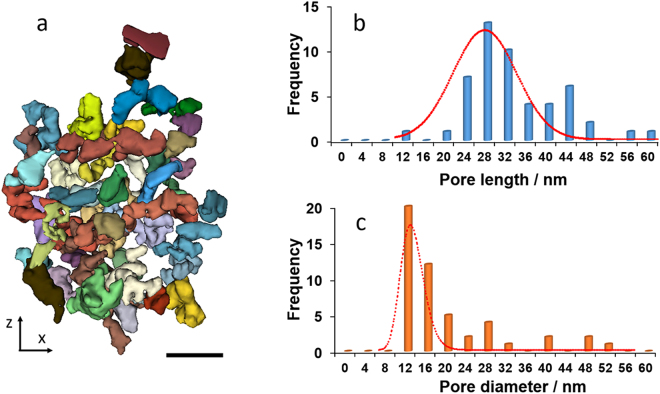
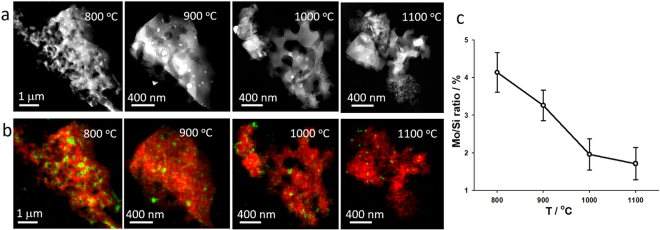
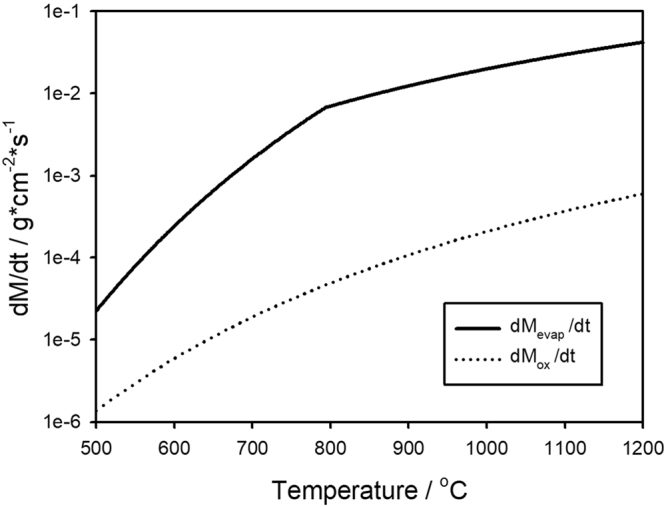
We report quantitative characterization of the high temperature oxidation process by using electron tomography and energy-dispersive X-ray spectroscopy. As a proof of principle, we performed 3D imaging of the oxidation layer of a model system (MoSi) at nanoscale resolution with elemental specificity and probed the oxidation kinetics as a function of the oxidation time and the elevated temperature. Our tomographic reconstructions provide detailed 3D structural information of the surface oxidation layer of the MoSi system, revealing the evolution of oxidation behavior of MoSi from early stage to mature stage. Based on the relative rate of oxidation of MoSi, the volatilization rate of MoO and reactive molecular dynamics simulations, we propose a model to explain the mechanism of the formation of the porous silica structure during the oxidation process of MoSi. We expect that this 3D quantitative characterization method can be applied to other material systems to probe their structure-property relationships in different environments.
我们通过电子断层扫描和能量色散X射线光谱法报告了高温氧化过程的定量表征。作为原理验证,我们以纳米级分辨率对模型系统(MoSi)的氧化层进行了具有元素特异性的三维成像,并探究了氧化动力学与氧化时间和升高温度的函数关系。我们的断层扫描重建提供了MoSi系统表面氧化层的详细三维结构信息,揭示了MoSi从早期到成熟阶段氧化行为的演变。基于MoSi的相对氧化速率、MoO的挥发速率和反应性分子动力学模拟,我们提出了一个模型来解释MoSi氧化过程中多孔二氧化硅结构的形成机制。我们期望这种三维定量表征方法能够应用于其他材料系统,以探究它们在不同环境中的结构-性能关系。