Khalid Muhammad Ali, Iqbal Jawaid, Memon Hassan Liaquat, Hanif Farina M, Butt Muhammad Osama Tariq, Luck Nasir Hassan, Majid Zain
Department of Hepatogastroenterology, Sindh Institute of Urology and Transplantation, Karachi, Pakistan.
J Transl Int Med. 2018 Jun 26;6(2):78-81. doi: 10.2478/jtim-2018-0013. eCollection 2018 Jun.
Gastrointestinal symptoms are common in patients with end stage renal disease (ESRD) among which dyspepsia is frequently observed. The aim of the study was to determine the frequency and associations of dyspepsia in ESRD patients using the Leeds questionnaire.
All ESRD patients on maintenance hemodialysis were consecutively enrolled in the study. Leeds questionnaire was used to interrogate the patients for the assessment of dyspepsia. Mean and standard deviation were calculated for age, body mass index (BMI), disease duration and number of hemodialysis sessions. Independent t-test and Chi square tests were used for statistical analysis.
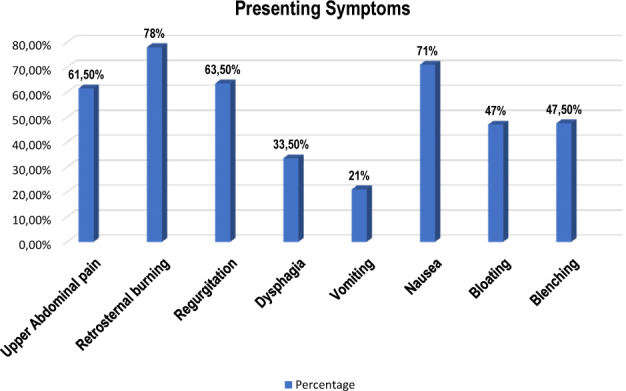
Total number of patients was 200, out which 118 (59.3%) were male. The mean age was of 41.4 years. According to the Leeds questionnaire, dyspepsia was present in 62 (63.9%) patients. Younger patients (age 20-40 years) more frequently had dyspeptic symptoms (61.5% patients), retrosternal pain (156 patients, 78.0%), regurgitation (127 patients, 63.5%), dysphagia (67 patients, 33.5%), and nausea (142 patients, 71.0%). Patients presented with intermittent pattern of symptoms in 179 (89.5%) cases, while continuous symptoms in 6 (3.0%). Dyspepsia was associated with aspartate aminotransferase (AST) levels > 25 U/L ( = 0.001), alanine aminotransferase (ALT) levels > 28U/L ( = 0.000) and gamma glutamyl transferase (GGT) levels > 34 U/L ( = 0.002). On multivariate analysis, urea, creatinine, and presenting symptoms of dysphagia and belching showed significant statistical association with dyspepsia.
Dyspepsia is a common problem affecting patients with end stage renal disease and is associated with raised serum AST, ALT and GGT in such patients.
胃肠道症状在终末期肾病(ESRD)患者中很常见,其中消化不良较为频繁。本研究的目的是使用利兹问卷确定ESRD患者中消化不良的发生率及其相关因素。
所有接受维持性血液透析的ESRD患者连续纳入本研究。使用利兹问卷询问患者以评估消化不良情况。计算年龄、体重指数(BMI)、病程和血液透析次数的均值及标准差。采用独立t检验和卡方检验进行统计分析。
患者总数为200例,其中118例(59.3%)为男性。平均年龄为41.4岁。根据利兹问卷,62例(63.9%)患者存在消化不良。较年轻患者(20 - 40岁)更常出现消化不良症状(61.5%的患者)、胸骨后疼痛(156例患者,78.0%)、反流(127例患者,63.5%)、吞咽困难(67例患者,33.5%)和恶心(142例患者,71.0%)。179例(89.5%)患者症状呈间歇性,6例(3.0%)为持续性。消化不良与天冬氨酸转氨酶(AST)水平>25 U/L(P = 0.001)、丙氨酸转氨酶(ALT)水平>28 U/L(P = 0.000)和γ-谷氨酰转移酶(GGT)水平>34 U/L(P = 0.002)相关。多因素分析显示,尿素、肌酐以及吞咽困难和嗳气的症状与消化不良有显著统计学关联。
消化不良是影响终末期肾病患者的常见问题,且与这类患者血清AST、ALT和GGT升高有关。