Division of Experimental Cardiology, Department of Cardiology, Thoraxcenter, Erasmus MC, University Medical Center Rotterdam, 3015GD Rotterdam, The Netherlands.
Department of Cardiology, Cardiovascular Research Institute Maastricht, Maastricht University Medical Centre, 6229ER Maastricht, The Netherlands.
Int J Mol Sci. 2018 Jul 6;19(7):1968. doi: 10.3390/ijms19071968.
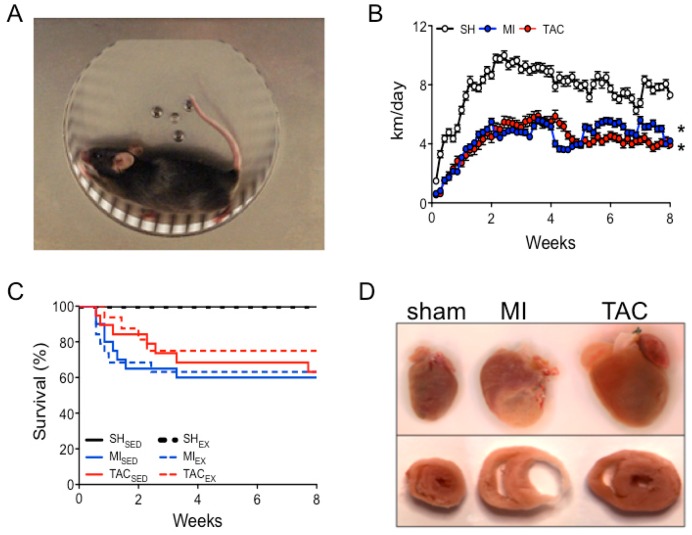
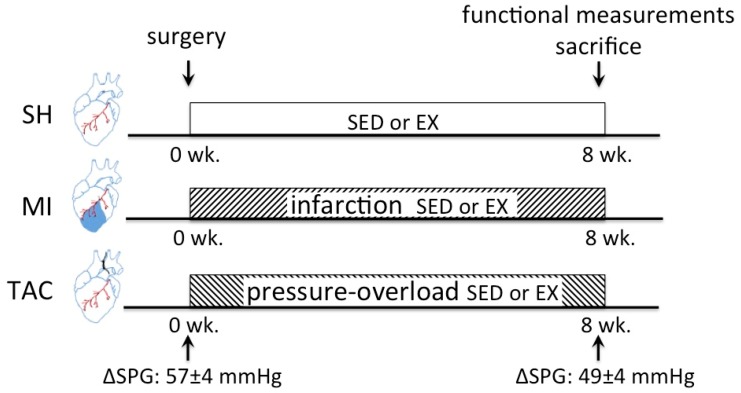
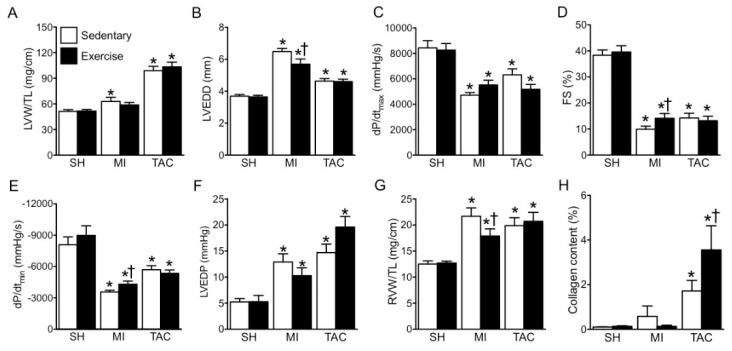
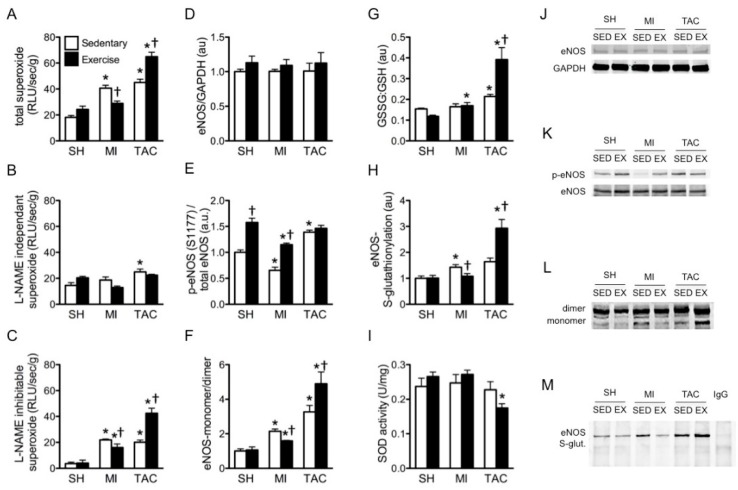
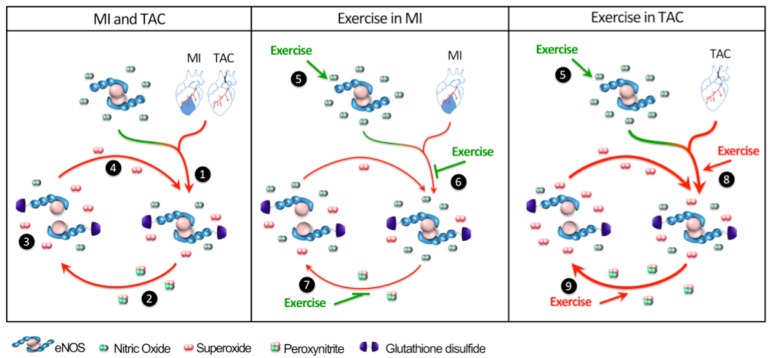
The beneficial effects of exercise training (EX) on cardiac pathology are well recognized. Previously, we found that the effects of EX on cardiac dysfunction in mice critically depend on the underlying etiology. EX exerted beneficial effects after myocardial infarction (MI); however, cardiac pathology following pressure overload produced by transverse aortic constriction (TAC) was aggravated by EX. In the presented study, we investigated whether the contrasting effects of EX on cardiac dysfunction can be explained by an etiology-specific response of endothelial nitric oxide (NO) synthase (eNOS) to EX, which divergently affects the balance between nitric oxide and superoxide. For this purpose, mice were exposed to eight weeks of voluntary wheel running or sedentary housing (SED), immediately after sham, MI, or TAC surgery. Left ventricular (LV) function was assessed using echocardiography and hemodynamic measurements. EX ameliorated LV dysfunction and remodeling after MI, but not following TAC, in which EX even aggravated fibrosis. Strikingly, EX attenuated superoxide levels after MI, but exacerbated NOS-dependent superoxide levels following TAC. Similarly, elevated eNOS S-glutathionylation and eNOS monomerization, which were observed in both MI and TAC, were corrected by EX in MI, but aggravated by EX after TAC. Additionally, EX reduced antioxidant activity in TAC, while it was maintained following EX in MI. In conclusion, the present study shows that EX mitigates cardiac dysfunction after MI, likely by attenuating eNOS uncoupling-mediated oxidative stress, whereas EX tends to aggravate cardiac dysfunction following TAC, likely due to exacerbating eNOS-mediated oxidative stress.
运动训练(EX)对心脏病理学的有益影响是众所周知的。以前,我们发现 EX 对小鼠心脏功能障碍的影响取决于潜在的病因。EX 在心肌梗死(MI)后具有有益作用;然而,通过横主动脉缩窄(TAC)产生的压力超负荷引起的心脏病理学,被 EX 加重了。在本研究中,我们研究了 EX 对心脏功能障碍的相反影响是否可以通过 EX 对内皮型一氧化氮合酶(eNOS)的病因特异性反应来解释,该反应会影响一氧化氮和超氧化物之间的平衡。为此,在 sham、MI 或 TAC 手术后,立即将小鼠暴露于八周的自愿轮跑或久坐(SED)中。使用超声心动图和血液动力学测量评估左心室(LV)功能。EX 改善了 MI 后的 LV 功能障碍和重构,但不能改善 TAC 后的 LV 功能障碍和重构,在 TAC 中,EX 甚至加重了纤维化。引人注目的是,EX 在 MI 后减轻了超氧化物水平,但在 TAC 后加剧了依赖 NOS 的超氧化物水平。同样,在 MI 和 TAC 中观察到的 eNOS S-谷胱甘肽化和 eNOS 单体化增加,在 MI 中被 EX 纠正,但在 TAC 后被 EX 加重。此外,EX 在 TAC 中降低了抗氧化活性,而在 MI 后则保持了 EX。总之,本研究表明,EX 通过减轻 eNOS 解偶联介导的氧化应激,减轻了 MI 后的心脏功能障碍,而 EX 可能通过加剧 eNOS 介导的氧化应激,加重了 TAC 后的心脏功能障碍。