Ito Daisuke, Bettencourt-Dias Mónica
Instituto Gulbenkian de Ciência, Rua da Quinta Grande 6, 2780-156 Oeiras, Portugal.
Cells. 2018 Jul 6;7(7):71. doi: 10.3390/cells7070071.
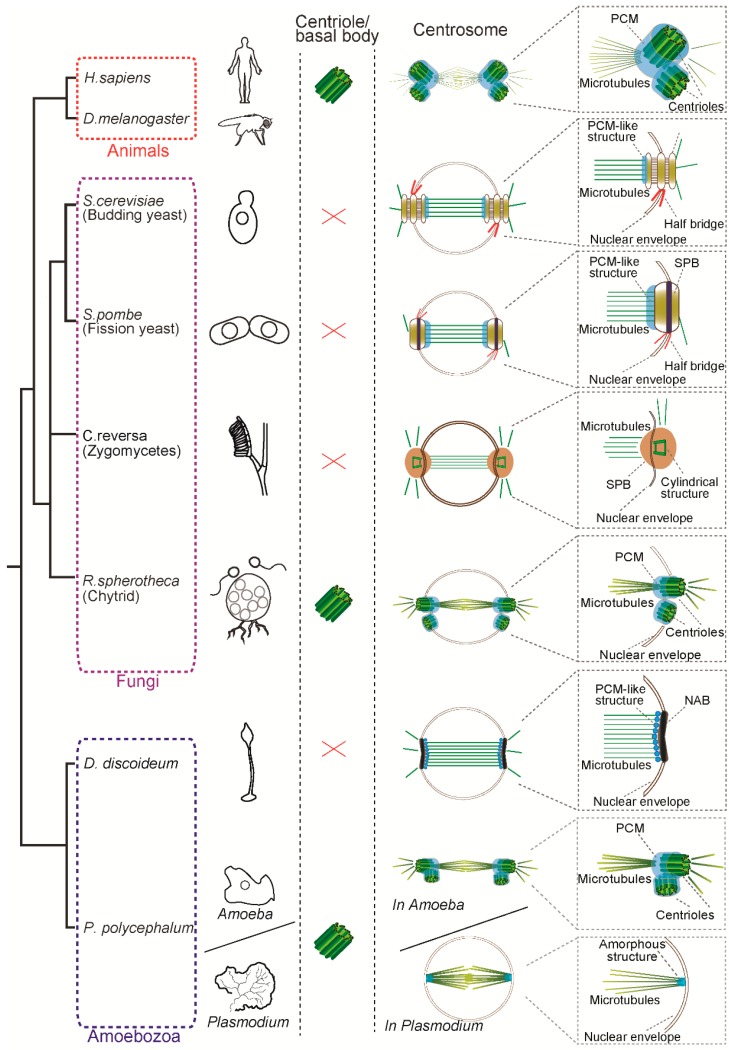
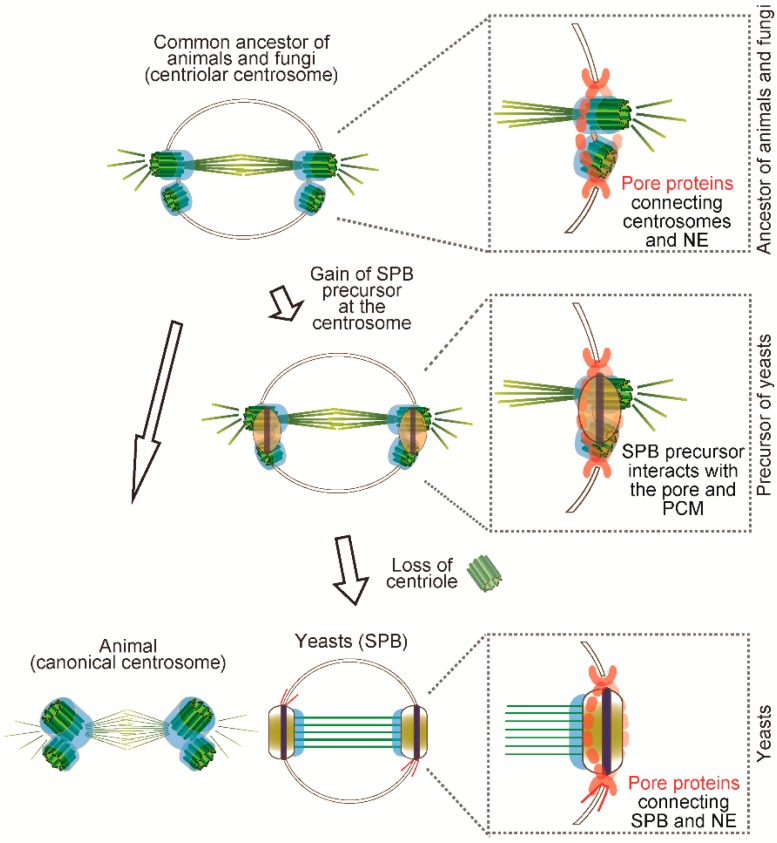
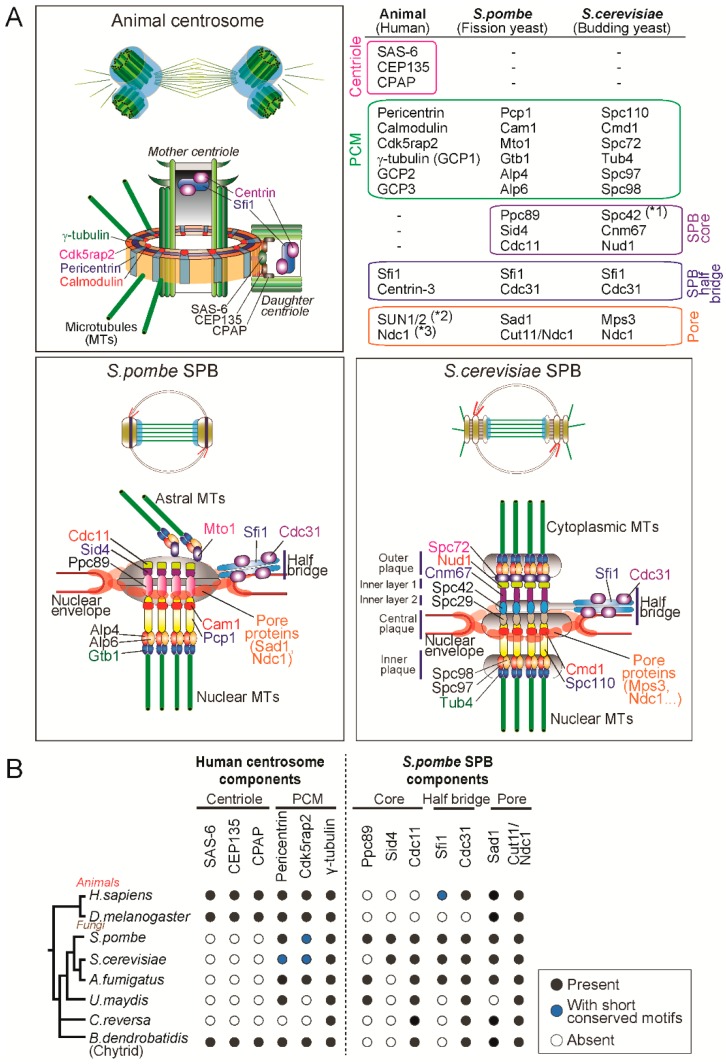
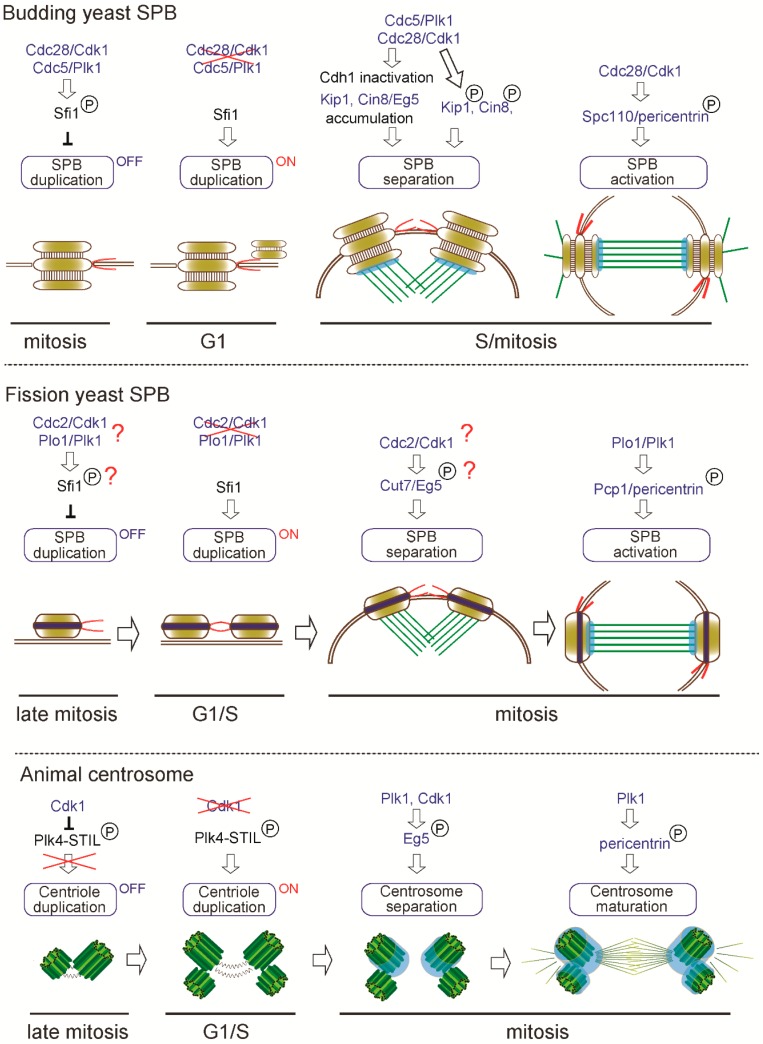
The centrosome is the major microtubule organizing centre (MTOC) in animal cells. The canonical centrosome is composed of two centrioles surrounded by a pericentriolar matrix (PCM). In contrast, yeasts and amoebozoa have lost centrioles and possess acentriolar centrosomes—called the spindle pole body (SPB) and the nucleus-associated body (NAB), respectively. Despite the difference in their structures, centriolar centrosomes and SPBs not only share components but also common biogenesis regulators. In this review, we focus on the SPB and speculate how its structures evolved from the ancestral centrosome. Phylogenetic distribution of molecular components suggests that yeasts gained specific SPB components upon loss of centrioles but maintained PCM components associated with the structure. It is possible that the PCM structure remained even after centrosome remodelling due to its indispensable function to nucleate microtubules. We propose that the yeast SPB has been formed by a step-wise process; (1) an SPB-like precursor structure appeared on the ancestral centriolar centrosome; (2) it interacted with the PCM and the nuclear envelope; and (3) it replaced the roles of centrioles. Acentriolar centrosomes should continue to be a great model to understand how centrosomes evolved and how centrosome biogenesis is regulated.
中心体是动物细胞中主要的微管组织中心(MTOC)。典型的中心体由两个中心粒和周围的中心粒外周基质(PCM)组成。相比之下,酵母和变形虫已经失去了中心粒,分别拥有无中心粒的中心体——称为纺锤极体(SPB)和核相关体(NAB)。尽管它们的结构有所不同,但有中心粒的中心体和纺锤极体不仅共享组件,还共享常见的生物发生调节因子。在这篇综述中,我们聚焦于纺锤极体,并推测其结构是如何从祖先中心体进化而来的。分子成分的系统发育分布表明,酵母在失去中心粒后获得了特定的纺锤极体成分,但保留了与该结构相关的中心粒外周基质成分。由于其对微管成核的不可或缺的功能,即使在中心体重塑后,中心粒外周基质结构可能仍然保留。我们提出酵母纺锤极体是通过一个逐步的过程形成的:(1)一个类似纺锤极体的前体结构出现在祖先有中心粒的中心体上;(2)它与中心粒外周基质和核膜相互作用;(3)它取代了中心粒的作用。无中心粒的中心体应该继续是理解中心体如何进化以及中心体生物发生如何被调控的一个很好的模型。