de Oliveira Natália Gomes, de Souza Araújo Pollyana Rodrigues, da Silveira Marina Torreão, Sobral Ana Paula Veras, Carvalho Marianne de Vasconcelos
Department of Dentistry and Endodontics, Faculty of Dentistry, University of Pernambuco, Camaragibe, PE, Brazil.
Department of Patology, Faculty of Dentistry, University of Pernambuco, Camaragibe, PE, Brazil.
Eur J Dent. 2018 Apr-Jun;12(2):317-326. doi: 10.4103/ejd.ejd_347_17.
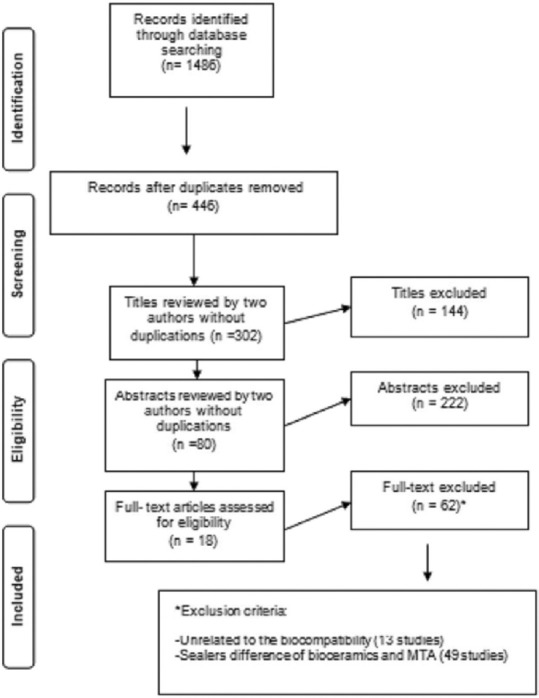
The objective of this systematic review was to evaluate the biocompatibility and interaction of bioceramic materials with animal and human mesenchymal cells and and to compare them with mineral trioxide aggregate (MTA). Two independent researchers conducted PubMed/Medline, Web of Science, and Scopus searches to identify studies published in English, without restrictions on year of publication using the following keywords: "root canal sealer," "root repair material," "cytotoxicity," and "bioceramics." The articles were selected following the PRISMA statement. A total of 1486 titles were identified in the initial search. However, only 18 studies met the inclusion and exclusion criteria. The results showed that bioceramic materials have biological properties similar to those of MTA, including low cytotoxicity as well as promoting cell proliferation and adhesion, low expression of inflammatory cytokines, and reduced pulp inflammation. This systematic review therefore suggests that the choice of repair bioceramic materials or MTA based on biocompatibility should be the professional's decision.
本系统评价的目的是评估生物陶瓷材料与动物和人间充质细胞的生物相容性及相互作用,并将它们与三氧化矿物凝聚体(MTA)进行比较。两名独立研究人员在PubMed/Medline、科学网和Scopus数据库中进行检索,以识别用英文发表的研究,对发表年份无限制,使用以下关键词:“根管封闭剂”、“牙根修复材料”、“细胞毒性”和“生物陶瓷”。文章的选择遵循PRISMA声明。在初步检索中总共识别出1486个标题。然而,只有18项研究符合纳入和排除标准。结果表明,生物陶瓷材料具有与MTA相似的生物学特性,包括低细胞毒性以及促进细胞增殖和黏附、炎症细胞因子低表达和减轻牙髓炎症。因此,本系统评价表明,基于生物相容性选择修复生物陶瓷材料或MTA应由专业人员决定。