Physical Sciences, Sunnybrook Research Institute, Toronto, Ontario, Canada.
Medical Biophysics, University of Toronto, Toronto, Ontario, Canada.
Sci Rep. 2018 Jul 11;8(1):10447. doi: 10.1038/s41598-018-28731-0.
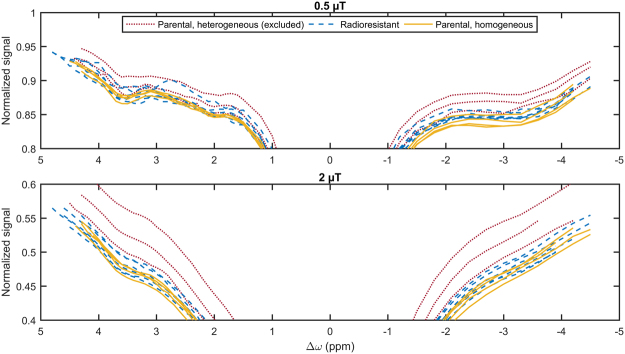
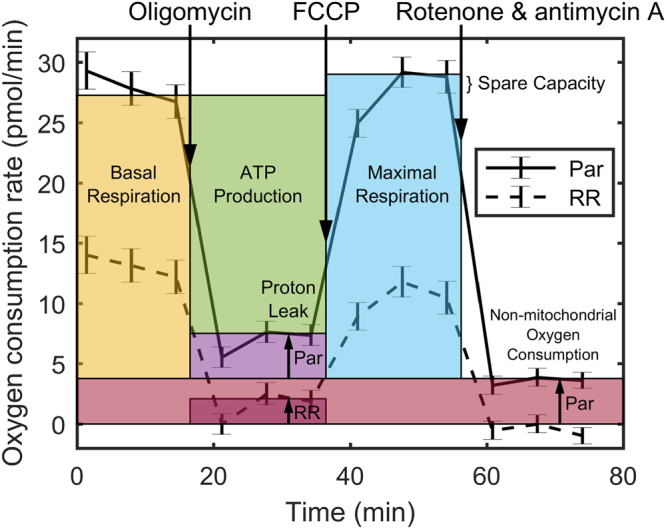
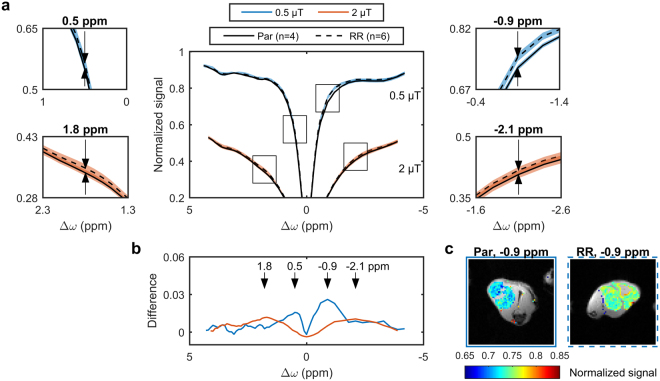
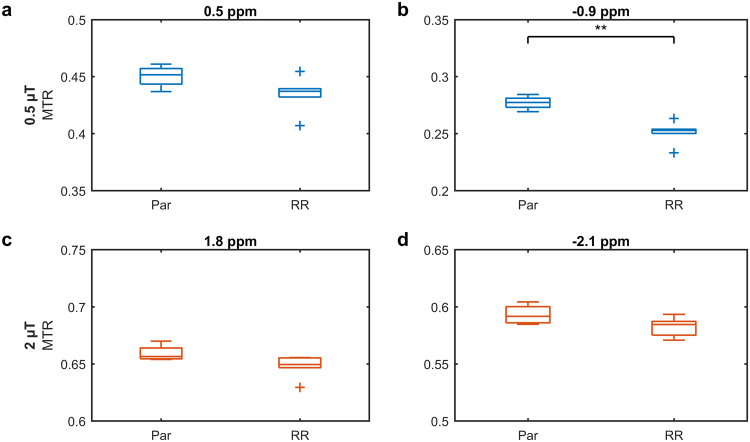
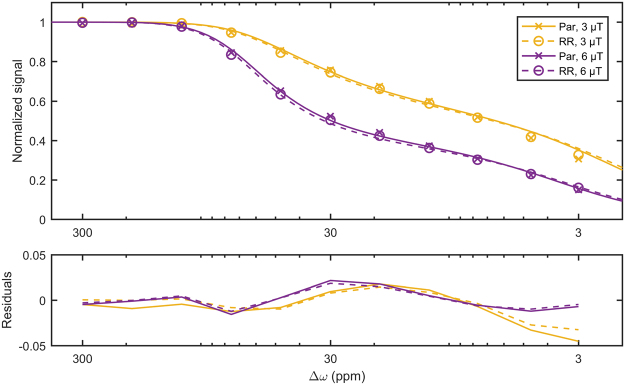
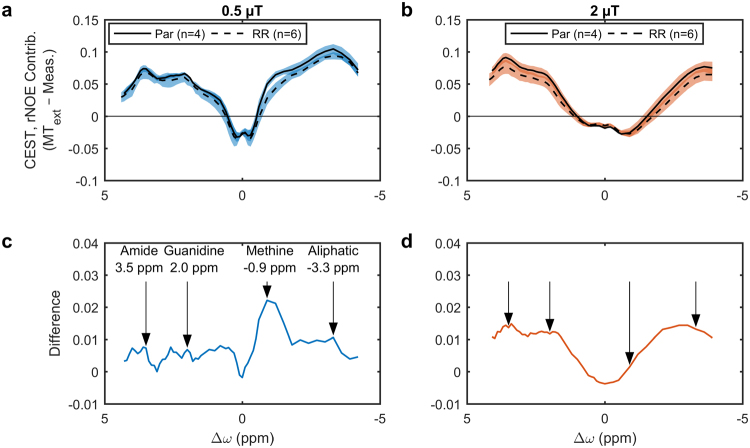
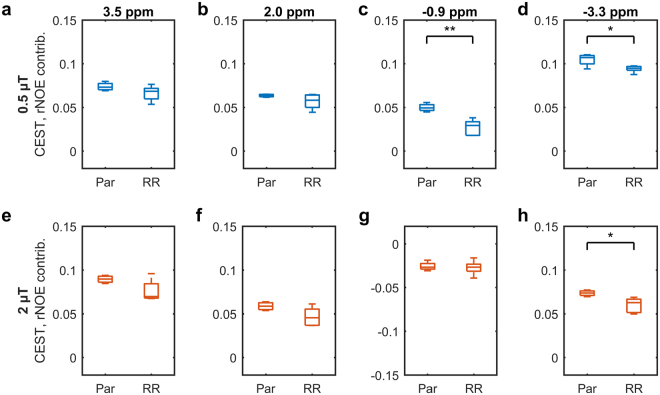
The ability of MRI to differentiate between normal and radioresistant cancer was investigated in prostate tumour xenografts in mice. Specifically, the process of magnetization exchange between water and other molecules was studied. It was found that magnetization transfer from semisolid macromolecules (MT) and chemical exchange saturation transfer (CEST) combined were significantly different between groups (p < 0.01). Further, the T relaxation of the semisolid macromolecular pool (T), a parameter specific to MT, was found to be significantly different (p < 0.01). Also significantly different were the rNOE contributions associated with methine groups at -0.9 ppm with a saturation B of 0.5 µT (p < 0.01) and with other aliphatic groups at -3.3 ppm with 0.5 and 2 µT (both p < 0.05). Independently, using a live-cell metabolic assay, normal cells were found to have a greater metabolic rate than radioresistant ones. Thus, MRI provides a novel, in vivo method to quantify the metabolic rate of tumours and predict their radiosensitivity.
这项研究旨在探讨 MRI 区分正常和耐辐射肿瘤的能力,实验在小鼠前列腺肿瘤异种移植模型中进行。具体而言,研究了水与其他分子之间的磁化交换过程。结果发现,半固体大分子间的磁化转移(MT)和化学交换饱和转移(CEST)联合的磁化转移在组间有显著差异(p<0.01)。此外,半固体大分子池的 T 弛豫时间(T),即 MT 特有的参数,也有显著差异(p<0.01)。与 -0.9 ppm 处亚甲基组相关的 rNOE 贡献也有显著差异,饱和 B 值为 0.5 µT(p<0.01),与 -3.3 ppm 处其他脂肪族基团相关的 rNOE 贡献在 0.5 和 2 µT 时也有显著差异(均 p<0.05)。此外,通过活细胞代谢测定发现,正常细胞的代谢率高于耐辐射细胞。因此,MRI 提供了一种新的、活体方法来定量肿瘤的代谢率并预测其放射敏感性。