Institute of Neuroscience, Shanghai Institute for Biological Sciences, Chinese Academy of Sciences, Shanghai, P. R. China.
State Key Laboratory of Genetic Engineering, School of Life Sciences, Fudan University, Shanghai, P. R. China.
PLoS One. 2018 Jul 11;13(7):e0199448. doi: 10.1371/journal.pone.0199448. eCollection 2018.
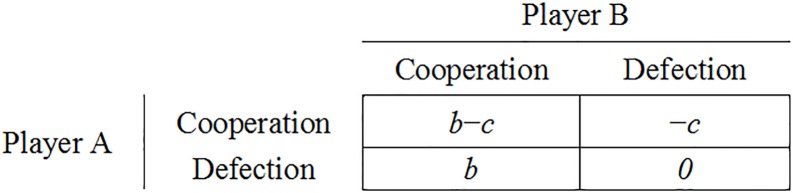
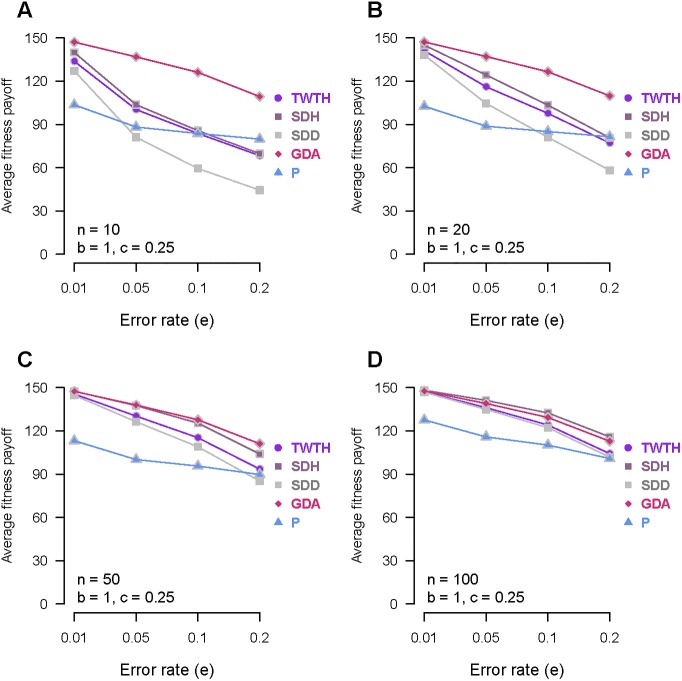
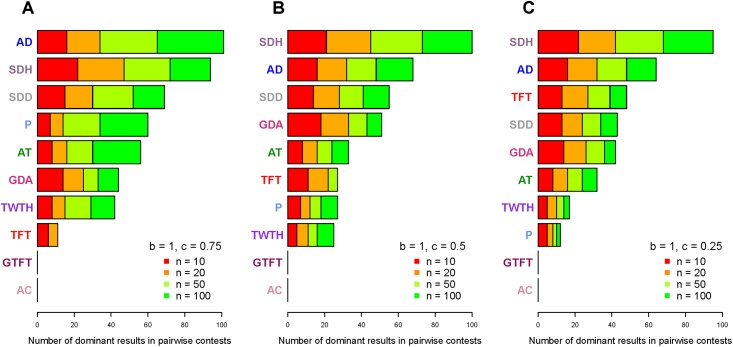
Shame and guilt seem to be two synonymous moral emotions but actually lead to contrasting human behaviors or behavioral tendencies. Shame drives people to hide or deny their wrongdoings while guilt drives people to amend their mistakes. How shame and guilt evolved in humans is still obscure. Here we present a computer model featured with reciprocal altruism and gregarious lifestyle for studying this question. We tested ten different strategies in our model and the pairwise contests show that shame-driven-hiding strategy can dominate the other strategies such as tit-for-tat and Pavlov in more than half of parameter combinations. The mathematical analysis of our model demonstrates that shame-driven-hiding strategy is an evolutionary stable strategy within a group as long as hiding can let an individual evade the retaliations to his wrongdoings. However, the problem of hiding is that it reduces an individual's social circle, i.e. living in a smaller group. Our analysis also shows that guilt-driven-amending strategy can outperform shame-driven-denying strategy at both individual and group levels if the cooperative behavior is sustainable within a group (b/(b-c) < T/n). Thus, we propose that shame is more adaptive at the individual level while guilt is more advantageous in the context of intergroup competition.
羞耻感和内疚感似乎是两种同义的道德情感,但实际上导致了相反的人类行为或行为倾向。羞耻感驱使人们隐藏或否认自己的错误,而内疚感则驱使人们纠正自己的错误。羞耻感和内疚感在人类中是如何进化的仍然不清楚。在这里,我们提出了一个具有互惠利他主义和群居生活方式的计算机模型来研究这个问题。我们在模型中测试了十种不同的策略,成对竞赛表明,在超过一半的参数组合中,羞耻感驱动的隐藏策略可以胜过其他策略,如以牙还牙和巴甫洛夫策略。我们模型的数学分析表明,只要隐藏可以让个人逃避对其错误的报复,羞耻感驱动的隐藏策略就是群体内部的一种进化稳定策略。然而,隐藏的问题是,它会减少个人的社交圈子,即生活在一个更小的群体中。我们的分析还表明,如果群体内部的合作行为是可持续的(b/(b-c)<T/n),那么内疚感驱动的纠正策略在个人和群体层面都可以胜过羞耻感驱动的否认策略。因此,我们提出,羞耻感在个体层面上更具适应性,而内疚感在群体间竞争的情况下更具优势。