Department of Computer Science, University College London, London, United Kingdom.
Biometrology Group, National Physical Laboratory, Teddington, United Kingdom.
PLoS One. 2018 Jul 11;13(7):e0200108. doi: 10.1371/journal.pone.0200108. eCollection 2018.
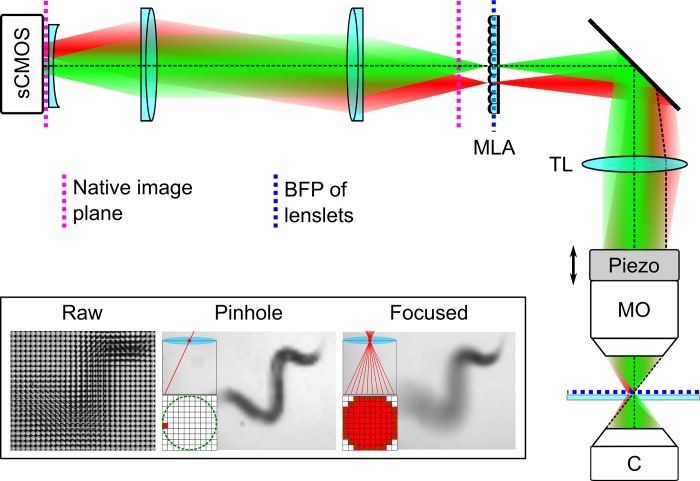
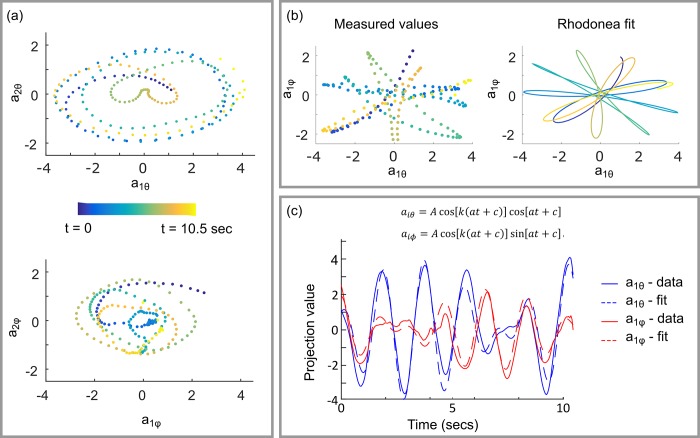
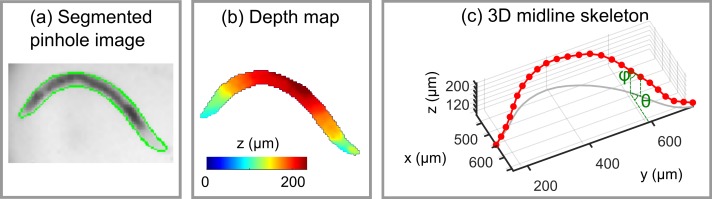
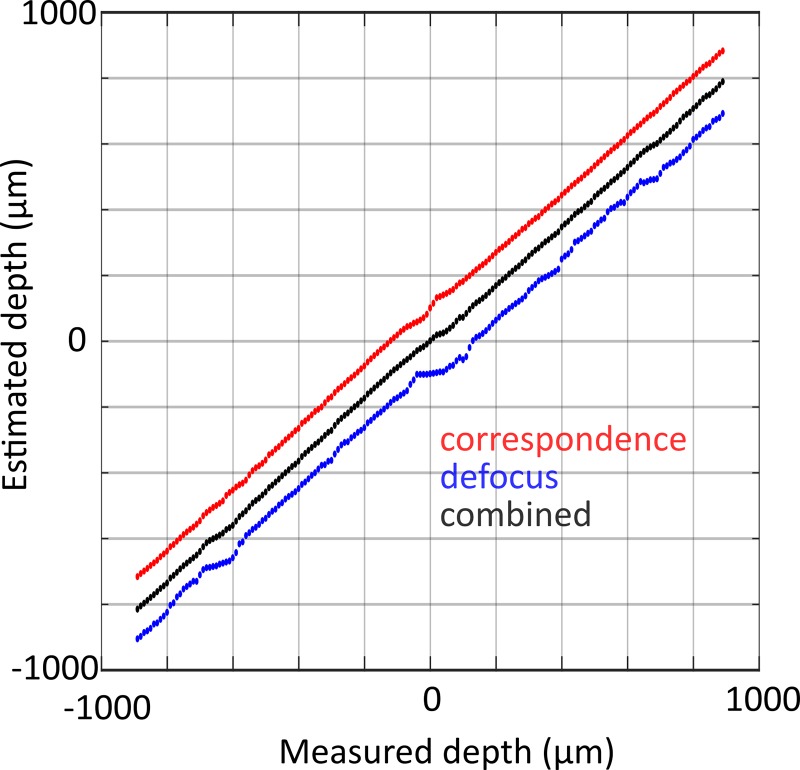
Behavioural phenotyping of model organisms is widely used to investigate fundamental aspects of organism biology, from the functioning of the nervous system to the effects of genetic mutations, as well as for screening new drug compounds. However, our capacity to observe and quantify the full range and complexity of behavioural responses is limited by the inability of conventional microscopy techniques to capture volumetric image information at sufficient speed. In this article we describe how combining light field microscopy with computational depth estimation provides a new method for fast, quantitative assessment of 3D posture and movement of the model organism Caenorhabditis elegans (C. elegans). We apply this technique to compare the behaviour of cuticle collagen mutants, finding significant differences in 3D posture and locomotion. We demonstrate the ability of quantitative light field microscopy to provide new fundamental insights into C. elegans locomotion by analysing the 3D postural modes of a freely swimming worm. Finally, we consider relative merits of the method and its broader application for phenotypic imaging of other organisms and for other volumetric bioimaging applications.
行为表型分析在模式生物中被广泛应用,旨在研究从神经系统功能到基因突变影响等生物学的基本方面,也可以用于筛选新的药物化合物。然而,由于传统显微镜技术无法以足够的速度捕获体积图像信息,我们观察和量化行为反应的全部范围和复杂性的能力受到限制。在本文中,我们描述了如何将光场显微镜与计算深度估计相结合,为快速、定量评估模型生物秀丽隐杆线虫(Caenorhabditis elegans,C. elegans)的 3D 姿势和运动提供一种新方法。我们应用该技术比较了表皮胶原突变体的行为,发现 3D 姿势和运动存在显著差异。我们通过分析自由游动的线虫的 3D 姿势模式,证明了定量光场显微镜在分析 C. elegans 运动方面具有提供新的基本见解的能力。最后,我们考虑了该方法的相对优点及其更广泛的应用,包括对其他生物体的表型成像以及其他体积生物成像应用。