Thapa Ganesh, Gunupuru Lokanadha R, Hehir James G, Kahla Amal, Mullins Ewen, Doohan Fiona M
UCD School of Biology and Environmental Science, UCD Earth Institute and UCD Institute of Food and Health, University College of Dublin, Belfield, Ireland.
Crop Science Department, Oak Park Crops Research Centre, Teagasc, Carlow, Ireland.
Front Plant Sci. 2018 Jun 26;9:867. doi: 10.3389/fpls.2018.00867. eCollection 2018.
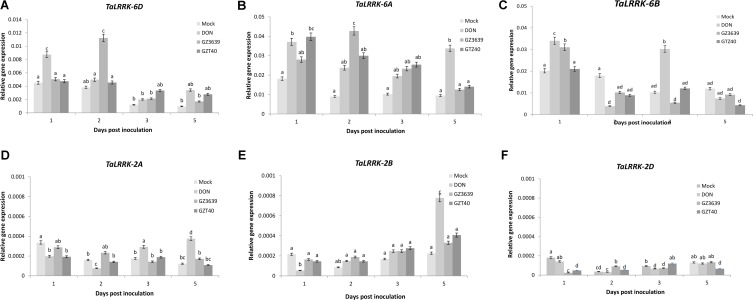
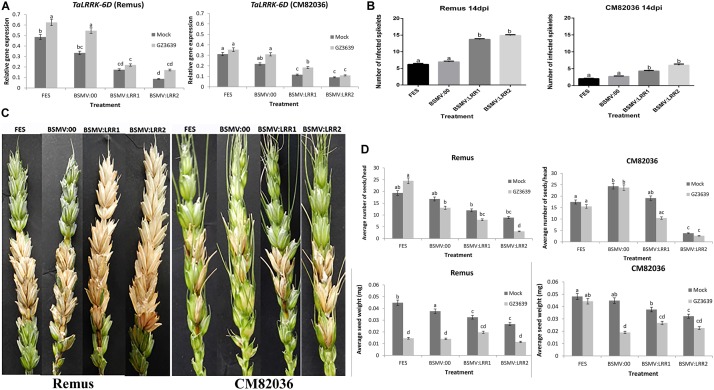
Receptor-like kinases form the largest family of receptors in plants and play an important role in recognizing pathogen-associated molecular patterns and modulating the plant immune responses to invasive fungi, including cereal defenses against fungal diseases. But hitherto, none have been shown to modulate the wheat response to the economically important Fusarium head blight (FHB) disease of small-grain cereals. Homologous genes were identified on barley chromosome 6H () and wheat chromosome 6DL (), which encode the characteristic domains of surface-localized receptor like kinases. Gene expression studies validated that the wheat is highly induced in heads as an early response to both the causal pathogen of FHB disease, , and its' mycotoxic virulence factor deoxynivalenol. The transcription of other wheat homeologs of this gene, located on chromosomes 6A and 6B, was also up-regulated in response to . Virus-induced gene silencing (VIGS) of the barley compromised leaf defense against . VIGS of in two wheat cultivars, CM82036 (resistant to FHB disease) and cv. Remus (susceptible to FHB), confirmed that contributes to basal resistance to FHB disease in both genotypes. Although the effect of VIGS did not generally reduce grain losses due to FHB, this experiment did reveal that positively contributes to grain development. Further gene expression studies in wheat cv. Remus indicated that VIGS of suppressed the expression of genes involved in salicylic acid signaling, which is a key hormonal pathway involved in defense. Thus, this study provides the first evidence of receptor like kinases as an important component of cereal defense against and highlights this gene as a target for enhancing cereal resistance to FHB disease.
类受体激酶构成了植物中最大的受体家族,在识别病原体相关分子模式以及调节植物对入侵真菌的免疫反应中发挥重要作用,包括谷物对真菌病害的防御。但迄今为止,尚未发现有类受体激酶能够调节小麦对小粒谷物中具有重要经济意义的赤霉病(FHB)的反应。在大麦6H染色体()和小麦6DL染色体()上鉴定出了同源基因,它们编码表面定位的类受体激酶的特征结构域。基因表达研究证实,小麦中的该基因在穗部受到FHB病致病病原体以及其霉菌毒素毒力因子脱氧雪腐镰刀菌烯醇的早期刺激后高度诱导表达。该基因位于6A和6B染色体上的其他小麦同源基因的转录在受到病原体刺激后也会上调。大麦中该基因的病毒诱导基因沉默(VIGS)削弱了叶片对病原体的防御能力。在两个小麦品种CM82036(抗FHB病)和雷穆斯品种(感FHB病)中对该基因进行VIGS,证实该基因在两种基因型中均有助于对FHB病的基础抗性。尽管VIGS的作用通常不会减少因FHB造成的谷物损失,但该实验确实表明该基因对谷物发育有积极作用。在雷穆斯小麦品种中进一步的基因表达研究表明,该基因的VIGS抑制了参与水杨酸信号传导的基因的表达,而水杨酸信号传导是防御中的关键激素途径。因此,本研究首次证明类受体激酶是谷物抵御该病原体的重要组成部分,并突出了该基因作为增强谷物对FHB病抗性的靶点。