Arab Somayyeh Abbasabad, Nikravesh Mohammad Reza, Jalali Mahdi, Fazel AliReza
M.Sc. Student of Anatomy, Department of Anatomy and Cell Biology, School of Medicine, Mashhad University of Medical Sciences, Mashhad, Iran.
Ph.D. of Anatomy, Professor, Department of Anatomy and Cell Biology, School of Medicine, Mashhad University of Medical Sciences, Mashhad, Iran.
Electron Physician. 2018 May 5;10(5):6789-6795. doi: 10.19082/6789. eCollection 2018 May.
Malathion is one of organophosphate pesticides that is extensively used in farming and crops to control pests. Malathion induces oxidative stress in the various tissues such as the reproductive system.
To determine the effects of malathion on malondialdehyde (MDA) level and glutathione (GSH) content in female rat ovary tissue as well as to assess the protective role of Ascorbic Acid.
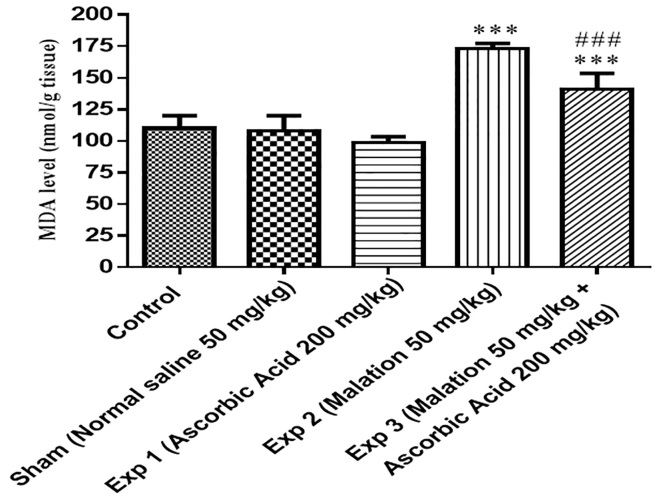
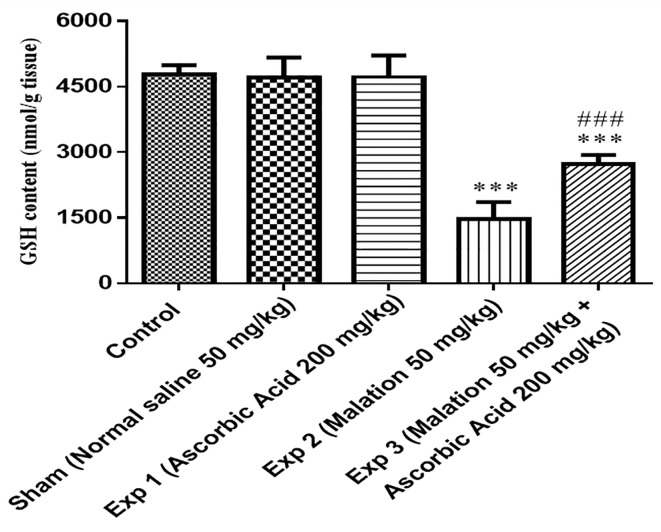
This study was carried out at the Department of Anatomy and Cell Biology (School of Medicine, Mashhad University of Medical Sciences, Mashhad, Iran) in 2015. In this experimental study, 30 adult, female, Wistar rats (weight range: 200-250 g) were divided into five groups, each group consisting of six rats: control group (no interventions), sham group (normal saline 0.9% 50 mg/kg), experimental group 1 (Ascorbic Acid 200 mg/kg), experimental group 2 (malathion 50 mg/kg), and experimental group 3 (malathion 50 mg/kg + Ascorbic Acid 200 mg/kg). Malathion, solvents and Ascorbic Acid were injected intraperitoneally. After two weeks, the animals were anaesthetized with intraperitoneal ketamine/xylazine (60 and 6 mg/kg, respectively) and then scarified, and the right ovarian was used to measure levels of MDA, a marker of lipid peroxidation, and GSH content. Data were analyzed by SPSS version 16, using descriptive statistics, One Way ANOVA, and Tukey-Kramer test. A p-value <0.05 was set as significance level.
This study has shown that malathion increased MDA level and reduced GSH content compared with the control group (p<0.001). Also, administration of malathion in combination with Ascorbic Acid, reduced MDA level and increased the GSH content in rat ovarian tissue.
Malathion induced lipid peroxidation and Oxidative stress in the ovarian of Rats. In addition, it appears that Ascorbic Acid, due to its antioxidant, can recover malathion-induced poisonous changes.
马拉硫磷是一种有机磷农药,广泛用于农业和农作物害虫防治。马拉硫磷可在包括生殖系统在内的多种组织中诱导氧化应激。
确定马拉硫磷对雌性大鼠卵巢组织中丙二醛(MDA)水平和谷胱甘肽(GSH)含量的影响,并评估抗坏血酸的保护作用。
本研究于2015年在伊朗马什哈德医科大学医学院解剖学与细胞生物学系开展。在这项实验研究中,30只成年雌性Wistar大鼠(体重范围:200 - 250克)被分为五组,每组六只:对照组(无干预)、假手术组(0.9%生理盐水50毫克/千克)、实验组1(抗坏血酸200毫克/千克)、实验组2(马拉硫磷50毫克/千克)和实验组3(马拉硫磷50毫克/千克 + 抗坏血酸200毫克/千克)。马拉硫磷、溶剂和抗坏血酸通过腹腔注射给药。两周后,用腹腔注射氯胺酮/赛拉嗪(分别为60和6毫克/千克)对动物进行麻醉,然后处死,取右侧卵巢测量脂质过氧化标志物MDA的水平和GSH含量。数据采用SPSS 16版软件进行分析,使用描述性统计、单因素方差分析和Tukey - Kramer检验。将p值<0.05设定为显著性水平。
本研究表明,与对照组相比,马拉硫磷增加了MDA水平并降低了GSH含量(p<0.001)。此外,马拉硫磷与抗坏血酸联合给药可降低大鼠卵巢组织中的MDA水平并增加GSH含量。
马拉硫磷可诱导大鼠卵巢脂质过氧化和氧化应激。此外,抗坏血酸因其抗氧化作用,似乎可以恢复马拉硫磷诱导的毒性变化。