Institute for Biomedical Engineering, ETH Zurich and University of Zurich, Zurich, Switzerland.
Institute of Pharmacology and Toxicology, University of Zurich, Zurich, Switzerland.
Sci Rep. 2018 Jul 12;8(1):10591. doi: 10.1038/s41598-018-28766-3.
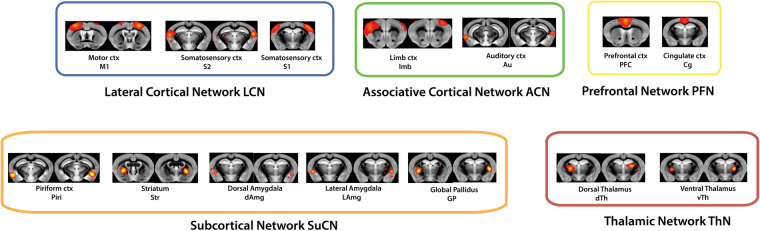
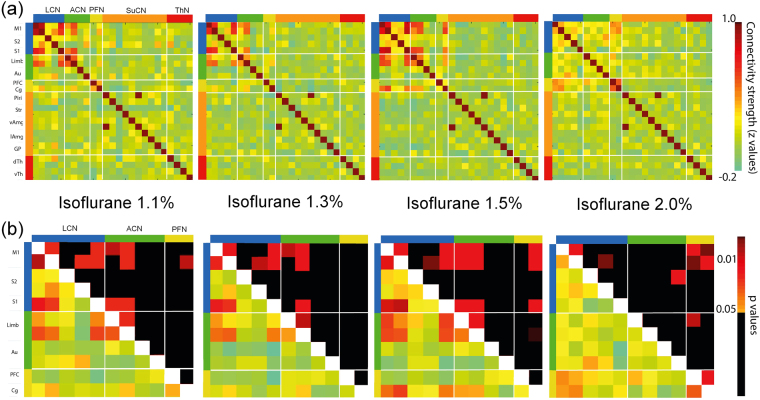
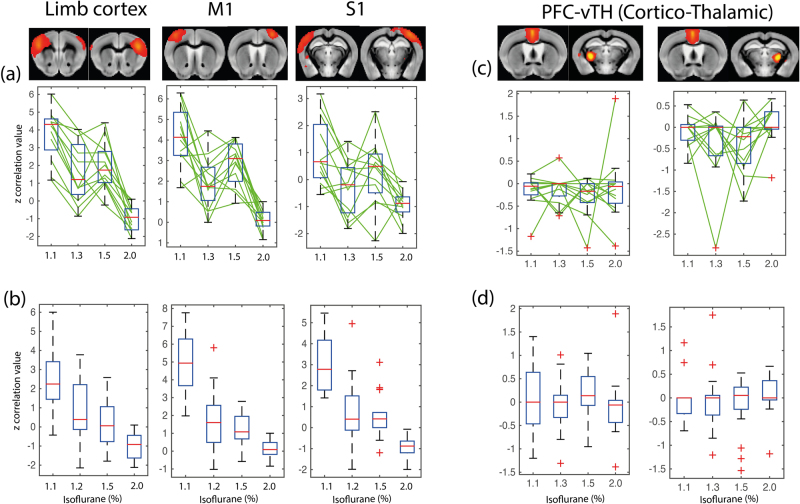
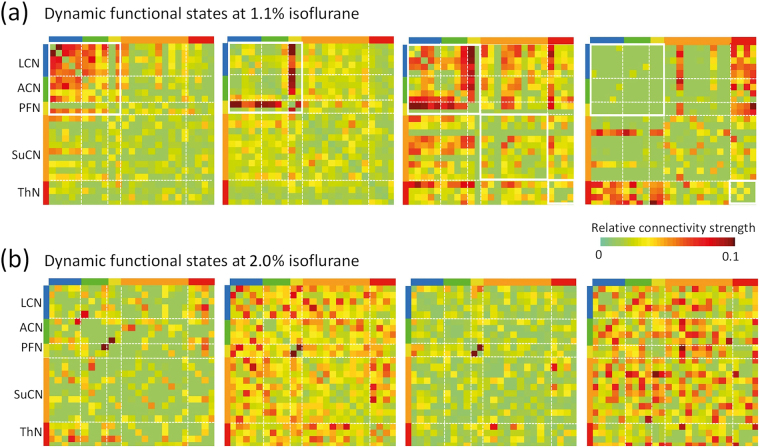
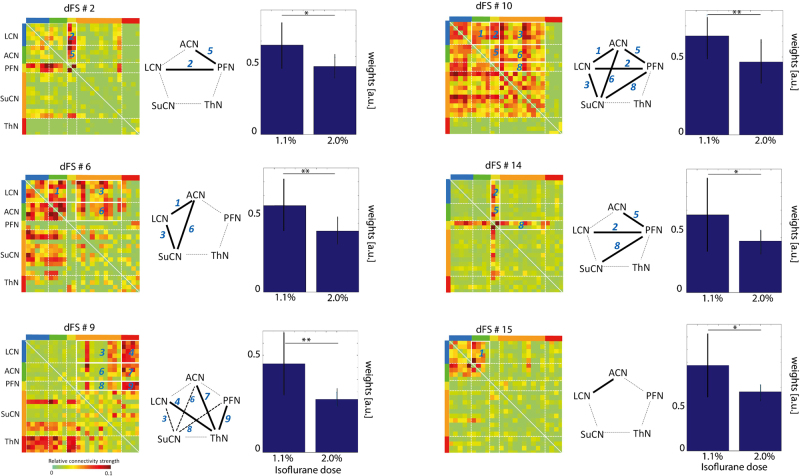
Effects of anesthetics on brain functional networks are not fully understood. In this work, we investigated functional brain networks derived from resting-state fMRI data obtained under different doses of isoflurane in mice using stationary and dynamic functional connectivity (dFC) analysis. Stationary network analysis using FSL Nets revealed a modular structure of functional networks, which could be segregated into a lateral cortical, an associative cortical network, elements of the prefrontal network, a subcortical network, and a thalamic network. Increasing isoflurane dose led to a loss of functional connectivity between the bilateral cortical regions. In addition, dFC analysis revealed a dominance of dynamic functional states (dFS) exhibiting modular structure in mice anesthetized with a low dose of isoflurane, while at high isoflurane levels dFS showing widespread unstructured correlation displayed highest weights. This indicates that spatial segregation across brain functional networks is lost with increasing dose of the anesthetic drug used. To what extent this indicates a state of deep anesthesia remains to be shown. Combining the results of stationary and dynamic FC analysis indicates that increasing isoflurane levels leads to loss of modular network organization, which includes loss of the strong bilateral interactions between homotopic brain areas.
麻醉药物对大脑功能网络的影响尚未完全阐明。在这项工作中,我们使用静态和动态功能连接性(dFC)分析,研究了在不同剂量异氟醚麻醉下小鼠静息态 fMRI 数据得到的功能脑网络。使用 FSL Nets 的静态网络分析揭示了功能网络的模块化结构,这些网络可以分为外侧皮质、联合皮质网络、前额叶网络的组成部分、皮质下网络和丘脑网络。异氟醚剂量的增加导致双侧皮质区域之间的功能连接丧失。此外,dFC 分析显示,在低剂量异氟醚麻醉的小鼠中,动态功能状态(dFS)表现出具有模块化结构的优势,而在高异氟醚水平下,dFS 显示出广泛的无结构相关性,其权重最高。这表明随着麻醉药物剂量的增加,大脑功能网络之间的空间分离丢失。在多大程度上这表明一种深度麻醉状态仍有待观察。结合静态和动态 FC 分析的结果表明,增加异氟醚水平会导致模块化网络组织的丧失,包括同源脑区之间的强双侧相互作用的丧失。