Lin Shuang, Yu Chengfu, Chen Weiqi, Tian Yunlong, Zhang Wei
School of Education, Guangzhou University, Guangzhou, China.
School of Management, Guangzhou University, Guangzhou, China.
Front Psychol. 2018 Jun 28;9:1036. doi: 10.3389/fpsyg.2018.01036. eCollection 2018.
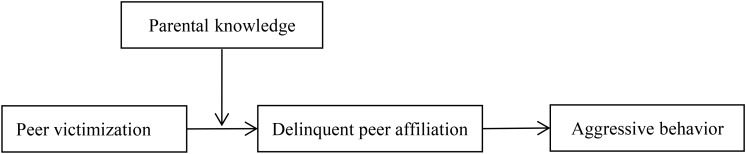
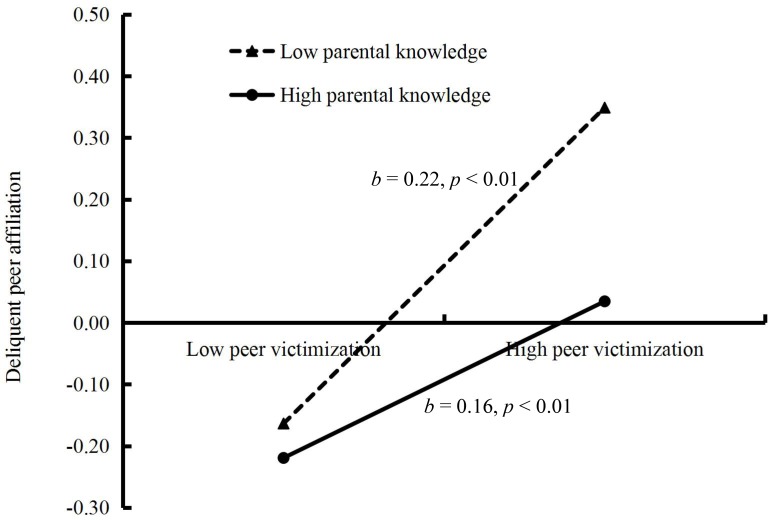
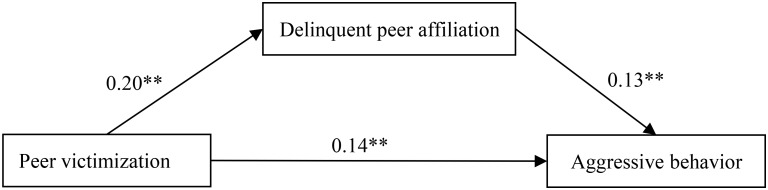
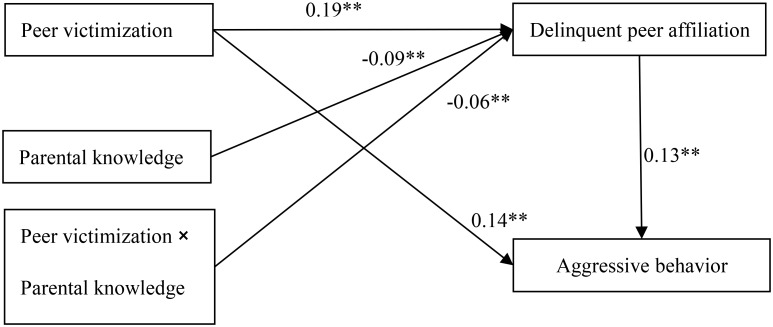
Grounded in social network theory and a risk-buffering model, this study examined whether delinquent peer affiliation mediated the association between peer victimization and adolescent aggressive behavior and whether this mediating process was moderated by parental knowledge. A total of 4,209 Chinese adolescents (48.47% male, = 13.68) completed questionnaires on peer victimization, parental knowledge, delinquent peer affiliation, and adolescent aggressive behavior. Path analyses showed that delinquent peer affiliation partially mediated the relationship between peer victimization and aggressive behavior. Moreover, parental knowledge had a protective effect of buffering the adverse influence of peer victimization on aggressive behavior. This indirect link was stronger for adolescents with low parental knowledge than for those with high parental knowledge. This finding highlights delinquent peer affiliation as a potential link between peer victimization and aggressive behavior and provides an effective intervention for addressing the adverse effects of peer victimization.
基于社会网络理论和风险缓冲模型,本研究考察了不良同伴关系是否在同伴受害与青少年攻击行为之间起中介作用,以及这一中介过程是否受到父母了解程度的调节。共有4209名中国青少年(男性占48.47%,平均年龄=13.68岁)完成了关于同伴受害、父母了解程度、不良同伴关系和青少年攻击行为的问卷调查。路径分析表明,不良同伴关系在同伴受害与攻击行为之间起部分中介作用。此外,父母了解程度对缓冲同伴受害对攻击行为的不利影响具有保护作用。这种间接联系在父母了解程度低的青少年中比在父母了解程度高的青少年中更强。这一发现凸显了不良同伴关系是同伴受害与攻击行为之间的潜在联系,并为应对同伴受害的不利影响提供了一种有效的干预措施。