Anshari Dien, Yong Hua-Hie, Borland Ron, Hammond David, Swayampakala Kamala, Thrasher Jim
Department of Health Promotion, Education and Behavior, Arnold School of Public Health, University of South Carolina, Columbia, South Carolina, USA.
Department of Health Education and Behavioral Sciences, Faculty of Public Health, Universitas Indonesia, Depok, Indonesia.
BMJ Open. 2018 Jul 13;8(7):e021983. doi: 10.1136/bmjopen-2018-021983.
This study examined smokers' responses to pictorial health warnings (PHWs) with different types of imagery under natural exposure conditions.
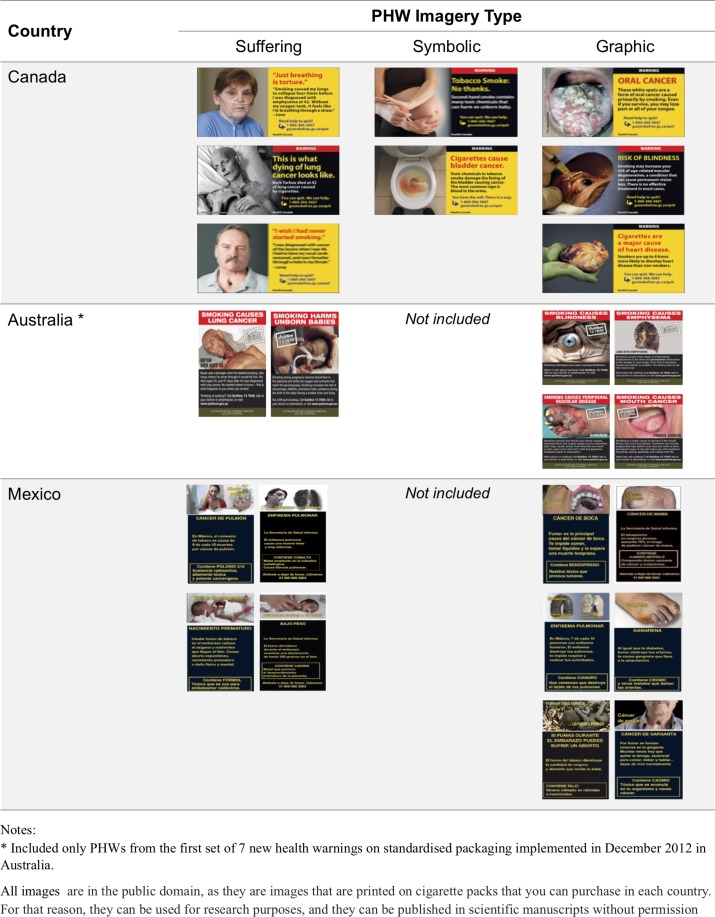
Adult smokers from online panels in Canada (n=2357), Australia (n=1671) and Mexico (n=2537) were surveyed every 4 months from 2012 to 2013. Participants were shown PHWs on packs in their respective countries and asked about: (1) noticing PHWs; (2) negative affects towards PHWs; (3) believability of PHWs; (4) PHW-stimulated discussions; and (5) quit motivation due to PHWs. Country-specific generalised estimating equation models regressed these outcomes on time (ie, survey wave), PHW imagery type (ie, symbolic representations of risk, suffering from smoking and graphic depictions of bodily harm) and interactions between them.
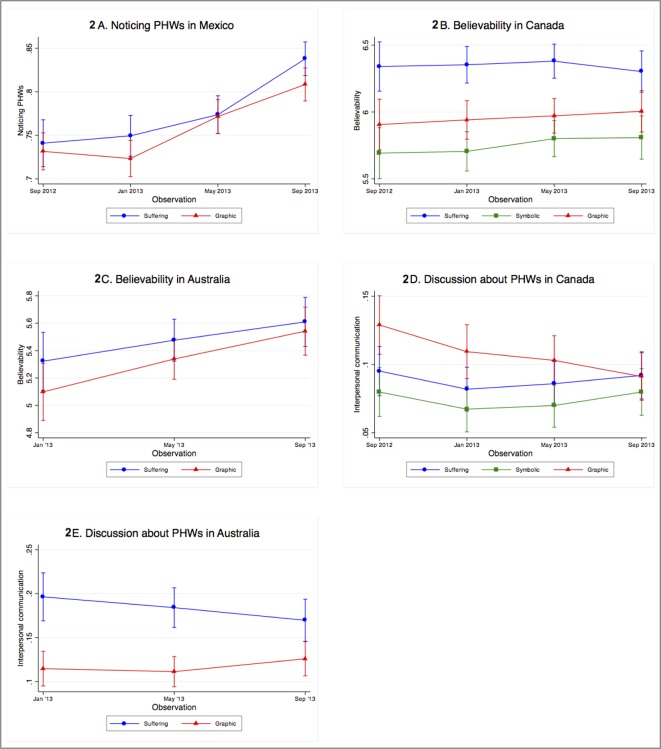
In all countries, PHW responses did not significantly change over time, except for increased noticing PHWs in Canada and Mexico, increased negative affect in Australia and decreased negative affect in Mexico. For all outcomes, symbolic PHWs were rated lower than suffering and graphic PHWs in Canada (the only country with symbolic PHWs). Graphic PHWs were rated higher than suffering PHWs for negative affect (all countries), discussions (Canada) and quit motivation (Australia). Suffering PHWs were rated higher than graphic PHWs for noticing PHWs (Canada), believability (all countries), discussions (AustraliaandMexico) and quit motivation (Mexico). Changes in noticing, believability and discussions varied somewhat by imagery type across countries.
The different PHW imagery appears to have different pathways of influence on adult smokers. Reactions to specific PHWs are similar over 1-2 years, suggesting that wear-out of PHW effects is due to decreased attention rather than the diminishing effectiveness of content.
本研究在自然暴露条件下,考察吸烟者对带有不同类型图像的图片健康警示(PHW)的反应。
2012年至2013年期间,每隔4个月对来自加拿大(n = 2357)、澳大利亚(n = 1671)和墨西哥(n = 2537)在线小组的成年吸烟者进行调查。向参与者展示各自国家烟包上的图片健康警示,并询问他们:(1)是否注意到图片健康警示;(2)对图片健康警示的负面情绪;(3)图片健康警示的可信度;(4)由图片健康警示引发的讨论;以及(5)因图片健康警示而产生的戒烟动机。特定国家的广义估计方程模型将这些结果按时间(即调查波次)、图片健康警示图像类型(即风险的象征性表示、吸烟导致的痛苦以及身体伤害的图形描绘)及其之间的相互作用进行回归分析。
在所有国家中,除了加拿大和墨西哥注意到图片健康警示的情况有所增加、澳大利亚负面情绪增加以及墨西哥负面情绪减少外,图片健康警示的反应随时间并未显著变化。对于所有结果,在加拿大(唯一有象征性图片健康警示的国家),象征性图片健康警示的评分低于体现痛苦和图形化的图片健康警示。在负面情绪(所有国家)、讨论(加拿大)和戒烟动机(澳大利亚)方面,图形化图片健康警示的评分高于体现痛苦的图片健康警示。在注意到图片健康警示(加拿大)、可信度(所有国家)、讨论(澳大利亚和墨西哥)和戒烟动机(墨西哥)方面,体现痛苦的图片健康警示的评分高于图形化图片健康警示。不同国家中,注意到、可信度和讨论方面的变化因图像类型而有所不同。
不同的图片健康警示图像似乎对成年吸烟者有不同的影响途径。在1 - 2年的时间里,对特定图片健康警示的反应相似,这表明图片健康警示效果的减弱是由于关注度下降,而非内容有效性的降低。