Eyal Guy, Verhoog Matthijs B, Testa-Silva Guilherme, Deitcher Yair, Benavides-Piccione Ruth, DeFelipe Javier, de Kock Christiaan P J, Mansvelder Huibert D, Segev Idan
Department of Neurobiology, Hebrew University of Jerusalem, Jerusalem, Israel.
Department of Integrative Neurophysiology, Centre for Neurogenomics and Cognitive Research, Amsterdam Neuroscience, VU University Amsterdam, Amsterdam, Netherlands.
Front Cell Neurosci. 2018 Jun 29;12:181. doi: 10.3389/fncel.2018.00181. eCollection 2018.
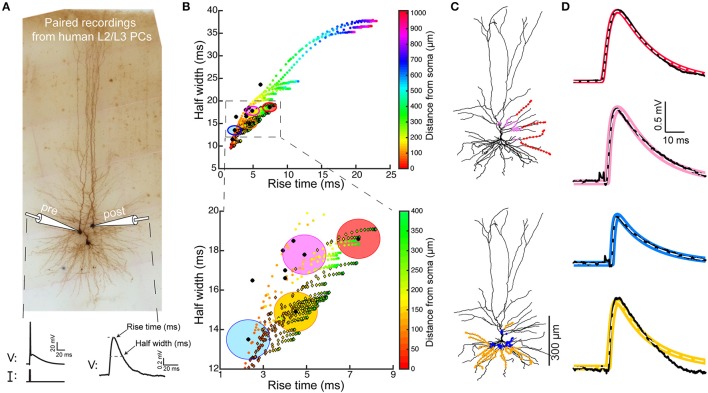
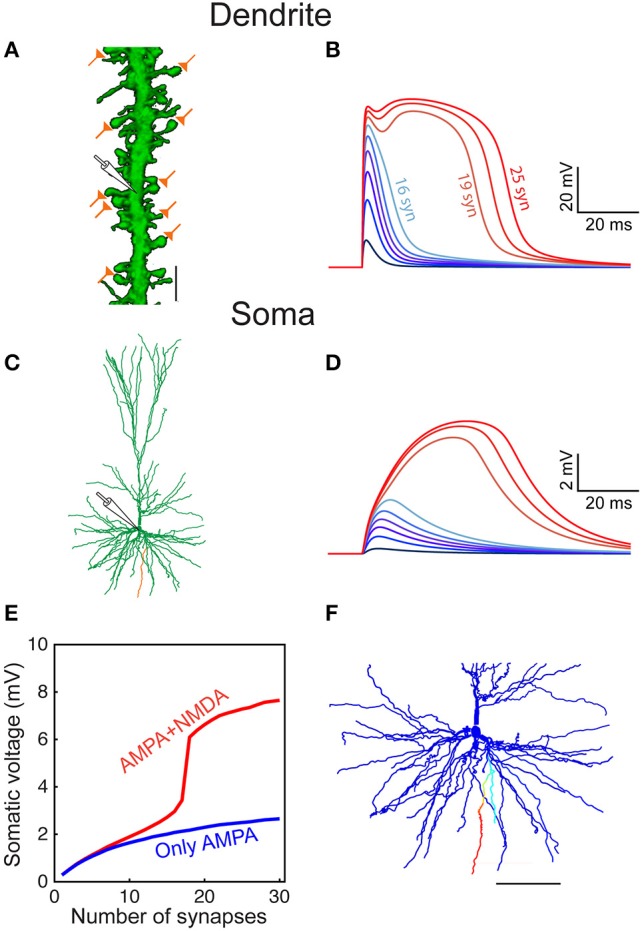
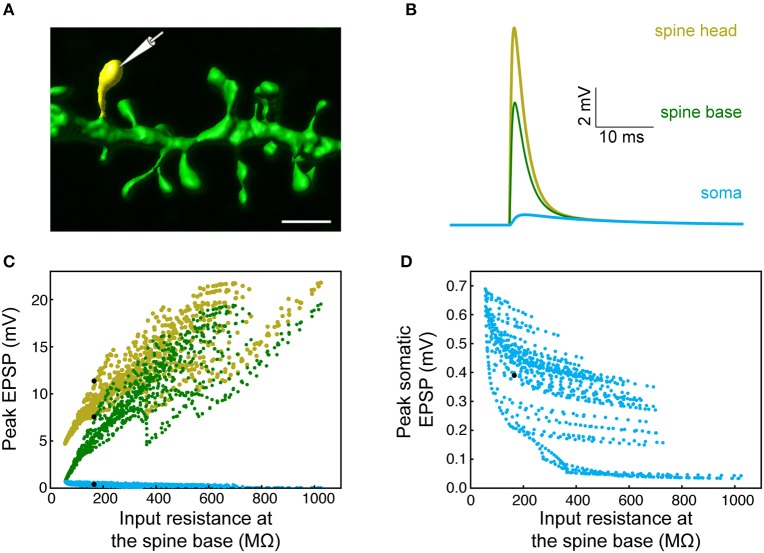
We present detailed models of pyramidal cells from human neocortex, including models on their excitatory synapses, dendritic spines, dendritic NMDA- and somatic/axonal spikes that provided new insights into signal processing and computational capabilities of these principal cells. Six human layer 2 and layer 3 pyramidal cells (HL2/L3 PCs) were modeled, integrating detailed anatomical and physiological data from both fresh and postmortem tissues from human temporal cortex. The models predicted particularly large AMPA- and NMDA-conductances per synaptic contact (0.88 and 1.31 nS, respectively) and a steep dependence of the NMDA-conductance on voltage. These estimates were based on intracellular recordings from synaptically-connected HL2/L3 pairs, combined with extra-cellular current injections and use of synaptic blockers, and the assumption of five contacts per synaptic connection. A large dataset of high-resolution reconstructed HL2/L3 dendritic spines provided estimates for the EPSPs at the spine head (12.7 ± 4.6 mV), spine base (9.7 ± 5.0 mV), and soma (0.3 ± 0.1 mV), and for the spine neck resistance (50-80 MΩ). Matching the shape and firing pattern of experimental somatic -spikes provided estimates for the density of the somatic/axonal excitable membrane ion channels, predicting that 134 ± 28 simultaneously activated HL2/L3-HL2/L3 synapses are required for generating (with 50% probability) a somatic spike. Dendritic NMDA spikes were triggered in the model when 20 ± 10 excitatory spinous synapses were simultaneously activated on individual dendritic branches. The particularly large number of basal dendrites in HL2/L3 PCs and the distinctive cable elongation of their terminals imply that 25 NMDA-spikes could be generated independently and simultaneously in these cells, as compared to ~14 in L2/3 PCs from the rat somatosensory cortex. These multi-sites non-linear signals, together with the large (30,000) excitatory synapses/cell, equip human L2/L3 PCs with enhanced computational capabilities. Our study provides the most comprehensive model of any human neuron to-date demonstrating the biophysical and computational distinctiveness of human cortical neurons.
我们展示了来自人类新皮层锥体细胞的详细模型,包括其兴奋性突触、树突棘、树突NMDA以及体细胞/轴突动作电位的模型,这些模型为这些主要细胞的信号处理和计算能力提供了新的见解。我们对六个人类第2层和第3层锥体细胞(HL2/L3 PCs)进行了建模,整合了来自人类颞叶皮层新鲜组织和死后组织的详细解剖学和生理学数据。这些模型预测每个突触接触的AMPA和NMDA电导特别大(分别为0.88和1.31 nS),并且NMDA电导对电压有强烈依赖性。这些估计基于对突触连接的HL2/L3细胞对的细胞内记录,结合细胞外电流注入和突触阻滞剂的使用,以及每个突触连接有五个接触点的假设。一个包含高分辨率重建的HL2/L3树突棘的大型数据集提供了对树突棘头部(12.7±4.6 mV)、树突棘基部(9.7±5.0 mV)和体细胞(0.3±0.1 mV)处的兴奋性突触后电位(EPSP)以及树突棘颈部电阻(50 - 80 MΩ)的估计。通过匹配实验性体细胞动作电位的形状和发放模式,提供了对体细胞/轴突可兴奋膜离子通道密度的估计,预测产生(50%概率)一个体细胞动作电位需要134±28个同时激活的HL2/L3 - HL2/L3突触。当在单个树突分支上同时激活20±10个兴奋性棘突触时,模型中触发了树突NMDA动作电位。HL2/L3 PCs中特别大量的基底树突及其末端独特的电缆状延伸意味着与大鼠体感皮层的L2/3 PCs中约14个相比,这些细胞中可独立且同时产生约25个NMDA动作电位。这些多位点非线性信号,连同每个细胞中大量(约30,000个)兴奋性突触,使人类L2/L3 PCs具有增强的计算能力。我们的研究提供了迄今为止任何人类神经元最全面的模型,证明了人类皮层神经元的生物物理和计算独特性。