Silva Diana, Moreira Rita, Sokhatska Oksana, Beltrão Marília, Montanha Tiago, Garcia-Larsen Vanessa, Villegas Rodrigo, Severo Milton, Pizarro Andreia, Pinto Mariana, Martins Carla, Duarte Ana, Delgado Luís, Rufo João, Paciência Inês, Teixeira João Paulo, Costa Carla, Moreira Pedro, Carvalho Joana, Moreira André
Basic and Clinical Immunology, Department of Pathology, Faculty of Medicine, University of Porto, Portugal.
Serviço de Imunoalergologia, Centro Hospitalar São João, EPE, Porto, Portugal.
Contemp Clin Trials Commun. 2018 May 9;10:177-189. doi: 10.1016/j.conctc.2018.05.010. eCollection 2018 Jun.
The effect of a pre-exercise meal as countermeasure to exercise induced immunodepression is poorly known. Also, sedentary behavior is associated with increased cardiometabolic risk but studies on immune changes are lacking. Therefore, we aimed to assess: 1) the impact of a pre-exercise Mediterranean meal (MdM) compared with a fast-food type meal (FFM) on exercise-induced immunological changes and 2) the impact of an induced acute period of sedentary behavior on neuro-immune-endocrine status.
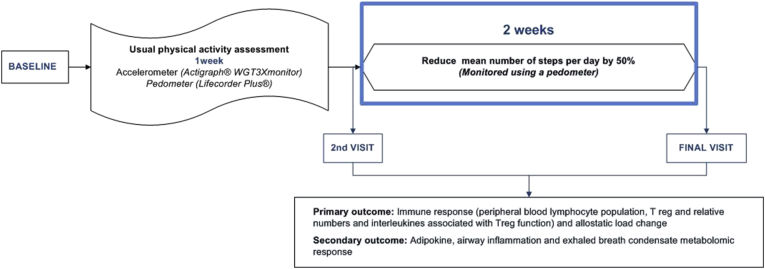
/Design: This is a two steps clinical trial including: (a) randomized crossover clinical trial, comparing the effect a high-fat/low-nutrient dense meal, FFM, with an isoenergetic similar high-nutrient dense meal, MdM, in the immune response to an exercise challenge (EC) and (b) a pilot trial assessing the neuro-immune-endocrine change induced by acute decreasing by half the usual physical activity level.
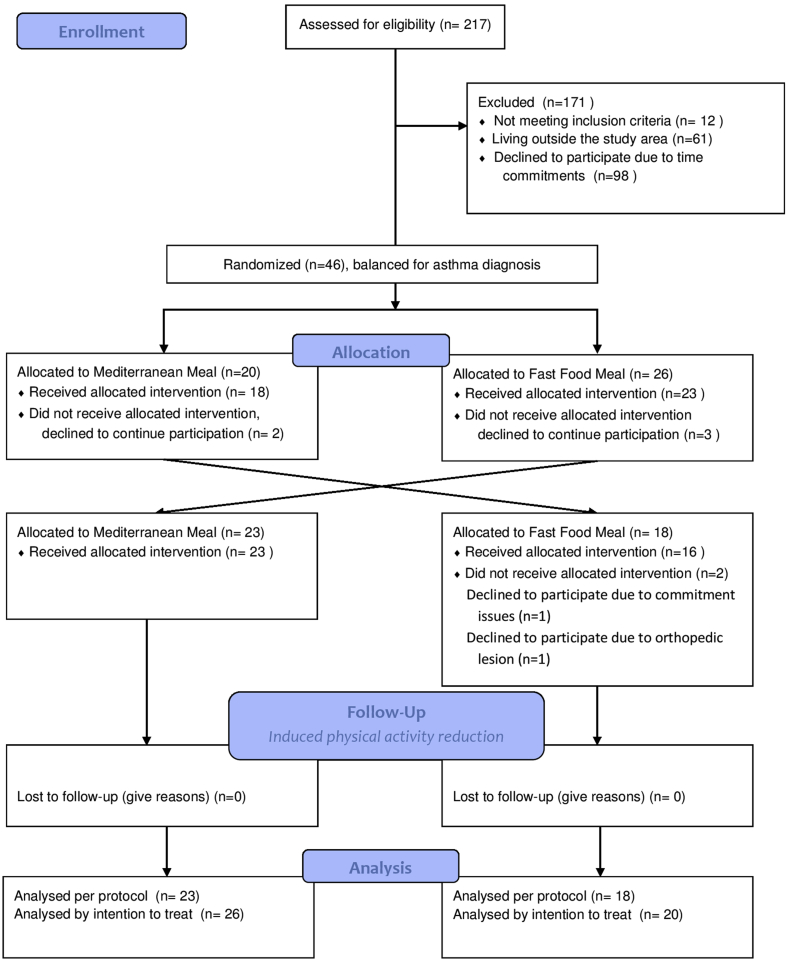
A total of 46 participants (26 females), median aged 25 years were included. Of those 39-completed protocol, including overweight, physical active and inactive and participants with asthma. There were no differences in the EC between interventions. Dietary factors and physical activity were closely monitored during interventions and kept similar. During physical inactivity induction, 31% reached the target of 50% reduction in mean step number and 77% reached a 30% reduction.
The use of a pre-exercise meal to modulate immune response and the understanding of the immunological impact of physical inactivity might help to establish future recommendations on how to practice exercise in a safer way and to recognize the potential impact of inactivity.
运动前用餐作为运动诱发免疫抑制的应对措施,其效果鲜为人知。此外,久坐行为与心血管代谢风险增加有关,但缺乏关于免疫变化的研究。因此,我们旨在评估:1)与快餐类膳食(FFM)相比,运动前地中海膳食(MdM)对运动诱发免疫变化的影响;2)诱导的急性久坐行为期对神经 - 免疫 - 内分泌状态的影响。
/设计:这是一项分两步的临床试验,包括:(a)随机交叉临床试验,比较高脂/低营养密度膳食(FFM)与等能量的类似高营养密度膳食(MdM)在运动挑战(EC)免疫反应中的效果;(b)一项试点试验,评估将日常身体活动水平减半所诱导的急性变化对神经 - 免疫 - 内分泌的影响。
共纳入46名参与者(26名女性),年龄中位数为25岁。其中39人完成方案,包括超重、身体活跃和不活跃者以及哮喘患者。各干预措施在运动挑战方面无差异。干预期间密切监测饮食因素和身体活动,并使其保持相似。在诱导久坐期间,31%的人达到平均步数减少50%的目标,77%的人达到减少30%的目标。
使用运动前膳食来调节免疫反应以及了解身体不活动对免疫的影响,可能有助于制定未来关于如何更安全地进行运动的建议,并认识到不活动的潜在影响。