Carvalho Cristina, Moreira Paula I
CNC - Center for Neuroscience and Cell Biology, University of Coimbra, Coimbra, Portugal.
Institute for Interdisciplinary Research, University of Coimbra, Coimbra, Portugal.
Front Physiol. 2018 Jul 3;9:806. doi: 10.3389/fphys.2018.00806. eCollection 2018.
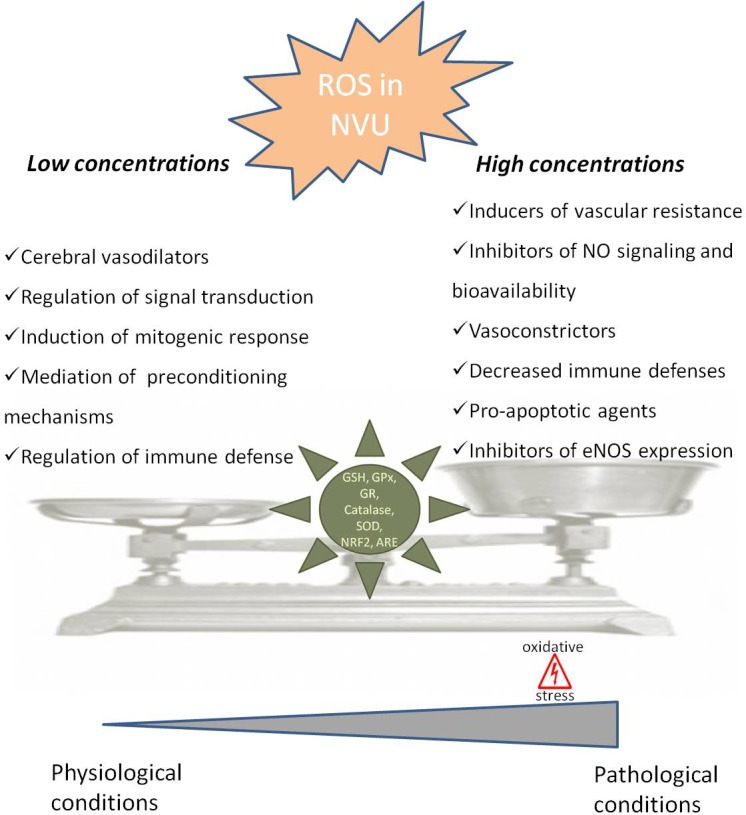
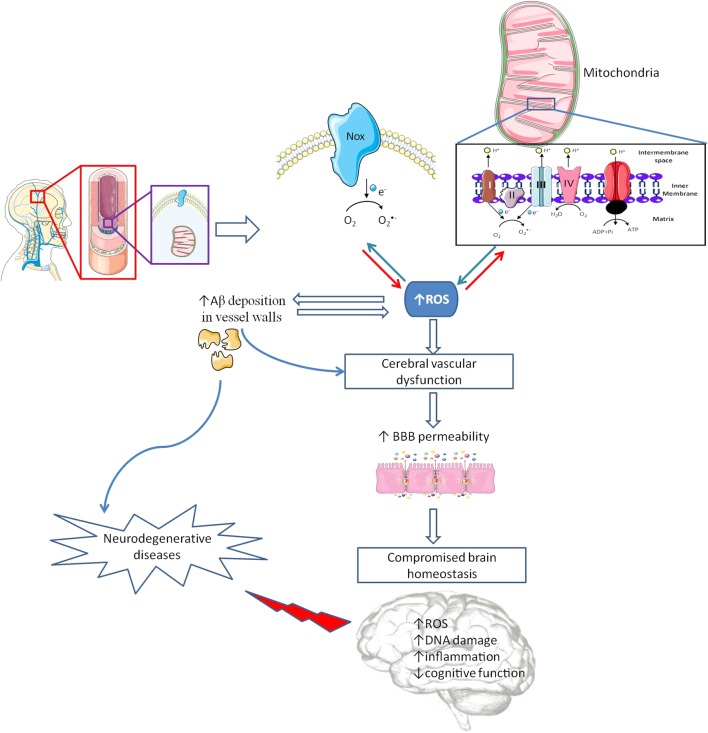
The brain is one of the most exquisite organs in the body with high metabolic demands, and requires a tight regulation of the surrounding environment. This tight control is exerted by the neurovascular unit (NVU) comprising different cell types, where endothelial cells play the commander-in-chief role. Thus, it is assumable that even slight perturbations in NVU might affect, in some cases irreversibly, brain homeostasis and health. In this line, recent findings support the two-hit vascular hypothesis for neurodegenerative conditions, where vascular dysfunction underlies the development of neurodegenerative diseases, such as Alzheimer's disease (AD). Knowing that endothelial cells are rich in mitochondria and nicotinamide adenine dinucleotide phosphate (NADPH) oxidases, two major reactive oxygen species (ROS) sources, this review aims to gather information on how oxidative stress is in the front line of vascular alterations observed in brain aging and neurodegenerative conditions, particularly AD. Also, a brief discussion about the therapeutic strategies aimed to protect against cerebrovascular diseases is included.
大脑是人体中最精密的器官之一,代谢需求很高,需要对周围环境进行严格调控。这种严格的控制由包含不同细胞类型的神经血管单元(NVU)来执行,其中内皮细胞起着总指挥的作用。因此,可以推测,即使NVU出现轻微扰动,在某些情况下可能会不可逆转地影响脑稳态和健康。在这方面,最近的研究结果支持神经退行性疾病的双打击血管假说,即血管功能障碍是神经退行性疾病(如阿尔茨海默病(AD))发展的基础。鉴于内皮细胞富含线粒体和烟酰胺腺嘌呤二核苷酸磷酸(NADPH)氧化酶这两种主要的活性氧(ROS)来源,本综述旨在收集有关氧化应激如何在脑衰老和神经退行性疾病(尤其是AD)中观察到的血管改变中处于前沿位置的信息。此外,还简要讨论了旨在预防脑血管疾病的治疗策略。