Eisinger Robert S, Urdaneta Morgan E, Foote Kelly D, Okun Michael S, Gunduz Aysegul
Department of Neuroscience, University of Florida, Gainesville, FL, United States.
Department of Neurosurgery, Center for Movement Disorders and Neurorestoration, University of Florida, Gainesville, FL, United States.
Front Neurosci. 2018 Jul 5;12:385. doi: 10.3389/fnins.2018.00385. eCollection 2018.
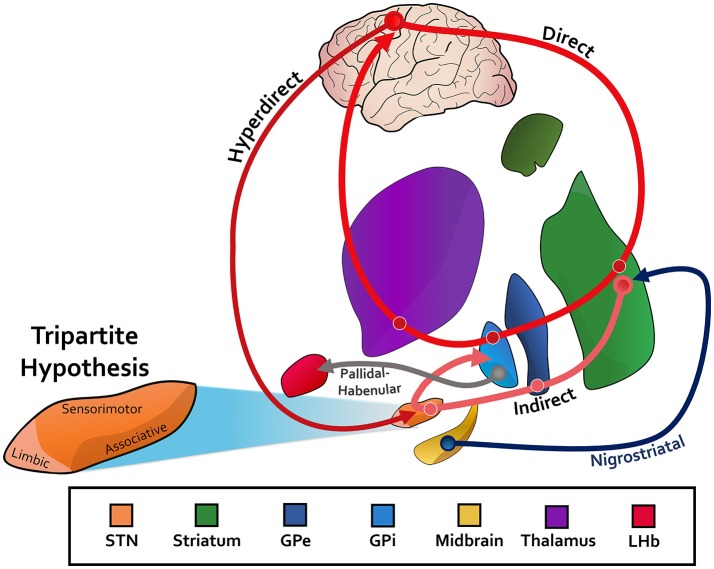
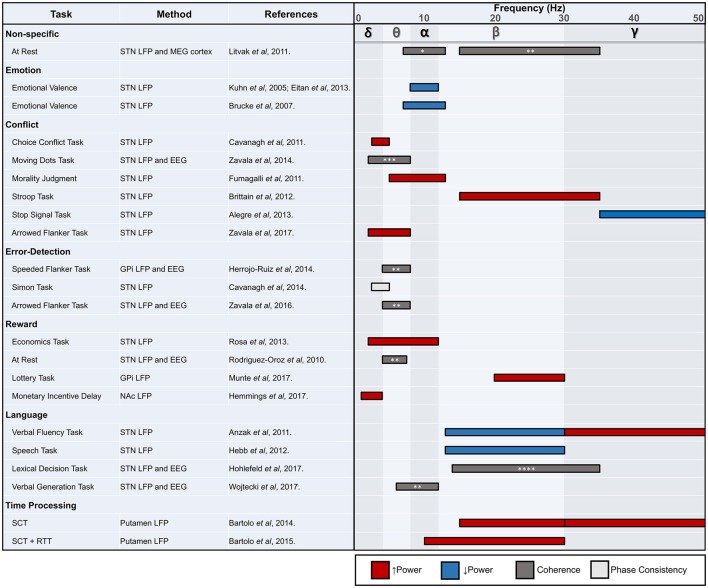
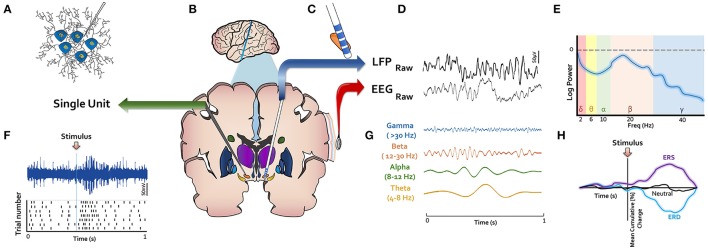
Although the basal ganglia have been implicated in a growing list of human behaviors, they include some of the least understood nuclei in the brain. For several decades studies have employed numerous methodologies to uncover evidence pointing to the basal ganglia as a hub of both motor and non-motor function. Recently, new electrophysiological characterization of the basal ganglia in humans has become possible through direct access to these deep structures as part of routine neurosurgery. Electrophysiological approaches for identifying non-motor function have the potential to unlock a deeper understanding of pathways that may inform clinical interventions and particularly neuromodulation. Various electrophysiological modalities can also be combined to reveal functional connections between the basal ganglia and traditional structures throughout the neocortex that have been linked to non-motor behavior. Several reviews have previously summarized evidence for non-motor function in the basal ganglia stemming from behavioral, clinical, computational, imaging, and non-primate animal studies; in this review, instead we turn to electrophysiological studies of non-human primates and humans. We begin by introducing common electrophysiological methodologies for basal ganglia investigation, and then we discuss studies across numerous non-motor domains-emotion, response inhibition, conflict, decision-making, error-detection and surprise, reward processing, language, and time processing. We discuss the limitations of current approaches and highlight the current state of the information.
尽管基底神经节与越来越多的人类行为有关,但它们包含了大脑中一些最不为人所了解的神经核团。几十年来,研究采用了多种方法来寻找证据,表明基底神经节是运动和非运动功能的枢纽。最近,作为常规神经外科手术的一部分,通过直接接触这些深部结构,对人类基底神经节进行新的电生理特征描述已成为可能。识别非运动功能的电生理方法有可能更深入地了解那些可能为临床干预尤其是神经调节提供信息的通路。各种电生理模式也可以结合起来,以揭示基底神经节与整个新皮层中与非运动行为相关的传统结构之间的功能联系。此前已有几篇综述总结了来自行为、临床、计算、成像和非灵长类动物研究的基底神经节非运动功能的证据;在本综述中,我们转而关注对非人类灵长类动物和人类的电生理研究。我们首先介绍用于基底神经节研究的常见电生理方法,然后讨论众多非运动领域的研究——情绪、反应抑制、冲突、决策、错误检测与惊讶、奖励处理、语言和时间处理。我们讨论了当前方法的局限性,并突出了当前的信息状态。