Department of Mechanical and Aerospace Engineering, Politecnico di Torino, Corso Duca degli Abruzzi 24, 10129 Turin, Italy; Department of Mechanical Engineering, Massachusetts Institute of Technology, 500 Technology Square, MIT Building, Room NE47-321, Cambridge, MA, 02139, USA.
Department of Mechanical Engineering, Massachusetts Institute of Technology, 500 Technology Square, MIT Building, Room NE47-321, Cambridge, MA, 02139, USA.
Biomaterials. 2018 Oct;180:117-129. doi: 10.1016/j.biomaterials.2018.07.014. Epub 2018 Jul 12.
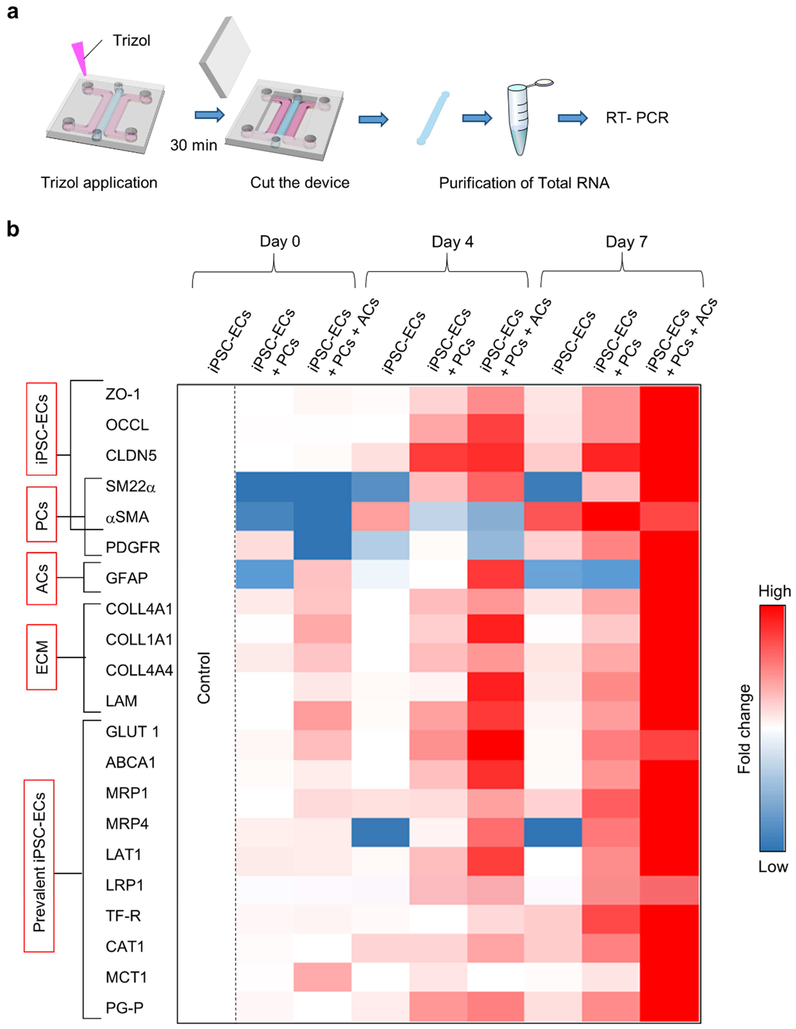
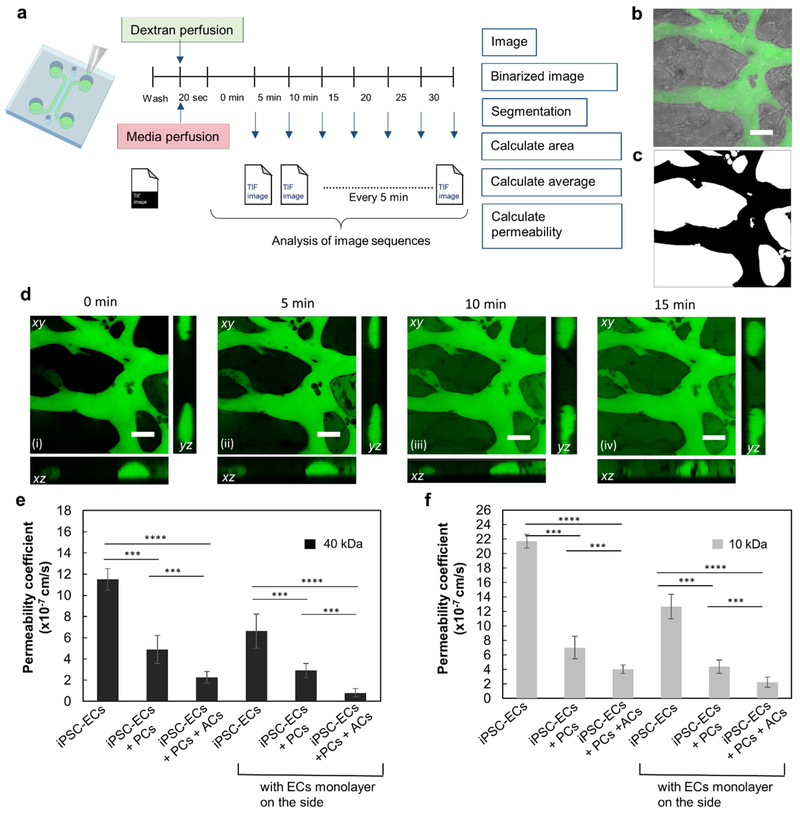
The blood-brain barrier (BBB) regulates molecular trafficking, protects against pathogens, and prevents efficient drug delivery to the brain. Models to date failed to reproduce the human anatomical complexity of brain barriers, contributing to misleading results in clinical trials. To overcome these limitations, a novel 3-dimensional BBB microvascular network model was developed via vasculogenesis to accurately replicate the in vivo neurovascular organization. This microfluidic system includes human induced pluripotent stem cell-derived endothelial cells, brain pericytes, and astrocytes as self-assembled vascular networks in fibrin gel. Gene expression of membrane transporters, tight junction and extracellular matrix proteins, was consistent with computational analysis of geometrical structures and quantitative immunocytochemistry, indicating BBB maturation and microenvironment remodelling. Confocal microscopy validated microvessel-pericyte/astrocyte dynamic contact-interactions. The BBB model exhibited perfusable and selective microvasculature, with permeability lower than conventional in vitro models, and similar to in vivo measurements in rat brain. This robust and physiologically relevant BBB microvascular model offers an innovative and valuable platform for drug discovery to predict neuro-therapeutic transport efficacy in pre-clinical applications as well as recapitulate patient-specific and pathological neurovascular functions in neurodegenerative disease.
血脑屏障(BBB)调节分子转运,保护机体免受病原体侵害,并防止药物有效递送至大脑。目前的模型未能复制人脑屏障的解剖复杂性,导致临床试验结果产生误导。为了克服这些限制,通过血管生成开发了一种新颖的 3 维 BBB 微血管网络模型,以准确复制体内神经血管组织。该微流控系统包括人诱导多能干细胞衍生的内皮细胞、脑周细胞和星形胶质细胞,作为纤维蛋白凝胶中的自组装血管网络。膜转运蛋白、紧密连接和细胞外基质蛋白的基因表达与几何结构的计算分析和定量免疫细胞化学一致,表明 BBB 成熟和微血管环境重塑。共聚焦显微镜验证了微血管-周细胞/星形胶质细胞动态接触相互作用。该 BBB 模型表现出可渗透和选择性的微血管,其通透性低于传统的体外模型,与大鼠脑中的体内测量值相似。这种稳健且与生理相关的 BBB 微血管模型为药物发现提供了一个创新且有价值的平台,可用于预测神经治疗药物在临床前应用中的输送效果,并重现神经退行性疾病中患者特异性和病理性的神经血管功能。