Jönsson Thérése, Ekvall Hansson Eva, Thorstensson Carina A, Eek Frida, Bergman Patrick, Dahlberg Leif E
Department of Clinical Sciences Lund, Orthopedics, Skane University Hospital, Lund University, Lund, Sweden.
BOA Registry, Centre of Registries, Västra Götaland, Gothenburg, Sweden.
BMC Musculoskelet Disord. 2018 Jun 21;19(1):198. doi: 10.1186/s12891-018-2098-3.
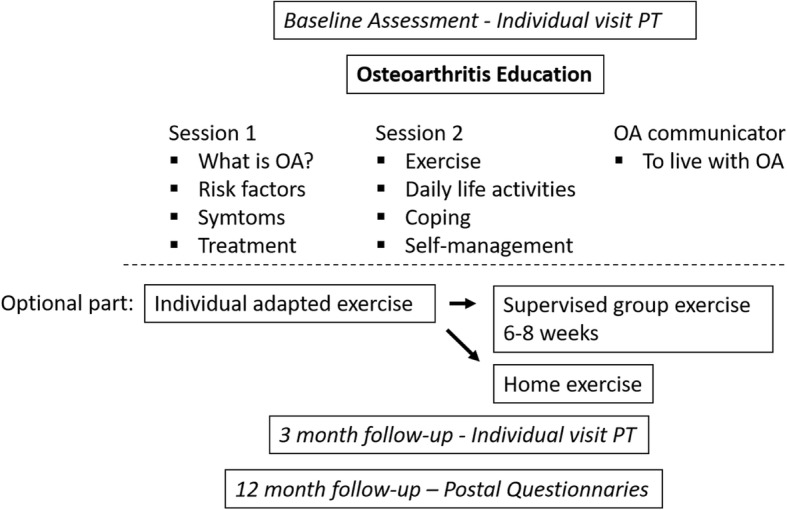
Individuals with knee and hip osteoarthritis (OA) are less physically active than people in general, and many of these individuals have adopted a sedentary lifestyle. In this study we evaluate the outcome of education and supervised exercise on the level of physical activity in individuals with knee or hip OA. We also evaluate the effect on pain, quality of life and self-efficacy.
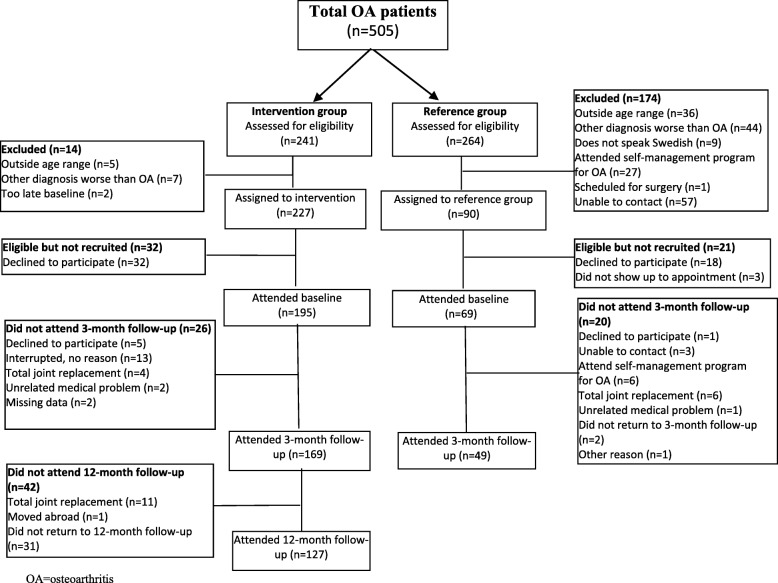
Of the 264 included individuals with knee or hip OA, 195 were allocated to the intervention group. The intervention group received education and supervised exercise that comprised information delivered by a physiotherapist and individually adapted exercises. The reference group consisted of 69 individuals with knee or hip OA awaiting joint replacement and receiving standard care. The primary outcome was physical activity (as measured with an accelerometer). The secondary outcomes were pain (Visual Analog Scale), quality of life (EQ-5D), and self-efficacy (Arthritis Self-Efficacy Scale, pain and other symptoms subscales). Participants in both groups were evaluated at baseline and after 3 months. The intervention group was also evaluated after 12 months.
No differences were found in the number of minutes spent in sedentary or in physical activity between the intervention and reference groups when comparing the baseline and 3 month follow-up. However, there was a significant difference in mean change (mean diff; 95% CI; significance) between the intervention group and reference group favoring the intervention group with regard to pain (13; 7 to 19; p < 0.001), quality of life (- 0.17; - 0.24 to - 0.10; p < 0.001), self-efficacy/other symptoms (- 5; - 10 to - 0.3; p < 0.04), and self-efficacy/pain (- 7; - 13 to - 2; p < 0.01). Improvements in pain and quality of life in the intervention group persisted at the 12-month follow-up.
Participation in an education and exercise program following the Swedish BOA program neither decreased the average amount of sedentary time nor increased the level of physical activity. However, participation in such a program resulted in decreased pain, increased quality of life, and increased self-efficacy.
The trial is registered with ClinicalTrials.gov. Registration number: NCT02022566 . Retrospectively registered 12/18/2013.
膝关节和髋关节骨关节炎(OA)患者的身体活动水平低于一般人群,其中许多人已养成久坐的生活方式。在本研究中,我们评估了教育和监督下的运动对膝关节或髋关节OA患者身体活动水平的影响。我们还评估了其对疼痛、生活质量和自我效能的影响。
在纳入的264例膝关节或髋关节OA患者中,195例被分配到干预组。干预组接受了教育和监督下的运动,包括物理治疗师提供的信息和个性化的运动。对照组由69例等待关节置换并接受标准护理的膝关节或髋关节OA患者组成。主要结局是身体活动(用加速度计测量)。次要结局是疼痛(视觉模拟量表)、生活质量(EQ-5D)和自我效能(关节炎自我效能量表,疼痛和其他症状子量表)。两组参与者在基线时和3个月后进行评估。干预组在12个月后也进行了评估。
在比较基线和3个月随访时,干预组和对照组在久坐或身体活动所花费的分钟数上没有差异。然而,在疼痛(13;7至19;p<0.001)、生活质量(-0.17;-0.24至-0.10;p<0.001)、自我效能/其他症状(-5;-10至-0.3;p<0.04)和自我效能/疼痛(-7;-13至-2;p<0.01)方面,干预组和对照组之间的平均变化(平均差异;95%置信区间;显著性)存在显著差异,有利于干预组。干预组的疼痛和生活质量改善在12个月随访时持续存在。
按照瑞典骨关节炎协会(BOA)计划参与教育和运动计划既没有减少平均久坐时间,也没有提高身体活动水平。然而,参与这样的计划可减轻疼痛、提高生活质量并增强自我效能。
该试验已在ClinicalTrials.gov注册。注册号:NCT02022566。2013年12月18日追溯注册。