Department of Infectious Disease Epidemiology, School of Public Health, Imperial College London, London, UK.
Department of Biochemistry and Molecular Biology, Bio21 Molecular Science and Biotechnology Institute, The University of Melbourne, Victoria, Australia; The London School of Hygiene and Tropical Medicine, London, United Kingdom.
Trends Microbiol. 2018 Dec;26(12):1008-1021. doi: 10.1016/j.tim.2018.06.006. Epub 2018 Jul 20.
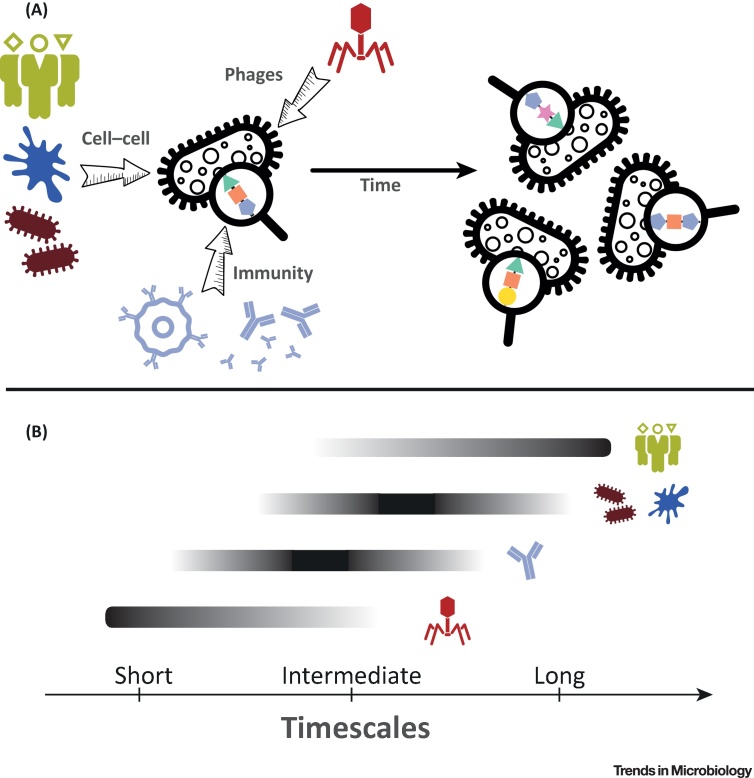
Bacterial pathogens and commensals are surrounded by diverse surface polysaccharides which include capsules and lipopolysaccharides. These carbohydrates play a vital role in bacterial ecology and interactions with the environment. Here, we review recent rapid advancements in this field, which have improved our understanding of the roles, structures, and genetics of bacterial polysaccharide antigens. Genetic loci encoding the biosynthesis of these antigens may have evolved as bacterial diversity-generating machines, driven by selection from a variety of forces, including host immunity, bacteriophages, and cell-cell interactions. We argue that the high adaptive potential of polysaccharide antigens should be taken into account in the design of polysaccharide-targeting medical interventions like conjugate vaccines and phage-based therapies.
细菌病原体和共生菌被多种表面多糖所包围,其中包括荚膜和脂多糖。这些碳水化合物在细菌生态学和与环境的相互作用中起着至关重要的作用。在这里,我们回顾了该领域的最新快速进展,这些进展提高了我们对细菌多糖抗原的作用、结构和遗传学的理解。编码这些抗原生物合成的遗传基因座可能是作为细菌多样性产生的机器而进化的,其驱动力来自多种力量的选择,包括宿主免疫、噬菌体和细胞-细胞相互作用。我们认为,在设计针对多糖的医疗干预措施(如结合疫苗和噬菌体疗法)时,应该考虑到多糖抗原的高适应性潜力。