Program on Reproductive Health and the Environment, Department of Obstetrics, Gynecology and Reproductive Sciences, University of California, San Francisco, California, USA
Bakar Computational Health Sciences Institute, University of California, San Francisco, California, USA
Environ Health Perspect. 2018 Jul 24;126(7):077009. doi: 10.1289/EHP2920. eCollection 2018 Jul.
exposure to environmental chemicals can adversely impact pregnancy outcomes and childhood health, but minimal biomonitoring data exist on the majority of chemicals used in commerce.
We aimed to profile exposure to multiple environmental organic acids (EOAs) and identify novel chemicals that have not been previously biomonitored in a diverse population of pregnant women.
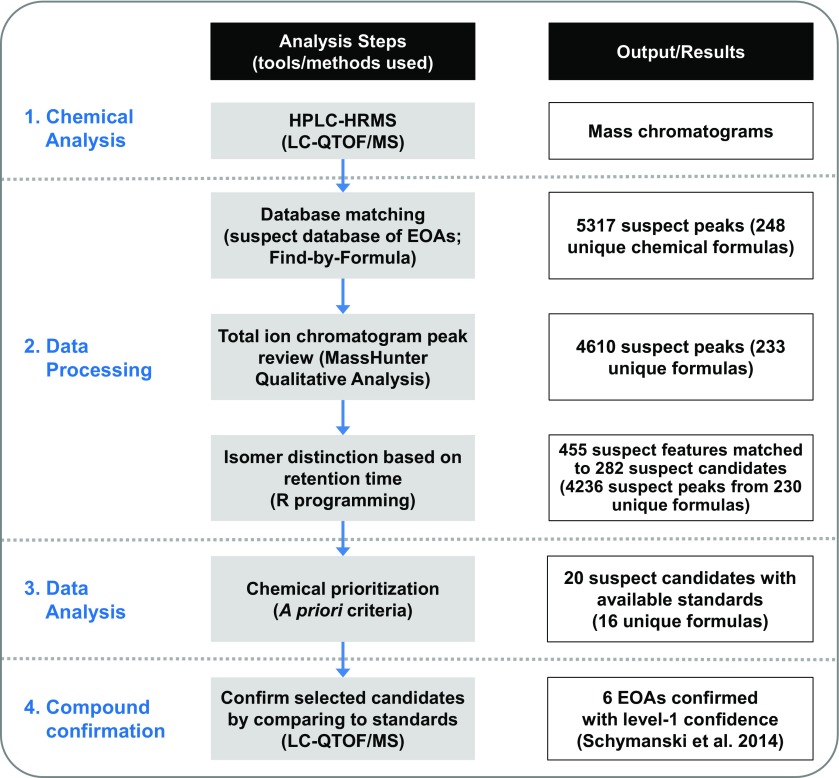
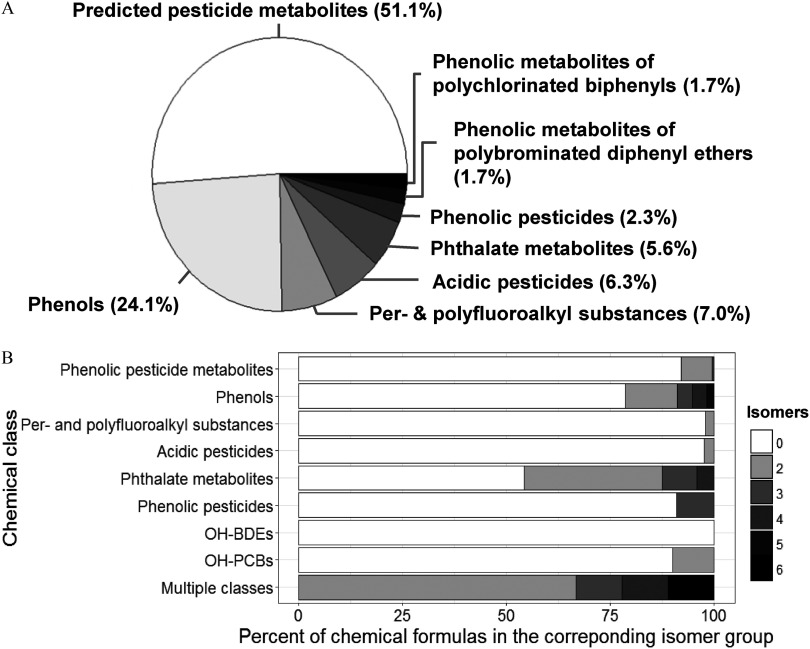
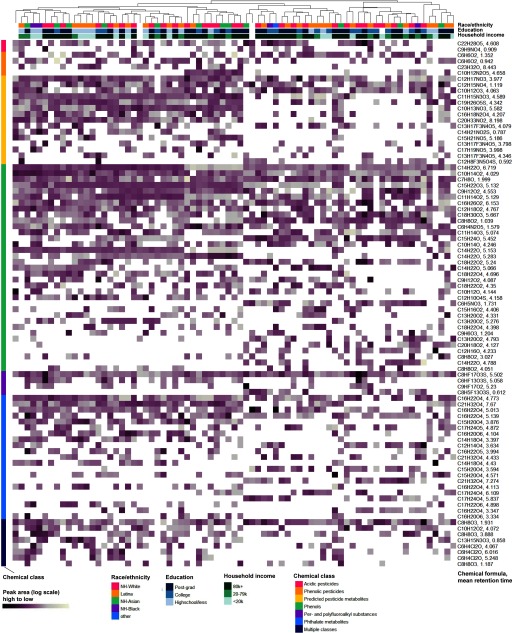
We used liquid chromatography-quadrupole time-of-flight mass spectrometry (LC-QTOF/MS) to perform a suspect screen for 696 EOAs, (e.g., phenols and phthalate metabolites) on the maternal serum collected at delivery from 75 pregnant women delivering at two large San Francisco Hospitals. We examined demographic differences in peak areas and detection frequency (DF) of suspect EOAs using a Kruskal-Wallis Rank Sum test or Fisher's exact test. We confirmed selected suspects by comparison with their respective reference standards.
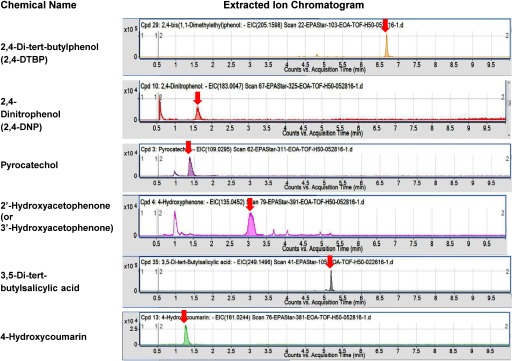
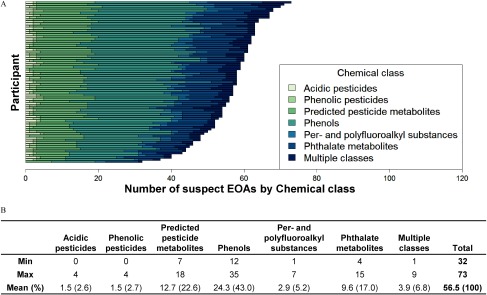
We detected, on average, 56 [standard deviation (SD)]: 8) suspect EOAs in each sample (range: 32-73). Twelve suspect EOAs with DF≥60 were matched to 21 candidate compounds in our EOA database, two-thirds of which are novel chemicals. We found demographic differences in DF for 13 suspect EOAs and confirmed the presence of 6 priority novel chemicals: 2,4-Di-tert-butylphenol, Pyrocatechol, 2,4-Dinitrophenol, 3,5-Di-tert-butylsalicylic acid, 4-Hydroxycoumarin, and 2'-Hydroxyacetophenone (or 3'-Hydroxyacetophenone). The first two are high-production-volume chemicals in the United States.
Suspect screening in human biomonitoring provides a viable method to characterize a broad spectrum of environmental chemicals to prioritize for targeted method development and quantification. https://doi.org/10.1289/EHP2920.
接触环境化学物质会对妊娠结局和儿童健康产生不利影响,但商业用途的大多数化学物质的生物监测数据极少。
我们旨在描述多种环境有机酸(EOAs)的暴露情况,并确定在不同人群的孕妇中以前未进行生物监测的新型化学物质。
我们使用液相色谱-四级杆飞行时间质谱(LC-QTOF/MS)对来自两家旧金山大型医院分娩的 75 名孕妇分娩时采集的母体血清中的 696 种 EOAs(例如酚类和邻苯二甲酸代谢物)进行了嫌疑筛查。我们使用 Kruskal-Wallis 秩和检验或 Fisher 确切检验检查了不同人群中可疑 EOAs 的峰面积和检测频率(DF)的差异。我们通过与各自的参比标准进行比较来确认选定的可疑物。
我们平均检测到每个样本中的 56 [标准差(SD)]:8)可疑 EOAs(范围:32-73)。12 种 DF≥60 的可疑 EOAs 与我们的 EOA 数据库中的 21 种候选化合物匹配,其中三分之二是新型化学物质。我们发现 13 种可疑 EOAs 的 DF 存在差异,并确认了 6 种优先新型化学物质的存在:2,4-二叔丁基苯酚、邻苯二酚、2,4-二硝基苯酚、3,5-二叔丁基水杨酸、4-羟基香豆素和 2'-乙酰基苯乙酮(或 3'-乙酰基苯乙酮)。前两种是美国高产量的化学物质。
可疑筛查在人体生物监测中提供了一种可行的方法,可以对广泛的环境化学物质进行特征描述,以优先进行有针对性的方法开发和量化。https://doi.org/10.1289/EHP2920.