Murray Olivia, Turner Debra, Streeter Kristen, Guo Jianhua, Shivaprasad H L, Payne Susan, Tizard Ian
Schubot Exotic Bird Health Center, Department of Veterinary Pathobiology, College of Veterinary Medicine, Texas A&M University, College Station, TX,
California Animal Health and Food Safety Laboratory System, University of California, Tulare, CA, USA.
Vet Med (Auckl). 2017 Jul 6;8:31-36. doi: 10.2147/VMRR.S134969. eCollection 2017.
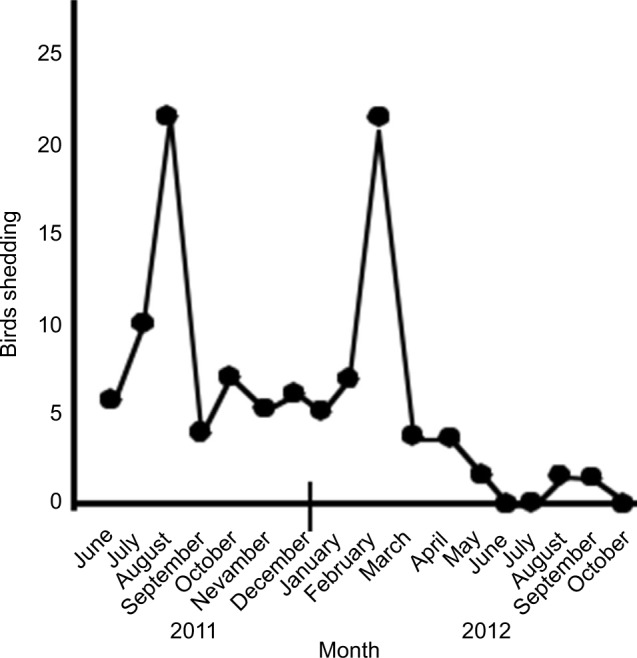
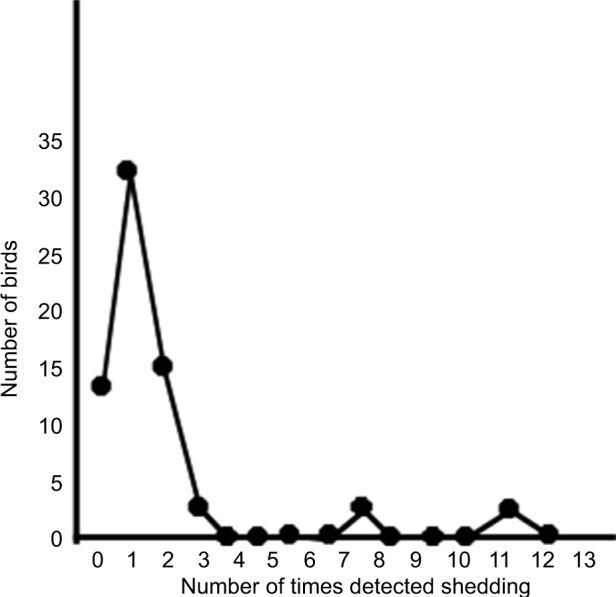
Parrot bornavirus (PaBV), the etiologic agent of proventricular dilatation disease (PDD), is a major cause of concern in the avian health community. Within an infected flock, some birds will develop PDD and succumb to disease, while others remain healthy. Until now, there has been no study describing the results of long-term infection in apparently healthy carriers. For the last 5 years, the Schubot Exotic Bird Health Center at Texas A&M University has monitored individual PaBV shedding data in a flock of 66 naturally infected cockatiels. Of these birds, 53 were detected shedding PaBV4 in their droppings by reverse transcriptase polymerase chain reaction on at least one occasion. However, the prevalence of shedding declined over time, with the last positive cloacal swab being in October 2013. To determine whether the decline and eventual lack of shedding was an indication of virus elimination, seven previously shedding birds were euthanized and necropsied in 2016. Neither any gross lesion of PDD was observed nor was there any evidence of PDD or bornaviral encephalitis detected by histopathology. All tissues tested were negative for the presence of PaBV by reverse transcriptase polymerase chain reaction and immunohistochemistry. Thus, there was no evidence of an ongoing, productive infection in these birds. There are two possible explanations for these results. One possibility is that the birds were previously infected and have subsequently eliminated the virus. Alternatively, there may have been as few as three truly infected birds in the flock and the transient detection of PaBV in the droppings of other birds may simply be a "pass-through" phenomenon.
鹦鹉博尔纳病毒(PaBV)是嗉囊扩张病(PDD)的病原体,是鸟类健康领域主要关注的问题。在受感染的鸟群中,一些鸟会患上PDD并死于该病,而其他鸟则保持健康。到目前为止,尚无研究描述表面健康的携带者长期感染的结果。在过去5年里,德克萨斯农工大学的舒博特珍禽健康中心监测了一群66只自然感染的玄凤鹦鹉个体的PaBV排毒数据。在这些鸟中,至少有一次通过逆转录聚合酶链反应检测到53只鸟的粪便中排出PaBV4。然而,随着时间的推移,排毒率下降,最后一次泄殖腔拭子检测呈阳性是在2013年10月。为了确定排毒率下降以及最终停止排毒是否表明病毒已被清除,2016年对7只之前有排毒现象的鸟实施安乐死并进行了尸检。既未观察到PDD的任何大体病变,组织病理学检查也未发现PDD或博尔纳病毒脑炎的任何证据。通过逆转录聚合酶链反应和免疫组织化学检测,所有检测的组织中均未检测到PaBV的存在。因此,没有证据表明这些鸟存在持续的、有活性的感染。对于这些结果有两种可能的解释。一种可能性是这些鸟之前受到感染,随后已清除病毒。另一种可能性是,该鸟群中可能只有3只真正受感染的鸟,而在其他鸟的粪便中短暂检测到PaBV可能只是一种“一过性”现象。