Ayele Yohanes, Taye Henok
Department of Clinical Pharmacy, School of Pharmacy, College of Health and Medical Sciences, Haramaya University, P.O. Box 235, Harar, Ethiopia.
Dil Chora Referal Hospital, Dire Dawa, Ethiopia.
BMC Res Notes. 2018 Jul 31;11(1):537. doi: 10.1186/s13104-018-3629-6.
The aim of this study was to assess utilization pattern of surgical antibiotic prophylaxis in surgical wards of Dil Chora Referral Hospital.
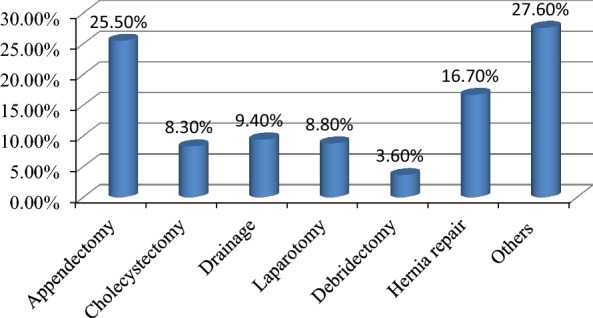
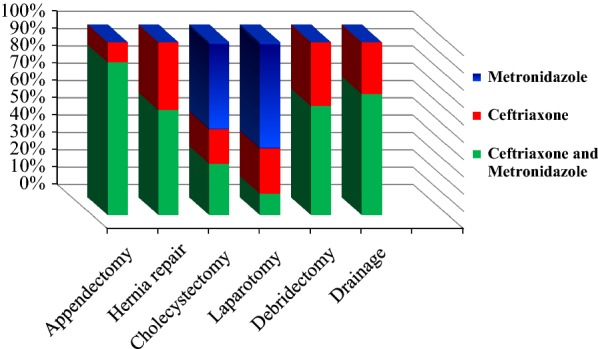
Prophylactic antibiotics were given in all surgical procedures. More than half of the participants 206(53.6%) were given Ceftriaxone while combination of Ceftriaxone and Metronidazole were used for 159(41.4%) patients. The most common procedure (88.3%), appendectomy, was managed with combination of Ceftriaxone and Metronidazole while the remaining was on Ceftriaxone. Hernia repair, another common procedure seen in this ward, was majorly managed by combination of Ceftriaxone and Metronidazole (60.7%) while the rest were on ceftriaxone alone. In general, inconsistence in antibiotic selection for different types of surgical procedures was seen. The surgical prophylactic antibiotics should be prescribed according to the international guidelines.
本研究旨在评估迪尔乔拉转诊医院外科病房手术抗生素预防的使用模式。
所有外科手术均使用了预防性抗生素。超过一半的参与者206人(53.6%)使用了头孢曲松,而159人(41.4%)的患者使用了头孢曲松和甲硝唑的联合用药。最常见的手术(88.3%),即阑尾切除术,采用头孢曲松和甲硝唑联合治疗,其余则使用头孢曲松。疝修补术是该病房另一种常见手术,主要采用头孢曲松和甲硝唑联合治疗(60.7%),其余仅使用头孢曲松。总体而言,不同类型外科手术的抗生素选择存在不一致性。手术预防性抗生素应根据国际指南开具。