Yoav Shahar, Salame Tomer M, Feldman Daria, Levinson Dana, Ioelovich Michael, Morag Ely, Yarden Oded, Bayer Edward A, Hadar Yitzhak
1Department of Plant Pathology and Microbiology, Robert H. Smith Faculty of Agriculture, Food and Environment, The Hebrew University of Jerusalem, Rehovot, 76100 Israel.
2Flow Cytometry Unit, Life Sciences Core Facilities, Weizmann Institute of Science, Rehovot, 76100 Israel.
Biotechnol Biofuels. 2018 Jul 27;11:212. doi: 10.1186/s13068-018-1209-6. eCollection 2018.
During the process of bioethanol production, cellulose is hydrolyzed into its monomeric soluble units. For efficient hydrolysis, a chemical and/or mechanical pretreatment step is required. Such pretreatment is designed to increase enzymatic digestibility of the cellulose chains inter alia by de-crystallization of the cellulose chains and by removing barriers, such as lignin from the plant cell wall. Biological pretreatment, in which lignin is decomposed or modified by white-rot fungi, has also been considered. One disadvantage in biological pretreatment, however, is the consumption of the cellulose by the fungus. Thus, fungal species that attack lignin with only minimal cellulose loss are advantageous. The secretomes of white-rot fungi contain carbohydrate-active enzymes (CAZymes) including lignin-modifying enzymes. Thus, modification of secretome composition can alter the ratio of lignin/cellulose degradation.
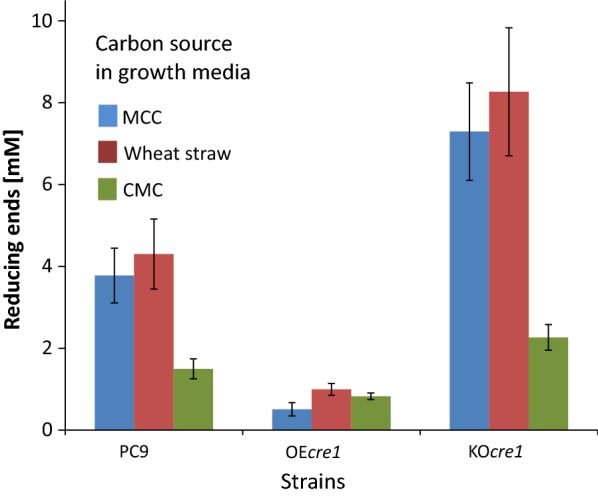
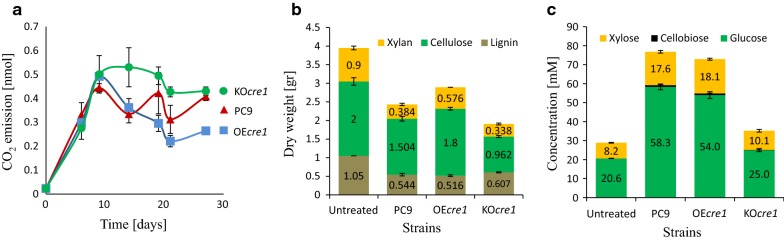
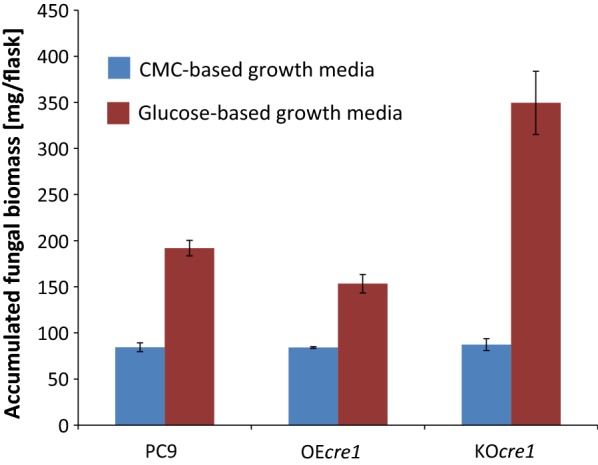
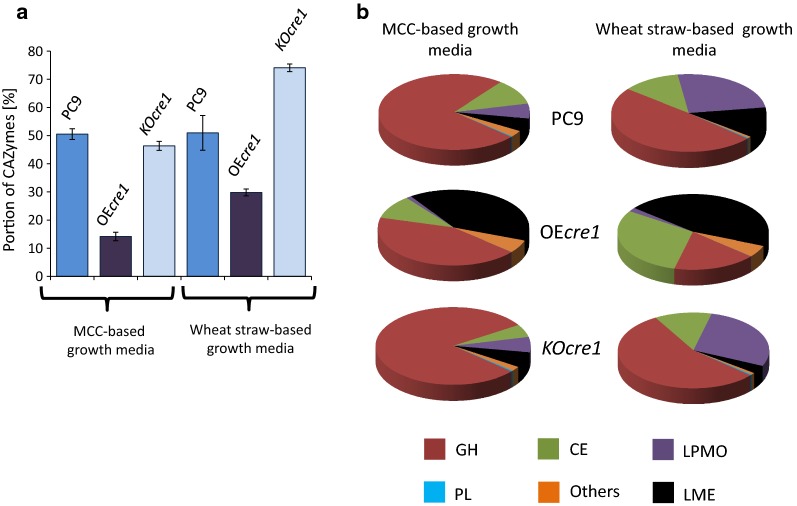
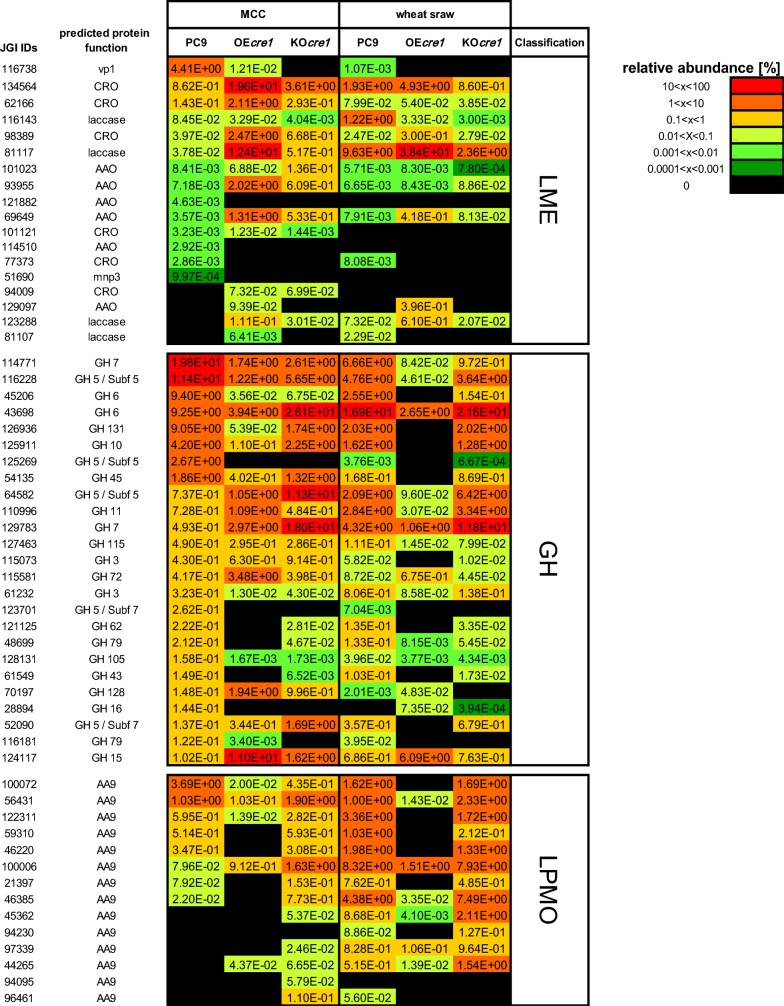
was genetically modified to either overexpress or eliminate (by gene replacement) the transcriptional regulator CRE1, known to act as a repressor in the process of carbon catabolite repression. The -overexpressing transformant demonstrated lower secreted cellulolytic activity and slightly increased selectivity (based on the chemical composition of pretreated wheat straw), whereas the knockout transformant demonstrated increased cellulolytic activity and significantly reduced residual cellulose, thereby displaying lower selectivity. Pretreatment of wheat straw using the wild-type PC9 resulted in 2.8-fold higher yields of soluble sugar compared to untreated wheat straw. The overexpression transformant showed similar yields (2.6-fold), but the knockout transformant exhibited lower yields (1.2-fold) of soluble sugar. Based on proteomic secretome analysis, production of numerous CAZymes was affected by modification of the expression level of .
The gene functions as a regulator for expression of fungal CAZymes active against plant cell wall lignocelluloses, hence altering the substrate preference of the fungi tested. While the knockout resulted in a less efficient biological pretreatment, i.e., less saccharification of the treated biomass, the converse manipulation of (overexpression) failed to improve efficiency. Despite the inverse nature of the two genetic alterations, the expected "mirror image" (i.e., opposite regulatory response) was not observed, indicating that the secretion level of CAZymes, was not exclusively dependent on CRE1 activity.
在生物乙醇生产过程中,纤维素被水解成其单体可溶性单元。为了实现高效水解,需要进行化学和/或机械预处理步骤。这种预处理旨在通过使纤维素链脱结晶以及去除植物细胞壁中的木质素等障碍来提高纤维素链的酶消化率。也有人考虑过生物预处理,即通过白腐真菌分解或修饰木质素。然而,生物预处理的一个缺点是真菌会消耗纤维素。因此,仅使纤维素损失最小的攻击木质素的真菌物种具有优势。白腐真菌的分泌蛋白组包含碳水化合物活性酶(CAZymes),包括木质素修饰酶。因此,改变分泌蛋白组的组成可以改变木质素/纤维素降解的比例。
通过基因改造使(某真菌)要么过表达要么消除(通过基因替换)转录调节因子CRE1,已知该调节因子在碳分解代谢物阻遏过程中起阻遏作用。过表达转化体表现出较低的分泌纤维素分解活性和略有增加的选择性(基于预处理小麦秸秆的化学成分),而敲除转化体表现出增加的纤维素分解活性和显著降低的残留纤维素,从而显示出较低的选择性。与未处理的小麦秸秆相比,使用野生型PC9对小麦秸秆进行预处理可使可溶性糖产量提高2.8倍。过表达转化体显示出相似的产量(2.6倍),但敲除转化体的可溶性糖产量较低(1.2倍)。基于蛋白质组学分泌蛋白组分析,许多CAZymes的产生受到(某真菌)表达水平改变影响。
基因 作为针对植物细胞壁木质纤维素的真菌CAZymes表达的调节因子,从而改变所测试真菌的底物偏好。虽然 敲除导致生物预处理效率较低,即处理后的生物质糖化较少,但对 进行相反的操作(过表达)未能提高效率。尽管这两种基因改变具有相反的性质,但未观察到预期的“镜像”(即相反的调节反应),这表明CAZymes的分泌水平并不完全依赖于CRE1活性。