Brenner Darren R, Poirier Abbey E, Walter Stephen D, King Will D, Franco Eduardo L, Demers Paul A, Villeneuve Paul J, Ruan Yibing, Khandwala Farah, Grevers Xin, Nuttall Robert, Smith Leah, De Prithwish, Volesky Karena, O'Sullivan Dylan, Hystad Perry, Friedenreich Christine M
Departments of Oncology and Community Health Sciences, Cumming School of Medicine, University of Calgary, Calgary, Alberta, Canada.
Department of Cancer Epidemiology and Prevention Research, CancerControl Alberta, Alberta Health Services, Calgary, Alberta, Canada.
BMJ Open. 2018 Aug 1;8(7):e022378. doi: 10.1136/bmjopen-2018-022378.
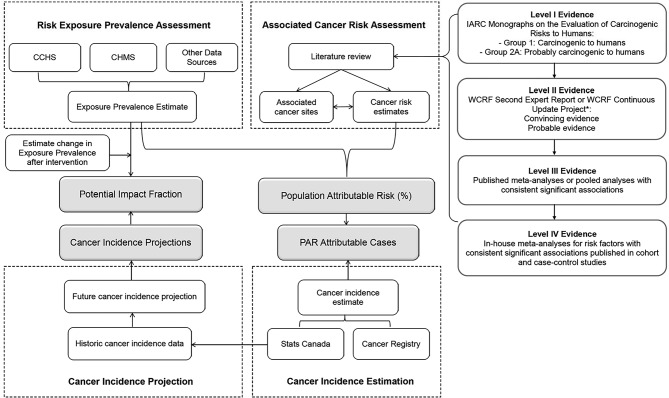
The Canadian Population Attributable Risk of Cancer project aims to quantify the number and proportion of cancer cases incident in Canada, now and projected to 2042, that could be prevented through changes in the prevalence of modifiable exposures associated with cancer. The broad risk factor categories of interest include tobacco, diet, energy imbalance, infectious diseases, hormonal therapies and environmental factors such as air pollution and residential radon.
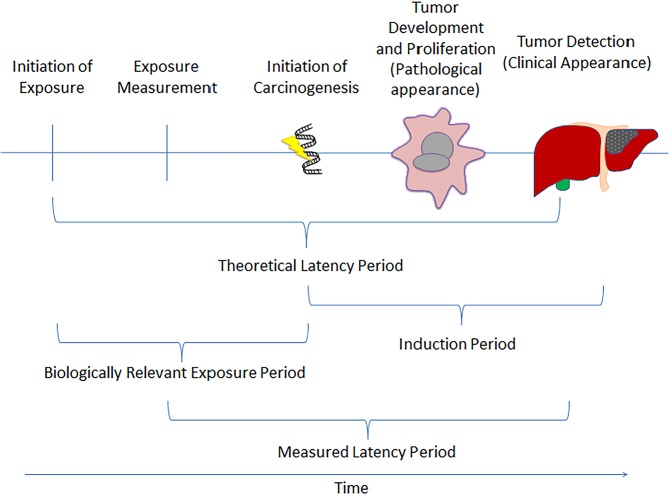
Using a national network, we will use population-attributable risks (PAR) and potential impact fractions (PIF) to model both attributable (current) and avoidable (future) cancers. The latency periods and the temporal relationships between exposures and cancer diagnoses will be accounted for in the analyses. For PAR estimates, historical exposure prevalence data and the most recent provincial and national cancer incidence data will be used. For PIF estimates, we will model alternative or 'counterfactual' distributions of cancer risk factor exposures to assess how cancer incidence could be reduced under different scenarios of population exposure, projecting incidence to 2042.
The framework provided can be readily extended and applied to other populations or jurisdictions outside of Canada. An embedded knowledge translation and exchange component of this study with our Canadian Cancer Society partners will ensure that these findings are translated to cancer programmes and policies aimed at population-based cancer risk reduction strategies.
加拿大癌症人群归因风险项目旨在量化加拿大目前以及预计到2042年期间,因可改变的癌症相关暴露因素流行率变化而可预防的癌症病例数量和比例。感兴趣的广泛风险因素类别包括烟草、饮食、能量失衡、传染病、激素疗法以及空气污染和室内氡等环境因素。
通过一个全国性网络,我们将使用人群归因风险(PAR)和潜在影响分数(PIF)来模拟归因性(当前)和可避免性(未来)癌症。分析中将考虑暴露与癌症诊断之间的潜伏期和时间关系。对于PAR估计,将使用历史暴露流行率数据以及最新的省级和全国癌症发病率数据。对于PIF估计,我们将对癌症风险因素暴露的替代或“反事实”分布进行建模,以评估在不同人群暴露情景下癌症发病率如何降低,并预测到2042年的发病率。
所提供的框架可轻松扩展并应用于加拿大以外的其他人群或司法管辖区。本研究与加拿大癌症协会合作伙伴的嵌入式知识转化与交流部分将确保这些研究结果转化为旨在基于人群的癌症风险降低策略的癌症项目和政策。