Centre for Clinical Epidemiology, Institute of Clinical Research, National Institute of Health, Ministry of Health Malaysia, Persiaran Setia Murni, Setia Alam, 40170, Shah Alam, Selangor, Malaysia.
BMC Public Health. 2021 Feb 26;21(1):410. doi: 10.1186/s12889-021-10412-9.
This is a systematic assessment of the burden of cancers in Malaysia in 2018 using epidemiologic approach. The purpose of this study was to identify the proportion of cancers in Malaysia that were attributable to the modifiable risk factors of excess weight, alcohol intake, physical inactivity, tobacco smoking and to estimate the number of cancer cases that could be prevented if the exposure to the modifiable risk factor was reduced.
We estimated the Population Attributable Fraction (PAF) of the modifiable risk factors to cancers incidences in Malaysia. The two parameters used for the estimation were exposure prevalence from national representative surveys and the relative risk of getting the cancers from worldwide literature review.
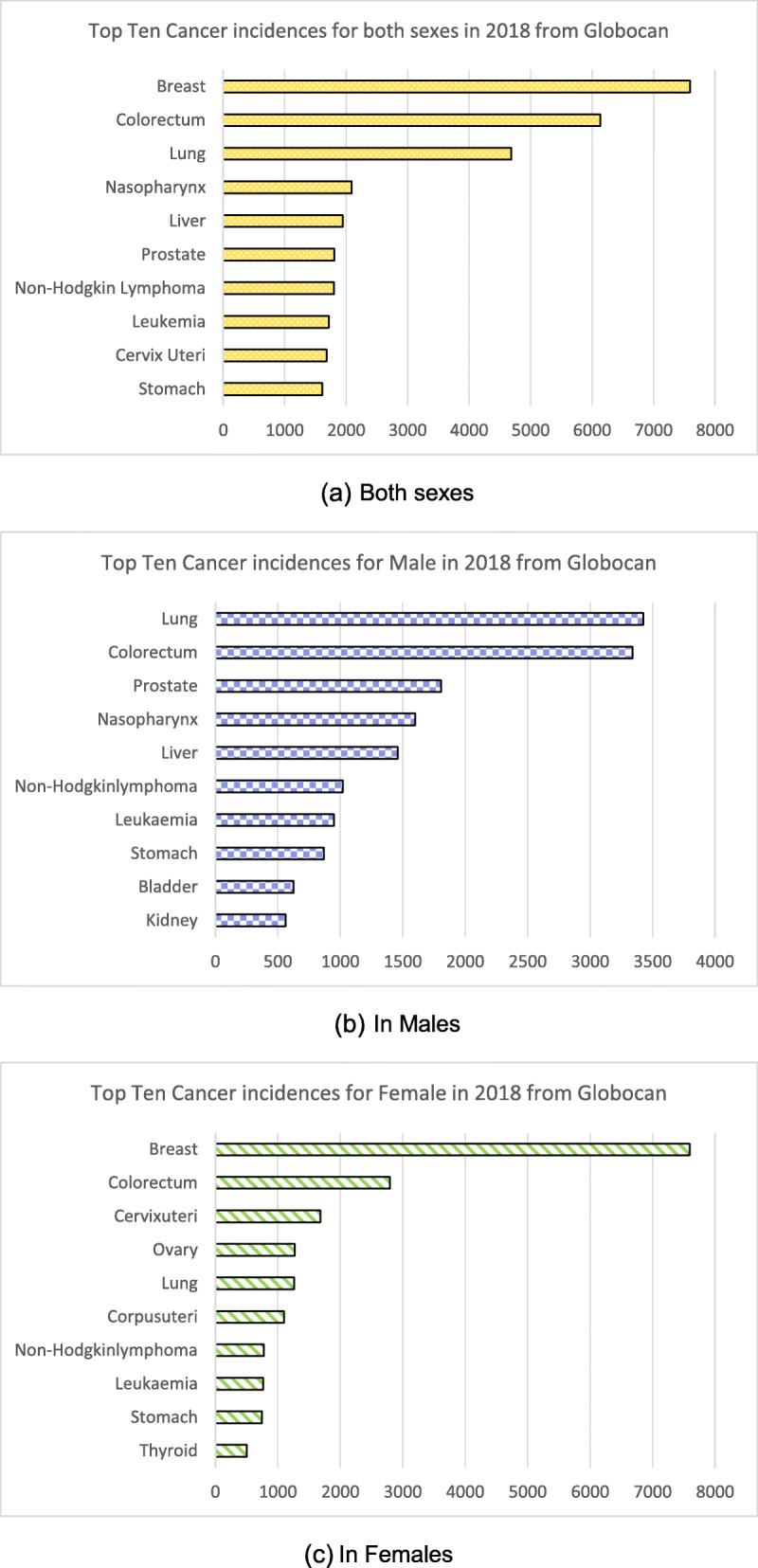
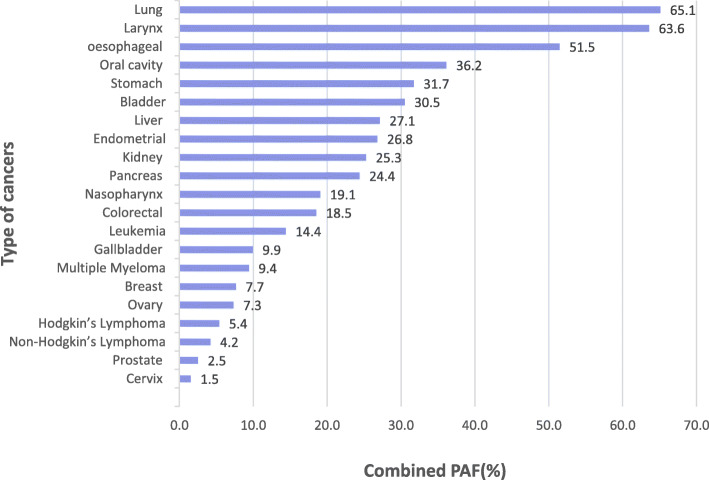
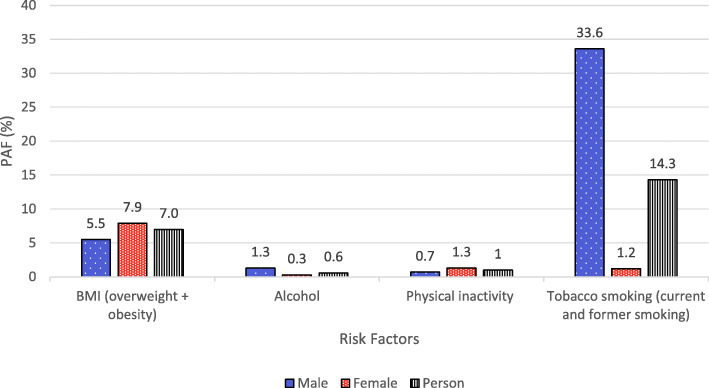
Among 38,426 cancer incidences in 2018 from Globocan data, we estimated that 22.2% (95% confidence interval (CI):14.9 to 29.6%) of the cancer incidences included in this study were attributable to the investigated modifiable risk factors. 39.1% (95% CI:27.2 to 49.7%) and 10.5% (95% CI:5.8 to 15.7%) of cancers in male and female respectively, were attributable to the studied modifiable risk factors. The top main cancers attributed by the risk factors were lung cancer (65.1%; 95% CI:56.4 to 72.9%), laryngeal cancer (63.6%; 95% CI:39.9 to 80.5%), and oesophageal cancer (51.5%; 95% CI:39.9 to 62.0%). For each risk factor studied across genders, tobacco smoking contributed the most (14.3%; 95% CI:9.9 to 17.3%), followed by excess weight (7.0%; 95% CI:4.1 to 10.2%), physical inactivity (1.0%; 95% CI:0.4 to 1.7%) and alcohol intake (0.6%; 95% CI:0.2 to 1.0%).
Findings from this study suggests that tobacco smoking and excess weight are the two predominant factors out of the four studied risk factors for cancer cases in Malaysia. Nationwide public health prevention campaigns tailored to these risk factors are recommended. However, the other risk factors such as physical inactivity and alcohol intake shall not be neglected. PAFs are estimated based on the best available data that we have currently. Regular collection of other risk factor exposure prevalence data is vital for future analyses.
本研究采用流行病学方法系统评估了 2018 年马来西亚癌症负担。本研究的目的是确定马来西亚癌症中归因于超重、饮酒、身体活动不足、吸烟等可改变的危险因素的比例,并估计如果降低可改变的危险因素暴露,可预防多少癌症病例。
我们估计了可改变的危险因素对马来西亚癌症发病率的人群归因分数(PAF)。用于估计的两个参数是来自全国代表性调查的暴露流行率和来自全球文献综述的癌症相对风险。
根据 Globocan 数据,在 2018 年的 38426 例癌症发病中,我们估计本研究纳入的癌症发病中,22.2%(95%置信区间:14.9%至 29.6%)归因于所研究的可改变的危险因素。男性和女性分别有 39.1%(95%置信区间:27.2%至 49.7%)和 10.5%(95%置信区间:5.8%至 15.7%)的癌症归因于所研究的可改变的危险因素。受这些危险因素影响的主要癌症类型是肺癌(65.1%;95%置信区间:56.4%至 72.9%)、喉癌(63.6%;95%置信区间:39.9%至 80.5%)和食管癌(51.5%;95%置信区间:39.9%至 62.0%)。对于每个在不同性别中研究的危险因素,吸烟的贡献最大(14.3%;95%置信区间:9.9%至 17.3%),其次是超重(7.0%;95%置信区间:4.1%至 10.2%)、身体活动不足(1.0%;95%置信区间:0.4%至 1.7%)和饮酒(0.6%;95%置信区间:0.2%至 1.0%)。
本研究结果表明,吸烟和超重是马来西亚癌症病例的四个研究危险因素中两个主要因素。建议针对这些危险因素开展全国性公共卫生预防运动。然而,其他风险因素如身体活动不足和饮酒不应被忽视。PAF 是根据我们目前拥有的最佳可用数据估计的。定期收集其他危险因素暴露流行率数据对于未来的分析至关重要。